


I have been fortunate enough to travel extensively across the world, and one of the greatest privileges of that journey has been meeting an extraordinary variety of entrepreneurs, businesses, governments, investors, families and innovators. Some of the ideas I encounter are genuinely remarkable, born from somebody seeing a problem differently and having the courage to do something about it. Some businesses are created when an opportunity suddenly presents itself; others emerge out of necessity, because someone simply has to find a way to survive.
Sometimes entrepreneurship comes from desperation, sometimes from ambition, sometimes from a genuine desire to change something and, if we are willing to admit it, sometimes the motivation is simply greed. What can we sell, where can we make money, what can we own and how quickly can we scale?
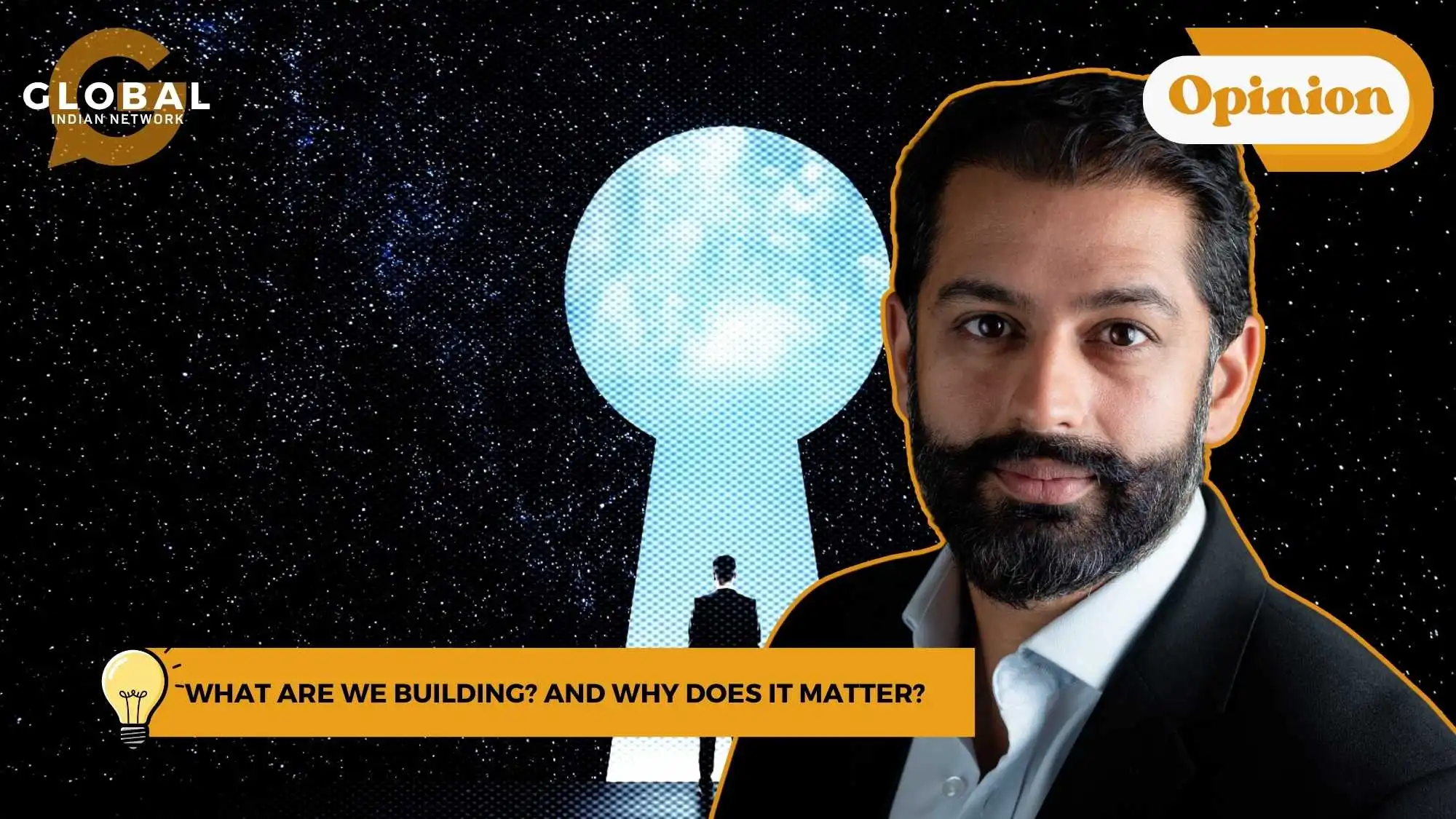
There is nothing inherently wrong with making money. Businesses have to be commercially viable; people have families to support; investors require returns; and economies require growth. I have spent enough time around business to understand that good intentions without commercial reality rarely survive for very long. But I do wonder whether we have become so sophisticated at asking how much something can make that we sometimes forget to ask a much more fundamental question: what are we actually building, and why does it matter?
Push everything else aside for a moment. Forget the borders, nationalities, political systems, religions and all the different labels through which we organise ourselves. Imagine looking down at this extraordinary planet as one interconnected place, inhabited by billions of people, each trying, in their own way, to make sense of life. Then look at everything we are creating, our companies, technologies, financial systems, cities, artificial intelligence, media, institutions, education systems and economies, and ask who all of this is ultimately for.
Because surely the measure cannot simply be whether something made money. What impact does it have on society? What impact does it have on the environment? What does it enable somebody else to do? Does it strengthen a community or weaken it? Does it create opportunity or merely extract value? What is the lasting change that occurs because this business, institution or idea exists? And perhaps an equally important question is whether we can partner with others to build it in such a way that the idea takes deeper root, survives beyond its founders and becomes something capable of creating value long after the initial commercial opportunity has passed.
These questions become increasingly important because our ability to build has arguably never been greater. Artificial intelligence is transforming how we work and think. Capital can move across continents almost instantaneously. A company founded in one country can affect the lives of people in dozens of others without its founders ever visiting them. Decisions made around a boardroom table can have consequences for communities thousands of miles away. Technology has dramatically expanded our capacity to create, but with that capacity surely comes an equally significant responsibility to think about the consequences of what we create.
And this is where, for me, the conversation goes beyond business.
We often talk about consciousness as though it were some metaphysical exercise, something reserved for the prayers of the morning or the reflections of the late evening. We compartmentalise it. There is the spiritual part of our lives, and then there is business. There is faith, and then there is commerce. There are the values we speak about within our homes and places of worship, and then there are the decisions we make when money, status, power and opportunity enter the room.
But surely consciousness cannot work like that. If it means anything, it has to be a constant and continual movement throughout the journey of our lives. It has to accompany us into the boardroom, into negotiations, into investments, into the way we employ people, into the way we treat suppliers, into the way we interact with somebody who can do absolutely nothing for us and, perhaps most importantly, into the decisions where doing the right thing may actually cost us something.
That is where faith becomes considerably more difficult. It is relatively easy to speak about compassion when compassion costs us nothing. It is easy to talk about equality when our own position is secure. It is easy to speak about service, humility and humanity when those principles are never required to compete with our financial interests. The real test comes when they do.
Sometimes, I admit, the soul does become slightly hardened when I look at what happens around us and ask whether, as a community, we need to rethink the relationship between our faith and our business practices. We come from traditions that speak profoundly about service, responsibility, equality, humility, stewardship and the temporary nature of material wealth. Yet we must be willing to ask ourselves whether we practise those principles with the same discipline and earnestness in every area of our lives.
Because if our faith disappears the moment the commercial negotiation begins, what exactly is the purpose of that faith?
That does not mean business should become charity, nor that ambition or wealth should somehow be regarded with suspicion. I don’t believe that at all. Successful businesses can be extraordinary engines of human progress. Profit allows ideas to survive, capital allows them to scale, and entrepreneurship allows people to challenge systems that no longer work. Wealth itself can create extraordinary possibilities. The more interesting question is what becomes possible because that wealth was created.
The People Who Change the Way We Think
There have been many people along this journey whom I owe special thanks to, not necessarily because they gave me an answer, but because something in the way they thought made me question the way I was thinking. Sometimes those influences are deliberate, but very often they are not. A conversation stays with you. An observation that seemed relatively insignificant at the time resurfaces months later. Eventually you realise that somebody else’s way of looking at the world has quietly become part of the lens through which you are looking at it yourself.
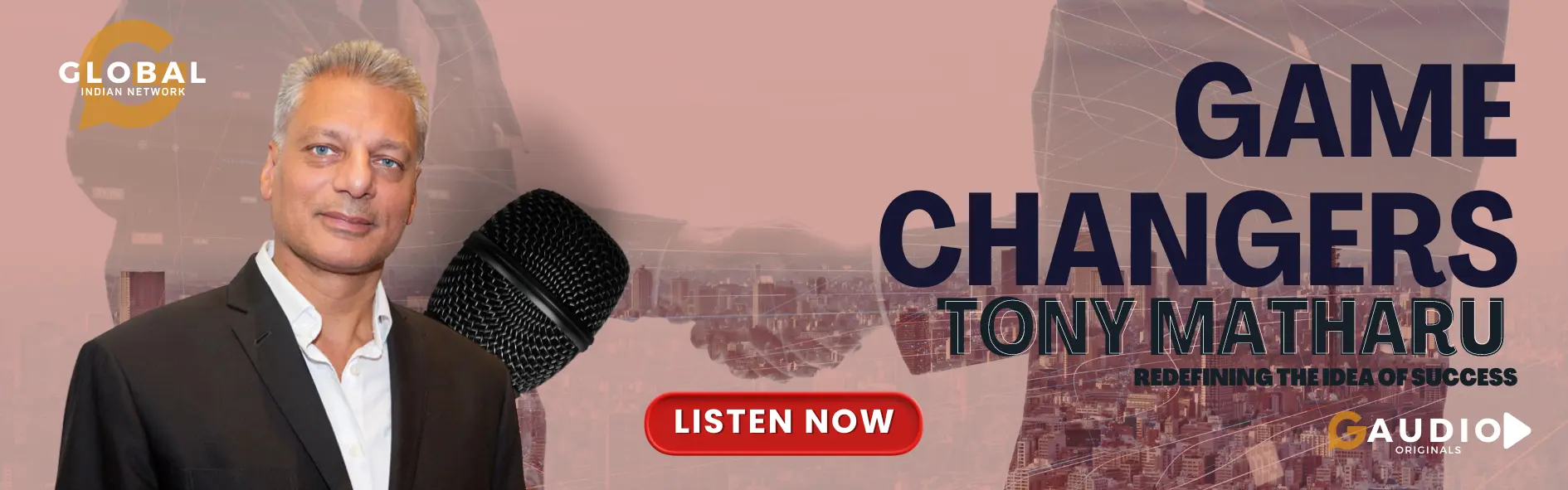
One person who has undoubtedly influenced my thinking is Tony Matharu. Every time we meet or speak, the conversation invariably comes back, in one form or another, to integrity, decision-making, and the importance of properly following a thought through. Those conversations have rubbed off on me because they have made me think much more deeply about integrity, not simply as a word that we use but as a mechanism through which decisions are actually made. It opens your eyes to a much more difficult distinction: is integrity something that is said, or is it something that is embodied?
It is easy for any of us to describe our values. The much harder exercise is looking at the sequence of decisions we make and asking whether those decisions provide evidence that those values actually exist. Integrity, viewed in that way, isn’t something that can be switched on when convenient. It becomes a discipline of thought followed by a discipline of action.
There is another person I would be remiss not to mention: Vivek Burman. Some of the conversations I have had with Vivek over the years have stayed with me long after they ended. I sometimes jokingly think of them as sermons, although I suspect he might object to the description. There is something profound in the way he talks about his own family, what they built through the Dabur enterprise and, importantly, the moments when he was prepared to look again at what already existed and ask whether it could be thought about differently.
Despite his wonderful, wine-like ageing process, there is still an unmistakable spark of curiosity in his eyes. There is humour, considerable wit and the mind of somebody who remains genuinely interested in ideas. I find that fascinating because curiosity is something we tend to associate with youth, when perhaps it should be something we work considerably harder to preserve as we grow older and become more successful. Experience can give us wisdom, but it can also make us rigid. The danger comes when we become so convinced by what has worked before that we lose the ability to imagine what might work differently tomorrow.
But there is something else about Vivek that has probably affected me more than any particular business lesson: the simplicity with which he deals with people. I have watched someone who has lived around considerable success and influence engage with people without allowing fortune, favour or status to determine the humanity of the interaction. He treats people with an extraordinary equality. That does not mean he isn’t opinionated; he is a passionate thinker and more than capable of making his position known, but there is a distinction between having strong views and believing that your success somehow makes another person’s humanity less important.
Perhaps we underestimate how significant that is. We spend enormous amounts of time studying how successful people allocate capital, structure businesses, negotiate transactions and identify opportunities. We study their strategies because we hope there might be something within them that we can replicate. Yet perhaps we should pay equal attention to something much simpler: how do they behave when there is absolutely nothing to gain from the person standing in front of them? How do they interact with the waiter, the driver, the young entrepreneur with nothing more than an idea, the employee who cannot advance their career or the person whose name carries no influence whatsoever?
Those interactions tell us something that a balance sheet never can.
The other person who profoundly influenced my thinking is someone I never personally met. José “Pepe” Mujica, the former President of Uruguay, occupied an entirely different world. I came to understand him not only through what I had read or watched, but through travelling in Uruguay, spending time in Montevideo and, importantly, meeting people who had known and worked closely with him.
What fascinated me was the apparent consistency between the philosophy and the life. Here was somebody who had reached the highest political office in his country and yet continued to live with an extraordinary degree of simplicity. He gave away much of his presidential salary, rejected many of the trappings normally associated with power and continued to speak about the danger of allowing consumption and possession to define our lives.
Whether one agrees with every element of his politics is almost beside the point. Like every political leader, there will be different perspectives on his record, and I am sure there are two sides to many parts of that story. What interested me was something deeper: the relationship between what somebody professes to believe and how they actually choose to live.
I remember sitting with one of the ministers who had been very close to him. He was an older gentleman, somebody who had spent decades around politics and government, and as he spoke about Mujica’s death, he began to cry. What struck me was that he wasn’t simply mourning an individual. He was talking about the systematic changes that one person’s way of thinking had helped make possible. In many respects, he was mourning an idea, or perhaps a way of approaching leadership, which he feared might disappear with the man.
And you can feel something of that when travelling through Uruguay and speaking with people who experienced that period. Leadership, at its most consequential, is not simply about the decisions somebody makes while occupying an office. It is about whether an idea takes root deeply enough for other people to carry it forward.
Tony Matharu, Vivek Burman and Pepe Mujica are very different people, emerging from very different circumstances, and I wouldn’t try to manufacture similarities where they don’t exist. Nor am I suggesting that any individual should be placed on a pedestal; human beings are considerably more complicated than that. But each, in very different ways, has prompted me to consider the same underlying question: what happens when the things we claim to believe are tested by how we actually live?
Integrity is partly about the decisions we make. It is partly about whether our behaviour remains consistent with our beliefs. But perhaps it is also revealed in something much more ordinary: whether wealth, success, status or power changes the value we assign to another human being.
And that matters enormously when we begin asking what kind of businesses we want to build. Because a business ultimately becomes an extension of thousands, sometimes millions, of human interactions. The culture we create inside it, the way it treats people, the opportunities it provides and the behaviour it rewards eventually become part of its impact on society.
So before we ask what our businesses can become, perhaps we should also ask what we are becoming while we build them.
So What Do We Build Next?
And perhaps this is where these thoughts have increasingly led me: if integrity is something that has to be embodied rather than simply spoken about, how should that change the way we build businesses?
I don’t think the answer is to stop pursuing growth, profit, or ambition. Far from it. Businesses need to grow. Entrepreneurs should be ambitious. Capital has to generate returns if it is going to continue moving towards new ideas. But perhaps alongside the traditional questions of market size, profitability, scalability and return on investment, there should be another set of questions running in parallel.
What happens if this succeeds? Who becomes better off because it exists? What happens to the community around it? What does it do to the environment? What opportunities does it create for people who were not sitting around the table when the original idea was conceived? Can we build something that others can participate in, strengthen and ultimately carry forward?
These aren’t questions that have suddenly arrived fully formed in my mind. In many ways, this article is simply taking you, the reader, through some of the meandering experiences of my brain at this particular moment in time. Travel has a habit of doing that to you. You meet somebody in one country, have a conversation somewhere else several months later, observe something that works brilliantly in another society and then witness something somewhere else that troubles you. Seemingly unrelated experiences begin connecting and, gradually, you realise that you have started asking a different question.
I will shortly be travelling back to Kenya, where I am looking forward to sitting down with many of the families who call the region home, some of whom have done so for generations. Many of these families have done extraordinarily well. They have built businesses, created employment, accumulated capital and become deeply woven into the economic story of East Africa. There is an enormous amount to learn from their successes, but I am becoming equally interested in what comes next.
What does one generation of success make possible for the generation that follows? What responsibility, if any, accompanies that success? And how can the institutions and businesses that have already taken root become part of building a healthier society around them?
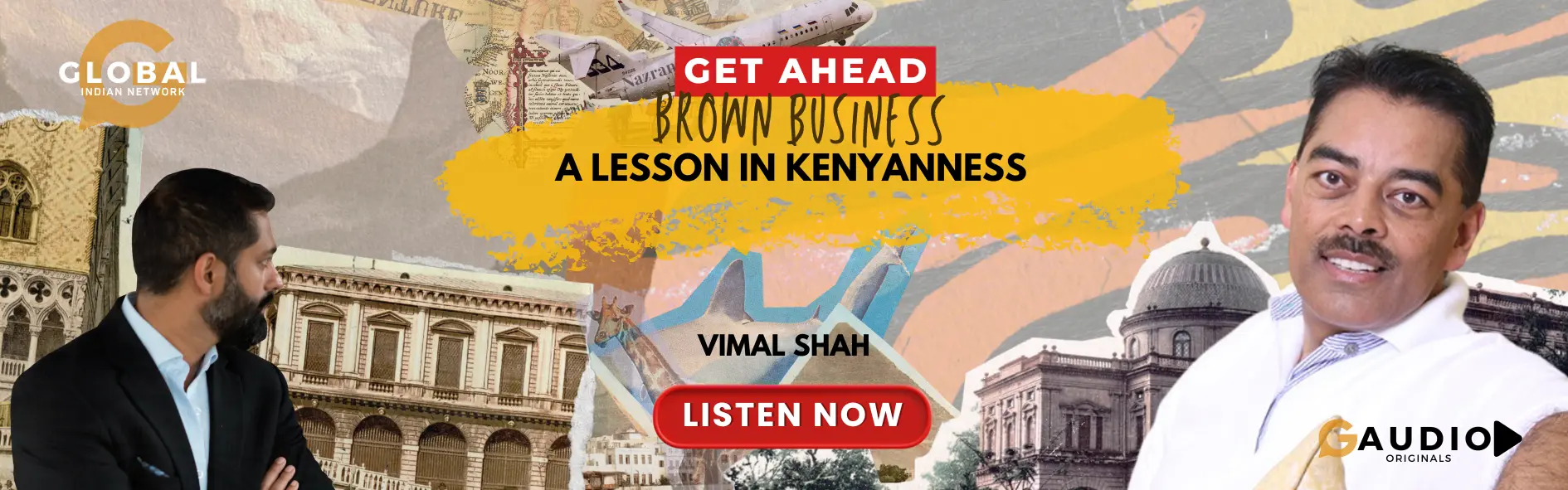
Amongst the people I am keenest to reconnect with is our Ambassador in Kenya, Dr Vimal Shah. I find Vimal extraordinarily fascinating because he represents another dimension of this question. He has done extraordinarily well in business, helping build one of East Africa‘s great business stories, but our conversations rarely remain confined to business. He is a firm believer in education, fairness and equality, and particularly in the power of thinking, the idea that the quality of the way we think, and the systems of thought that we encourage in the next generation, can determine the kind of society that eventually emerges.
And perhaps that is where business becomes much more interesting.
Once you have built the factory, the company, the investment portfolio or the institution, what comes next? Do you simply build another one? Do you accumulate more? Or does success eventually provide you with the ability to start building something else entirely?
Perhaps it allows you to build education, opportunity or institutions. Perhaps it allows us to develop better environmental practices. Perhaps it enables a generation of people capable of thinking differently from us. Perhaps capital accumulated by one generation can become the foundation from which thousands of other people can create something of their own.
And perhaps this is also where partnership matters. None of us has all the answers. Governments don’t. Businesses don’t. Investors don’t. Media organisations certainly don’t. But if we can bring together people who possess different pieces of the puzzle: capital, knowledge, experience, technology, networks, local understanding, and, importantly, trust, perhaps we can build things that take deeper root.
That, to me, is a far more interesting version of globalisation. Not simply the movement of money from one jurisdiction to another, but the movement of ideas, understanding, opportunity and responsibility.
What Are We Building?
It is also a question we continually ask ourselves at the Global Indian Network.
What are we building?
It would be very easy to describe what we do through numbers: countries reached, leaders engaged, conversations recorded, governments involved, businesses introduced and investment opportunities explored. Those things matter, and commercially they have to, because without a sustainable organisation, there is no platform through which to do anything else.
But they cannot be the reason for its existence.
The deeper ambition has always been to connect people, ideas, cultures, capital and opportunities that might otherwise never meet; to challenge assumptions; to allow somebody sitting in one part of the world to understand the reality of somebody living in another; and to connect good ideas with people who have the ability, resources and determination to turn them into something meaningful.
The Global Indian experience gives us a particularly interesting lens through which to consider this. Our histories stretch across borders. Our families have migrated. Our identities have evolved. Our businesses operate internationally. We belong to countries while simultaneously maintaining relationships, histories and responsibilities that extend far beyond them. We therefore understand, perhaps better than many, that decisions made in one place can reverberate across generations somewhere else.
But that should also force us to examine ourselves.
If we speak about equality, do we practise it?
If we speak about service, whom are we serving?
If we speak about community, who gets included in that community?
If we celebrate extraordinary wealth creation, are we equally curious about what that wealth makes possible?
If we speak proudly about the success of the Global Indian community, what does that success mean to the societies that enabled it to flourish?
These are not accusations. They are questions, and they are questions for me as much as anybody reading this. There is little value in asking the world to examine itself if we are unwilling to apply exactly the same examination to what we ourselves are building.
I don’t pretend to have a neat answer. In fact, the more of the world I see, the less interested I become in people who claim to possess neat answers to extraordinarily complicated questions. What interests me considerably more is whether we remain curious enough to keep asking the questions, conscious enough to recognise our own contradictions, and courageous enough to change course when the answers become inconvenient.
Because perhaps the final measure of what we build is not simply what we make?
What did we make possible?
And maybe, somewhere within the answer to that question, we begin to understand what should come next.
Let us know your thoughts. If you have burning thoughts or opinions to express, please feel free to reach out to us at larra@globalindiannetwork.com.