


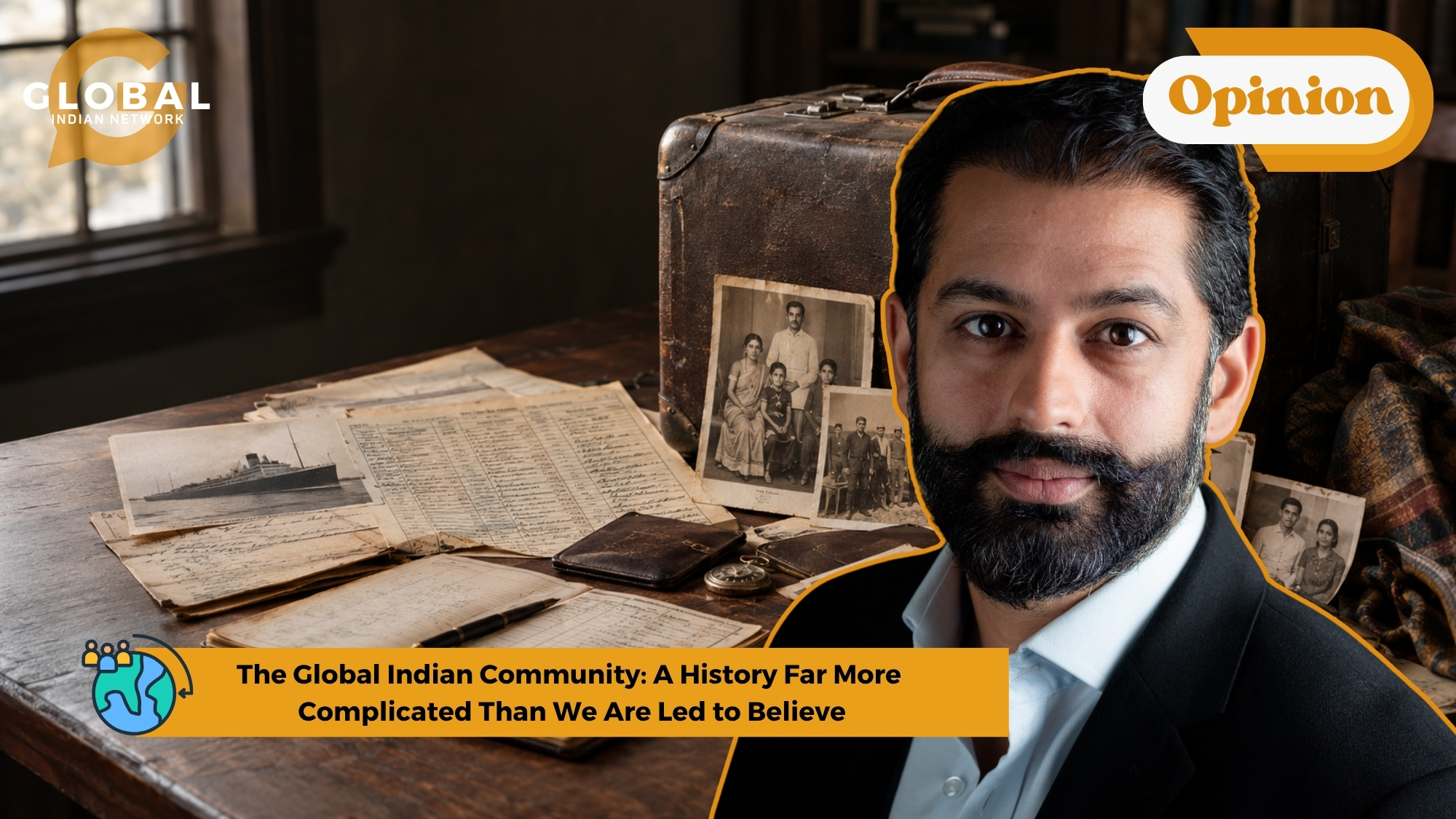
Over the years, I have travelled to more than 75 countries and encountered communities of Indian origin whose histories are far richer and more complicated than the convenient narratives often presented. Some trace their ancestry through generations of settlement, including families whose forebears arrived through indentured labour across the Caribbean during the nineteenth and early twentieth centuries. Others descend from traders, merchants and professionals who established themselves in different parts of the world through successive waves of migration, including during the 1920s, 1940s, 1960s and 1970s.
In parts of Africa, I have encountered families who describe themselves as seventh- or eighth-generation residents. Their connections to the countries they inhabit are not recent or temporary. Their ancestors contributed to the development of commercial networks, businesses and institutions, and their families have lived through colonialism, independence, political upheaval and the formation of modern nation-states.
Yet when we speak about the global Indian community, we often make the mistake of treating these communities as though they share one history, one identity and, perhaps most dangerously, one political allegiance.
They do not.
The experiences of an Indo-Caribbean family whose ancestors arrived as indentured labourers differ fundamentally from those of a Gujarati merchant family established in East Africa, a Punjabi family that migrated to Britain after the Second World War, or an Indian professional who moved to Dubai, Nairobi, or London within the last decade.
Their ancestral connections may overlap, but their identities have developed through different political, economic and social circumstances.
This distinction matters because identity is not simply inherited. Society shapes it through the struggles we face, the relationships we form, and the institutions we help build.
Across the Caribbean, Indian-origin communities have contributed enormously to the political, cultural and economic development of their respective nations. In countries such as Guyana, Trinidad and Tobago and Suriname, descendants of indentured labourers have become political leaders, entrepreneurs, academics, artists and influential members of society.
Their history cannot be separated from the history of those countries. The same is true across parts of East and Southern Africa, where Indian-origin communities have played important roles in commerce, industry and public life.
But their experiences have not always been comfortable.
In Uganda, the expulsion of Asians under Idi Amin in 1972 remains a defining historical event. In Kenya and elsewhere, questions of belonging, economic participation, citizenship and political identity have shaped relationships between communities for generations. In South Africa, the history of Indian-origin communities is inseparable from colonialism, apartheid and the continuing struggle for social and economic equality.
These histories are complex, and they cannot be reduced to a simple story of entrepreneurial success or cultural resilience.
There is also another dimension that I believe deserves far greater scrutiny.
Across my travels, particularly in African and Caribbean markets, I have observed what appears to be a growing distinction between some established communities of Indian origin and newer arrivals from India.
I have encountered individuals among more recent migrant communities whose political outlook appears more closely aligned with the interests and narratives of the Indian state than with the local political and social realities of the countries in which they now reside.
This is not a claim about all recent Indian migrants. Many are deeply committed to their adopted countries, contribute enormously to local economies and participate positively in their communities. Nor should we romanticise earlier generations, whose relationships with their host societies were also shaped by class, commerce, politics and competing loyalties.
Nevertheless, the distinction is worth examining.
There is a difference between maintaining a cultural connection to one’s ancestral homeland and allowing the political interests of that homeland to influence how one engages with the country in which one lives.
The former can enrich societies. The latter can create tensions, particularly where communities already face questions about economic influence, representation and belonging.
India’s emergence as a major global economic and political power has understandably strengthened its engagement with overseas Indian communities. Its diaspora represents an extraordinary international network of knowledge, capital, influence and cultural relationships.
But we should be careful not to assume that every person of Indian origin is naturally an extension of India’s national interests.
An eighth-generation Indo-Caribbean citizen may have little connection to contemporary Indian politics. Their understanding of identity may be shaped far more by Caribbean history, language, music, religion and national experience than by events in New Delhi.
Similarly, an Indian-origin family that has lived in Kenya for more than a century may regard Kenya as its unquestionable home, while still maintaining cultural traditions inherited from its ancestors.
Neither community should be expected to demonstrate political loyalty to India simply because of its ancestry.
The challenge becomes more pronounced when external political narratives begin to influence established relationships between communities.
In countries where economic inequality, unemployment, or historical resentment already exist, the perception that a particular community is advancing the interests of a foreign state can be damaging, regardless of whether that perception is justified.
We have seen throughout history how quickly questions of economic participation can become questions of national loyalty.
This is why I believe the language surrounding the global Indian community needs to evolve.
We should distinguish between Indian nationals living overseas, citizens of Indian origin whose families migrated in recent decades, and communities whose histories extend across multiple generations.
These groups may share elements of culture, ancestry and tradition, but they are not politically or socially interchangeable.

Equally, we must recognise that the Indian diaspora is not a single community. It is a collection of communities shaped by geography, religion, language, migration, class, opportunity and historical circumstance.
The experiences of an Indian-origin family in Mauritius are not identical to those of a family in Fiji. The experiences of Indians in Malaysia differ from those of Indians in Britain, Canada or the United States.
Even within individual countries, differences between communities can be substantial.
One of the most revealing aspects of my travels has been discovering how people of Indian origin have adapted their identities over generations. In some places, Indian cultural traditions remain highly visible. In others, they have blended with local languages, customs and ways of life to create something entirely distinctive.
That evolution should be celebrated rather than treated as a dilution of identity.
There is something remarkable about encountering people thousands of miles apart who recognise elements of shared ancestry yet interpret what that ancestry means in completely different ways.
It demonstrates that identity is not fixed. It evolves.
For me, this also raises a broader question about the responsibility of diaspora communities.
If you have lived in a country for generations, what obligations do you have towards that society? How do you balance ancestral identity with national belonging? And at what point does cultural solidarity risk becoming political separation?
These are not questions directed exclusively at people of Indian origin. They apply to diaspora communities across the world.
But they are particularly relevant at a time when India is expanding its international influence and when migration, nationalism and identity have become increasingly contested political issues.
India has an opportunity to build meaningful relationships with overseas communities without assuming ownership of their identities or political loyalties.
Established diaspora communities also have an opportunity to articulate their own histories more confidently, rather than allowing others to define them through the narrow lens of ancestry.
Newer migrants also have a responsibility to understand the historical, political, and social environments into which they arrive.
The communities that came before them may have spent generations building trust, navigating difficult relationships and establishing their place within society. Those histories deserve recognition and respect.
Ultimately, I believe we need to move beyond the simplistic idea that shared ancestry automatically creates shared interests.
The global Indian community is not a political constituency waiting to be mobilised. Nor is it a homogeneous commercial network.
It is a vast collection of human experiences, shaped by migration, displacement, ambition, hardship, adaptation and belonging.
Some of those stories began more than two centuries ago. Others are being written today.
What connects them is not necessarily allegiance to a modern nation-state, but a complicated relationship with history, heritage and identity.
Having travelled across more than 75 countries, I have come to appreciate that the most interesting conversations are rarely about where somebody’s ancestors came from.
They are about where people belong today, what they have contributed to the societies around them, and how they see their future.
Perhaps that is where our understanding of the global Indian community should begin.
Not by asking how Indian somebody is, but by understanding the society, history and human experience that have made them who they are.
Let us know your thoughts. If you have burning thoughts or opinions to express, please feel free to reach out to us at larra@globalindiannetwork.com.