



As Trump, Putin and Xi prepare to meet in Shenzhen, the growing relationship between Moscow and Beijing raises an uncomfortable question: does strategic partnership necessarily mean economic equality?
As Donald Trump, Vladimir Putin and Xi Jinping prepare for their historic meeting in Shenzhen on 19 November, the world’s attention is turning towards the relationship between three of its most influential powers.
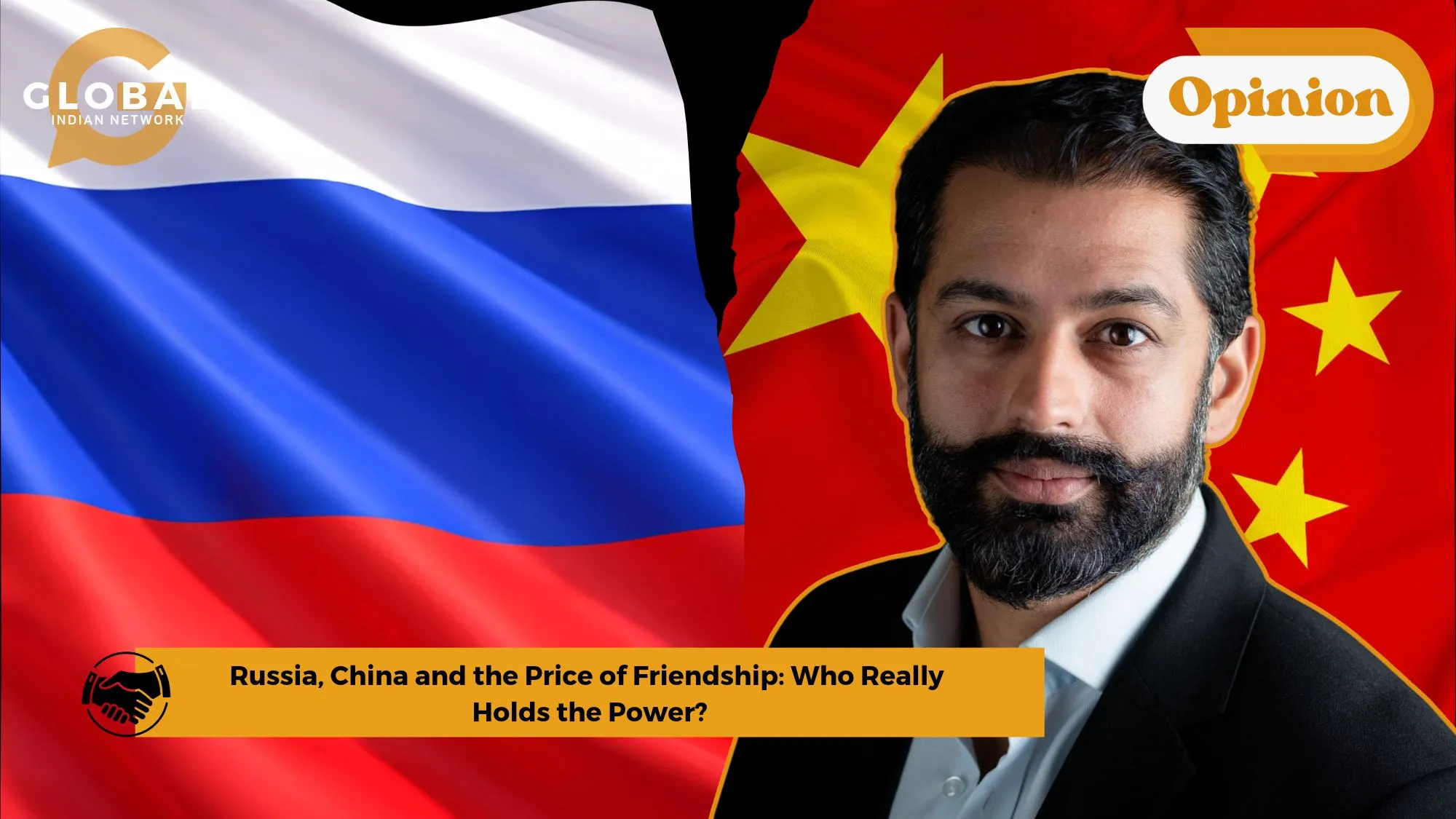
Xi and Putin have already met, reaffirming their commitment to closer cooperation and a multipolar world. But behind the diplomatic language lies a question that deserves greater scrutiny: how equal is the increasingly close relationship between Russia and China?
It is something I have reflected upon following a recent Global Indian Network conversation with geopolitical analyst Dr David Oualaalou, and through my own experiences working across Africa, Europe and the Caribbean.
Before Russia’s invasion of Ukraine, I was involved in discussions exploring opportunities for Russian businesses to enter Caribbean markets. From my earlier work in Ethiopia, I had also seen how international partnerships can create opportunities while raising difficult questions about economic dependence.
The lesson is that diplomatic friendship and economic leverage are not necessarily the same thing.
A partnership of unequal dependence?
Russia–China trade reached a record $244.8 billion in 2024, before declining by 6.9% in 2025. Although trade has subsequently recovered, the composition of that relationship tells a more revealing story.
Russia predominantly exports energy and raw materials. China supplies machinery, electronics, vehicles and manufactured goods.
China is Russia’s largest trading partner, yet Russia accounts for only a small proportion of China’s global trade.
That distinction matters.
For Moscow, access to Chinese markets and industrial products has become increasingly important following Western sanctions. Beijing, meanwhile, retains a far wider range of international commercial relationships.
Both countries benefit, but their exposure to one another is markedly different.
Energy cooperation illustrates this imbalance. The Power of Siberia pipeline is operational, yet the proposed second pipeline has faced prolonged negotiations over pricing and commercial terms.
Russia needs alternative customers for its gas. China has alternative suppliers.
The same questions arise in technology and manufacturing. Chinese companies have expanded their presence in Russia, but importing Chinese products is not necessarily equivalent to developing Russian technological capabilities.
The question is whether these relationships create greater economic independence or deepen reliance on a single partner.

What does a multipolar world really mean?
This is particularly relevant as the three leaders meet in Shenzhen.
Much of the discussion surrounding the emerging multipolar order focuses on challenging established Western influence. But replacing one concentration of power with another does not automatically create more balanced international relationships.
Having worked across different markets, I have seen the importance of countries and businesses maintaining multiple commercial relationships.
The ability to choose one’s partners is itself a form of economic strength.
For Russia, China’s support has provided important economic resilience. Yet that resilience comes alongside a growing dependence on Chinese demand, products and industrial capacity.
Where the relationship is flourishing
There is, however, one area where Russia–China cooperation is producing particularly visible benefits: culture and tourism.
Moscow’s Chinese New Year celebrations in February brought traditional performances, cuisine and cultural activities to Manezhnaya Square and locations across the city.
Beijing reciprocated with Moscow Maslenitsa celebrations, introducing Chinese audiences to Russian traditions.
These exchanges are more than ceremonial gestures. They create opportunities for tourism, hospitality, education and businesses while building familiarity between communities.
The extension of reciprocal visa-free travel arrangements through December 2027 provides further opportunities for people-to-people engagement.
Moscow’s investment in cultural programming demonstrates how international relationships can develop beyond government negotiations, allowing ordinary people to experience the benefits of closer ties.
Having spent much of my career connecting communities across borders, I believe this dimension of international cooperation deserves greater recognition.

Beyond the diplomatic declarations
The Russia–China relationship is strategically important and commercially substantial. But its success should not be measured solely by trade volumes, political declarations or photographs of leaders shaking hands.
The more meaningful questions concern economic independence, industrial capability and the freedom to develop alternative partnerships.
As Trump, Putin and Xi meet in Shenzhen, these questions extend far beyond Russia and China.
A genuinely multipolar world should create more opportunities and choices for nations, not simply rearrange existing dependencies.
And perhaps that is the greatest test of any strategic partnership: not how closely two countries stand together, but how much stronger each becomes as a result.
Let us know your thoughts. If you have burning thoughts or opinions to express, please feel free to reach out to us at larra@globalindiannetwork.com.
Rajan Singh Nazran is the Founder and Chief Explorer of the Global Indian Network, an international platform connecting communities, conversations and capital. His work has taken him across more than 75 countries, engaging with political leaders, entrepreneurs and communities on international cooperation, investment and the changing global order.