

A first-person dispatch from a Global Indian Network member shaping their industry.
“tāṃ ma āvaha jātavedo lakṣmīm anapagāminīm”
-The Śrī Sūktam (Rigveda appendix), verse 2
‘Bring me deeper, meaningful & lasting prosperity- bless me with Lakshmi who never departs’
Religious institutions and practitioners already steer trillions of dollars. Shariah-compliant finance alone is a US$6.5 trillion industry, Christian institutions run some of the largest endowments and insurers in the West, and Jewish communities have built their own interest-free lending societies. Within the Indic sphere (Hindu, Buddhist, Jain, Sikh and Parsi communities), there are notable examples too, from temple and gurdwara trusts to community housing and values-based bonds.
Currently, the 1.2 billion Hindus and the wider Indic faith community are not represented by a financial category of their own. This article traces how faith-based finance has evolved, maps the market as it stands today, shows where the money is growing and shrinking, and explains why the next opportunity may be Indic.
The evolution and untapped potential of faith-based finance
Faith has shaped finance for centuries through Islamic waqf endowments, church lands, Jewish free-loan societies and Hindu temple treasuries. In the past few decades, these traditions have grown into a market that is benchmarked, regulated, and sold to ordinary investors.
That evolution has come in three waves. The first was institutional. Community bodies were set up to pool and protect believers’ money, such as the Hebrew Free Loan Society (1892) and the Lutheran mutual-aid society that became Thrivent (1902). The second, from the 1970s, turned faith into investment policy.
Church investors used shareholder pressure against apartheid, which led to the founding of the Interfaith Center on Corporate Responsibility in 1971, and index providers created Islamic (1999) and Dharma (2008, screened on Hindu and Buddhist principles) benchmarks. The Dharma indexes were discontinued in 2009, while the Islamic indexes went on to support a global fund industry. The third wave, under way now, is mass-market and global, with low-cost faith ETFs, sovereign sukuk from Africa to Europe, Islamic fintech and faith-aligned green bonds.
| Year | Milestone |
| 2025 | Islamic finance assets reach US$6.5 trillion, and ESG sukuk issuance hits a record US$23.8 billion |
| 2025 | Global ESG funds record their first annual net outflow (US$84 billion), while faith-screened products keep growing |
| 2025 | Global X launches an S&P 500 Christian Values ETF. Bhutan’s values-based Gelephu bond draws 35,403 citizen investors |
| 2024 | Impact investing reaches US$1.57 trillion |
| 2019 | Islamic finance assets stand at US$2.88 trillion |
| 2016 | First Catholic Values ETF launches in the US |
| 2009 | Dow Jones Dharma Indexes discontinued, about a year after launch, without lasting fund products |
| 2008 | Dow Jones Dharma Indexes launched for Hindu and Buddhist investors |
| 1999 | Dow Jones Islamic Market Indexes launched |
| 1971 | Interfaith Center on Corporate Responsibility founded |
Researchers at the University of Oxford’s Faith-Aligned Impact Finance Project mapped 360 religious organisations across Abrahamic and Dharmic traditions and found about US$5 trillion in net assets.
In 2021, Iyad Abumoghli, director of the UN Environment Programme’s Faith for Earth Initiative, described faith groups collectively as “the third-largest economic power on Earth”.
The current market has three layers. At the top is a fully regulated Islamic financial system with its own banks, bonds and insurers. Below it are faith institutions, such as church endowments, pension boards, temple trusts and waqf bodies, that invest according to written religious guidelines. At the retail end is a smaller but fast-growing market of faith-screened managed funds and ETFs.
| Segment | Latest size | What it covers |
| Islamic finance | US$6.5 trillion (2025), +9% | Banks, sukuk, funds and takaful in 140 markets |
| All faith-aligned institutions | ~US$5 trillion | 360 organisations mapped by Oxford researchers |
| Secular ESG funds | US$3.9 trillion (end-2025) | Sustainable open-end funds and ETFs |
| Impact investing | US$1.57 trillion (2024) | Assets with an explicit social or environmental goal |
| Waqf (Islamic endowments) | ~US$700 billion | Land and property held in perpetuity as trusteeship |
| Thrivent (Lutheran roots) | US$212 billion | The largest single Christian-rooted financial institution |
| Faith-screened funds and ETFs | ~US$97 billion, ~150 funds | Christian, Catholic, Shariah and Jewish products |
These layers overlap and use different definitions, so they cannot simply be added together. The table also leaves a lot out. Much religious wealth still sits idle in land, gold and bank deposits, and structured religious giving, such as Islamic zakat, Christian and Jewish tithes, Sikh dasvandh and Hindu and Buddhist dana, is largely unmeasured. Zakat alone is estimated at US200billiontoUS1 trillion a year. The Indic communities, which form the world’s largest diaspora, also have no financial category of their own.
Featured Conversation
Why Finance Needs a New Intelligence Layer
with Prateek Hak
What if the real disruption in finance isn’t faster payments, but the intelligence beneath them? If fraud now arrives as deepfake identities and synthetic accounts, why do banks still lean on yesterday’s detection models? And as India’s UPI becomes a global template, what must Europe learn before real-time money outpaces trust?
How belief becomes a financial product
Across traditions, the core teachings on money are similar. Wealth is held in trust rather than owned outright, some ways of earning are off-limits, and lending must not exploit. A share of what you have belongs to others, whether as zakat, the Christian and Jewish tithe, the Sikh dasvandh, or the Hindu and Buddhist dana.
What differs is how precisely those teachings are written into rules, and that decides what kind of product a faith produces. Broadly, there are three approaches.
- Rules on the transaction itself. Islam prohibits riba (interest), excessive uncertainty, and gambling, which requires a separate system of profit-sharing banks, asset-backed sukuk, and mutual takaful insurance.
- Screening and engagement. Most Christian, Jewish, and Dharmic ethics govern what money funds rather than how a contract works. The result is a screen or voting policy applied to ordinary shares and bonds, such as the US Catholic bishops’ investment guidelines or the Buddhist ban on trading in weapons, intoxicants and poison.
- Social finance. Every tradition pools wealth to help others, through Islamic waqf endowments, Jewish interest-free loan societies, Christian microfinance, Sikh langar and Parsi housing trusts.
In general, the more precisely a faith codifies its rules, the easier it is to build standardised, regulated products and the larger the market can grow.
Islamic finance: the model that scaled
Islamic finance shows what happens when faith rules are fully codified. According to the 2026 Islamic Finance Development Report from LSEG and the Islamic Corporation for the Development of the Private Sector, industry assets reached about US$6.5 trillion in 2025, up 9% in a year and more than double the US$2.88 trillion recorded in 2019. The same report projects assets passing US$10.5 trillion by 2030.
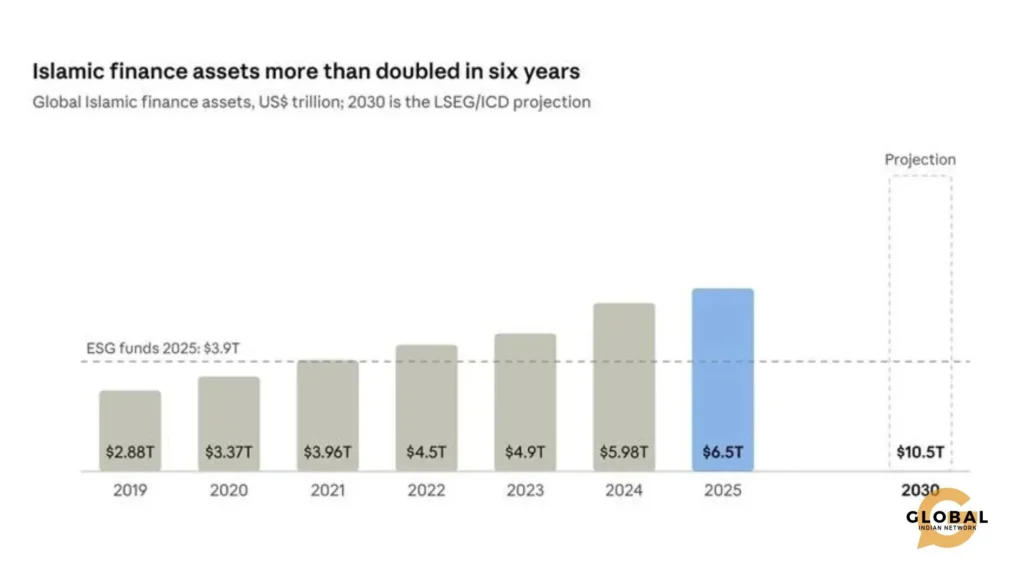
LSEG/ICD and Refinitiv Islamic Finance Development Reports 2020–2026, ESG line from Morningstar, end-2025
Islamic finance is now about 1.7 times the size of all global ESG funds. Its growth rests on three things other faiths have not yet built. These are common standards set by bodies such as AAOIFI and the IFSB, active state support through sovereign sukuk and Islamic “windows” inside conventional banks, and a clear product identity that ordinary savers recognise.
| Segment (2025) | Size | Annual change |
| Islamic banking | US$4.6 trillion (71% of total) | +8% |
| Sukuk issuance | US$291.4 billion, a record | +14.5% |
| Islamic investment funds | US$375 billion | +22% |
| Takaful (Islamic insurance) | US$146 billion | +9% |
| ESG sukuk issuance | US$23.8 billion, a record | +54% |
ESG sukuk, which combine faith rules with sustainability goals, are the fastest-growing segment. Issuance rose 54% in 2025.
Christian, Jewish and other traditions: institutions over products
Outside Islam, faith finance works through institutions. Christianity, with no single rulebook on money, has produced the widest range of them.
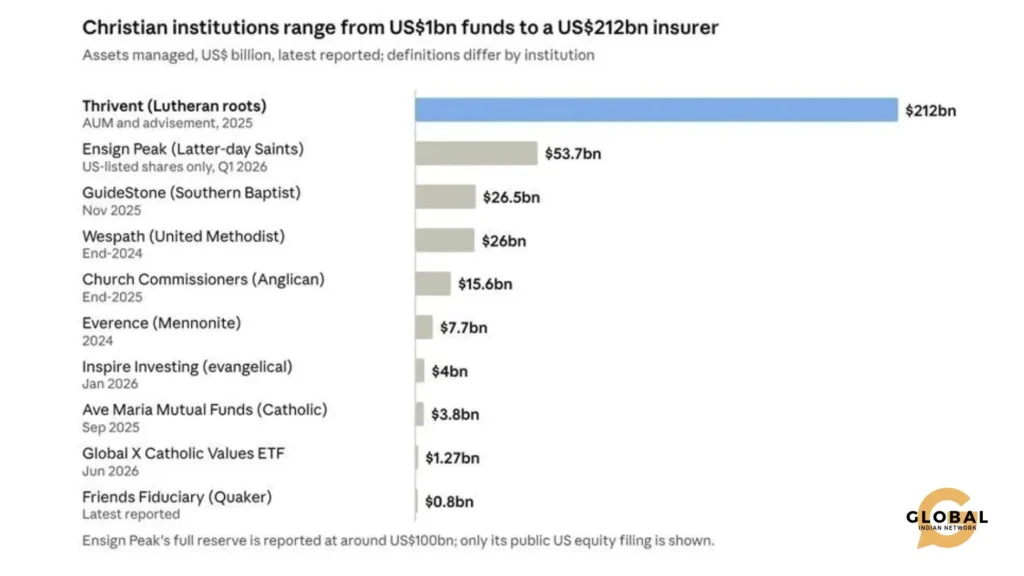
Thrivent, Salt Lake Tribune via Fox13, Baptist Press, Wespath, Church Commissioners, Everence, Inspire, Ave Maria, Global X, Friends Fiduciary
Thrivent began in 1902 as a Lutheran mutual-aid society and now manages or advises on US$212 billion for 2.4 million clients. The Church Commissioners for England returned 8% in 2025, its 17th straight positive year, lifting the endowment to £11.6 billion. The Vatican Bank posted its best profit in a decade, €51 million, on €5.9 billion of client assets, and launched Catholic equity benchmarks with Morningstar. In Germany, Catholic and Protestant church cooperative banks each hold €6.6–8.9 billion. Orthodox churches, by contrast, hold their wealth mainly in land, and publish little comparable data.
Other traditions have developed their own approaches.
- In the Jewish community, the Hebrew Free Loan Society of New York has lent more than US$400 million interest-free since 1892.
- Among Sikhs, the Shiromani Gurdwara Parbandhak Committee, which runs the Golden Temple, set a US$155 million budget for 2026–27, funded largely by dasvandh, the tradition of giving a tenth of earnings.
- Among Zoroastrians, the Bombay Parsi Punchayet, founded in the 1670s, is Mumbai’s largest private landlord and houses more than 5,500 families.
- In Japan, roughly 180,000 Shinto, Buddhist and other religious corporations hold land and deposits, but many rural temples now struggle as populations shrink.
At the retail end, faith-screened ETFs have become cheaper. The Inspire 500 ETF charges 0.09%, and the Catholic Values ETF has passed US$1.2 billion.
Featured Conversation
Decoding Family Offices: Where Global Capital Really Goes
with Saketh Patnam
Where does the world’s capital actually go once the easy money stops? Why do Indian family offices think in generations rather than quarters, and what makes them send money abroad even now? And if you are a founder hoping to raise from one, what does it take to get past the first meeting?
Where the money sits
Faith-based finance is concentrated in a few hubs. The Gulf and Southeast Asia anchor Islamic finance, while the United States, Britain and Germany lead in church institutions and faith-screened funds.
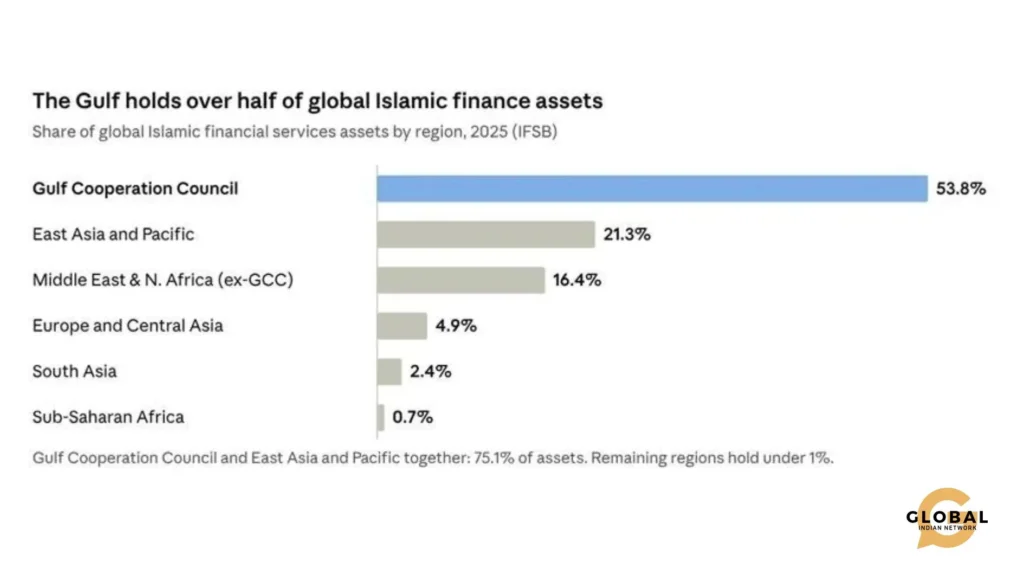
IFSB Islamic Financial Services Industry Stability Report, 2025 regional breakdown, via ICAEW
Newer markets are growing too. African sovereign sukuk rose from US$1.7 billion in 2021 to US$4.5 billion in 2025, and Benin’s debut US$500 million issue drew more than US$7 billion of orders. Uzbekistan and Kazakhstan are drafting their first Islamic banking laws.
Trends in faith and values-based finance, 2025
In 2025, faith-based products kept growing while funds sold on generic sustainability labels lost investors.
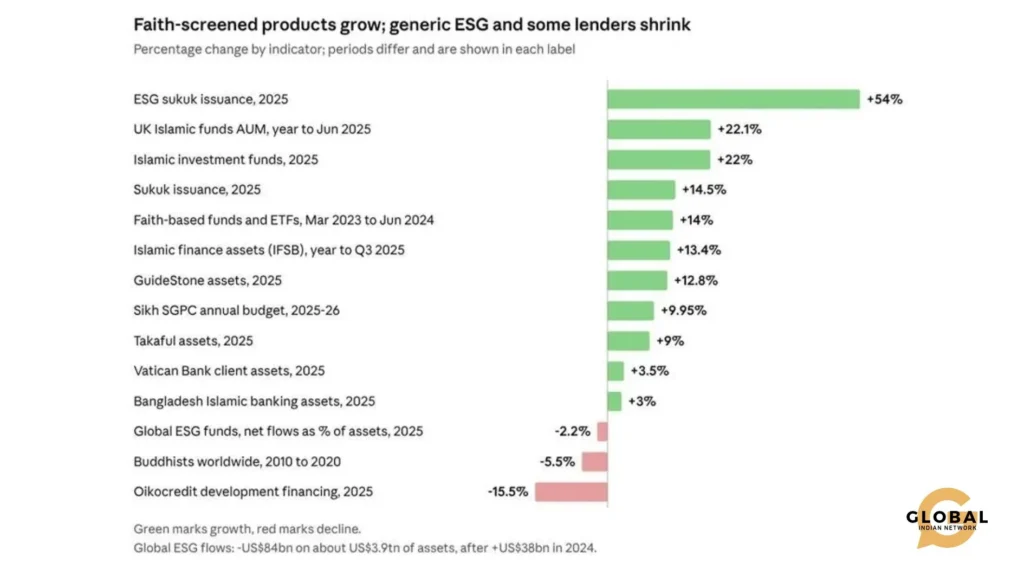
LSEG/ICD 2026, IFSB via ICAEW, S&P via Arab News, Global X, Baptist Press, SGPC, Vatican Bank, Morningstar, Pew Research Center 2025, Oikocredit
Faith-screened products have grown steadily. Assets in faith-based ETFs and managed funds grew 14% between March 2023 and June 2024 to more than US$130 billion, Islamic funds rose 22% in 2025, and church institutions such as GuideStone (+12.8%) and the Vatican Bank had strong years.
Secular ESG funds are in decline. Global sustainable funds recorded US$84 billion of net outflows in 2025, according to Morningstar, the first full year of outflows since tracking began in 2018. By the fourth quarter of 2025, US sustainable funds had seen 13 straight quarters of withdrawals.
Some mission-driven lenders also came under strain. Oikocredit, a church-founded development cooperative, saw its lending portfolio shrink 15.5% and reported a loss of about €20 million, while the ethical bank Triodos lost €25 million. In Bangladesh, Islamic banking growth slowed to 3% amid governance problems.
Suggested steps to increase awareness of and access to faith-based finance
Experience around the world suggests that a credible faith-based model needs five things, whatever the tradition.
- A published standard that turns teachings into specific, auditable investment rules.
- Independent oversight, with scholars and finance professionals working together.
- Measurement of financial and social outcomes, to avoid the credibility problems now affecting ESG.
- Distribution through mainstream banks, platforms and ETFs, not only specialist firms.
- Regulatory recognition, so products can compete on equal terms.
Faith-based finance already handles trillions of dollars. Over the next decade, the open question is which communities will build institutions around their values to manage that money, and whether the world’s largest diaspora will be among them.
The next article in this series, “Global Impact: Lessons from Faith-Based Finance and Opportunities for Dharmic Models“, takes up that question.
*Note: This is general information and is not investment advice.
Article Submitted By:
Geeta Kulkarni is a senior finance executive and strategic CFO who combines strong technical depth with a commercial outlook. She is a Chartered Accountant (India), a CPA (Australia), and a Graduate of the Australian Institute of Company Directors. Her career spans manufacturing, FMCG, agribusiness, renewables infrastructure, and private equity.
As a trusted adviser to CEOs, boards and stakeholders, Geeta turns financial insight into clear strategic direction. She is known for steering organisations through growth, digital transformation and change.
Geeta has led successful acquisitions from due diligence to post-acquisition integration. Her work has created lasting value for organisations and their investors. She has worked closely with Boards and stakeholders to strengthen financial performance and lift enterprise value, balancing near-term results with long-term growth.
Geeta builds and leads high-performing finance teams, developing talent and creating a culture of accountability and continuous improvement. She has a track record of putting in place best-practice processes, systems and controls. These deliver operational excellence in accounting, treasury, governance, risk and management reporting. Her governance training as an AICD Graduate gives her a director’s view of risk, compliance and stewardship.
Outside work, Geeta values time with family and friends and volunteers with not-for-profit boards and organisations, bringing her financial and governance skills to the community sector. She practises Ashtanga yoga and hiking when time permits.

Membership
A Private Circle for Global Indians
Join a trusted community of founders, investors, policymakers, and cultural leaders shaping the global Indian story across 46+ countries.
Sources
- LSEG and ICD, Islamic Finance Development Report 2026, via Arabian Post
- ICAEW, Islamic finance industry profile (IFSB 2025 data)
- FaithInvest, Oxford Faith-Aligned Impact Finance Project estimate
- Morningstar, Global sustainable fund flows 2025
- GIIN market sizing 2024, via NordSIP
- Thrivent fact sheet
- Civil Society, Church of England endowment 2025
- Vatican News, IOR 2025 annual report
- BVR, German cooperative bank rankings 2025
- Daily Excelsior, SGPC 2026-27 budget
- Inspire Investing, PTL ETF
- Oikocredit, 2025 results
- Triodos Bank, 2025 annual results
- Pew Research Center, global religious landscape 2010–2020
- RBI remittance data FY25, via HDFC Sky
- Hinduism Today, Dow Jones Dharma Indexes
- Business Bhutan, Gelephu bond