



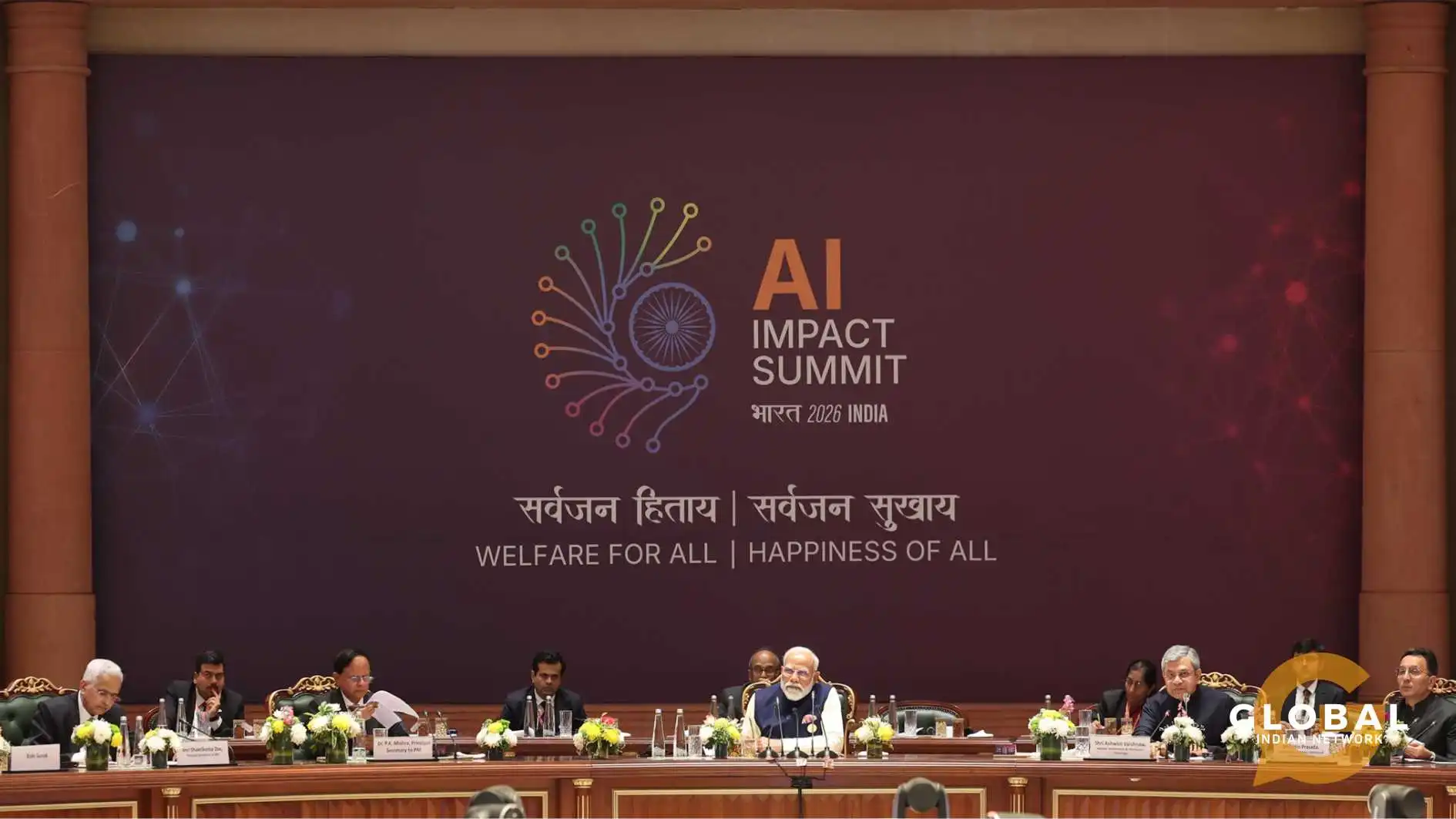

The global discourse around artificial intelligence has long been shaped by Washington, Silicon Valley, Brussels, and Beijing. What happened in New Delhi during the India AI Impact Summit 2026 signalled a subtle but significant shift in that geography of influence. It was a moment when India sought to position itself not as a consumer of artificial intelligence systems but as a civilizational stakeholder in the design, governance, and deployment of those systems.
Held at Bharat Mandapam, the summit brought together policymakers, researchers, startups, global technology leaders, and representatives from the Global South. According to reports by The Times of India and India Today, Prime Minister Narendra Modi has framed AI as a transformative force comparable to historic turning points, such as the advent of fire or the printing press. That framing was deliberate. It elevated AI from being a sectoral development to being a structural reordering of society.
The question underlying the event was not whether AI will shape the future, that is already settled, but who will influence the socioeconomic foundations of that future.
Table of Contents
India AI Impact Summit 2026 and the Reframing of Technological Sovereignty
A defining theme of the summit was the articulation of “democratised AI.” Modi emphasised equity and positioned India’s AI strategy as value-driven rather than purely market-driven. Government statements highlighted the importance of ensuring that AI remains human-centric and responsive to social diversity.
This reframing matters. In dominant global narratives, AI is often discussed in the language of competition, the strategic triad- compute supremacy, model scale and semiconductor advantage. At the India AI Impact Summit 2026, however, the rhetoric shifted toward sovereignty and public good. Sovereignty in this context does not merely refer to data localization but dominance.
Coverage from Business Today noted that Modi encouraged deeper collaboration between global technology companies and Indian students and researchers. The emphasis on talent suggests a recognition that infrastructure alone cannot guarantee influence. Intellectual capital must accompany hardware investment.
Yet sovereignty is complicated. India’s AI ambitions play out within a global ecosystem still dominated by multinational corporations. The summit, therefore, became a site of negotiation: how can India leverage foreign capital and expertise while nurturing indigenous capability?
A Meeting of Platforms and Policy
One of the most closely examined developments at the summit was the meeting between Prime Minister Modi and Google CEO Sundar Pichai. According to The Times of India and India Today, discussions centered on deepening AI collaboration, expanding digital infrastructure, and working with India’s student talent pool.
Pichai reiterated Google’s commitment to embedding AI across sectors in India, from education to public services, as reported by The Hans India. This overlap between government vision and private-sector ambition is consequential. Google remains central to global AI research, cloud computing, and large language model development. Its participation signals recognition of India as a pivotal digital economy rather than merely a user base.
However, collaboration is not synonymous with parity. Investment announcements, including large-scale commitments toward AI infrastructure, bring opportunities but also dependencies. Compute clusters, cloud ecosystems, and AI deployment pipelines often remain architecturally tied to the originating corporations. For India, the challenge will be ensuring that collaboration leads to capability transfer rather than prolonged technological reliance.
The significance of the India AI Impact Summit 2026 lies precisely in this balancing act. It demonstrated India’s willingness to engage global leaders while simultaneously asserting its own normative framework for AI governance.

Beyond Capital: Talent, Language, and the Democratic Question
India’s demographic dividend featured prominently in summit discussions. Reports indicated that thousands of students, startups, and developers participated, showcasing AI solutions tailored to vital sectors.
This focus on linguistic diversity is particularly consequential. Much of contemporary AI research has been disproportionately trained on English-dominant datasets. India’s multilingual reality challenges that imbalance. Startups developing vernacular AI tools referenced in technology coverage following the summit reflect a stronger possibility: AI systems that emerge from local contexts rather than being retrofitted for them.
If AI remains confined to English interfaces and metropolitan ecosystems, it risks amplifying digital inequality. The summit’s emphasis on inclusive design suggests awareness of this risk. The term “democratisation” therefore acquires substance only if access to AI tools extends beyond elite institutions and urban innovation hubs.
The India AI Impact Summit 2026 thus positioned AI not solely as a productivity engine but as an instrument of social restructuring. Whether that restructuring narrows or widens inequality depends on implementation.
Governance, Ethics, and the Global South Lens
Another undercurrent at the summit was India’s attempt to situate AI governance within a Global South framework. Many developing nations face shared challenges: limited computing infrastructure, data asymmetries, and regulatory gaps. India’s articulation of AI as accountable and human-centric resonates beyond its borders.
Ethical AI cannot remain an abstract aspiration. Questions of surveillance, algorithmic bias, labour displacement, and misinformation require regulatory clarity. As highlighted in post-summit expert commentary in economic reporting, equitable access to computing resources and data sovereignty remain pressing concerns.
India’s AI governance emerges at a unique crossroads, embodying the tensions of an emergent economy, a vibrant digital innovation nexus, and a resilient democratic order. This triadic identity inherently destabilizes any unitary regulatory paradigm: overzealous strictures risk throttling the very ingenuity that propels its ascent, while lax vigilance imperils the foundational rights of its polity. The summit, in its circumspect nod to this dialectic, refrained from prescriptive closure, opting instead for an implicit recognition of the aporia.
Yet therein lies a subtler virtue: the elevation of ethical deliberation within a conclave ostensibly devoted to technological prowess. This gesture signals an epistemic pivot from the unreflective euphoria of techno-utopianism to a more deliberative statecraft, in which technics are subordinated to normative scrutiny. Such a reorientation, though nascent, intimates the contours of a governance ethos attuned to pluralism and precaution.
The Economic Stakes: Infrastructure and Industrial Strategy
Artificial intelligence transcends the confines of a singular technological domain, weaving inextricably into semiconductors, cloud architectures, defence apparatuses, and manufacturing ecosystems. By convening a grand international conclave, India has proclaimed its resolve to embed AI within a comprehensive industrial strategy, positioning itself as a fulcrum in the global tech order.
The attendance of transnational executives illuminated the profound economic valences at play. Strategic infusions into data centers, research enclaves, and pedagogical reforms could fortify India’s digital sinews, rendering it resilient amid geopolitical flux. Nonetheless, entrenched impediments loom large: erratic energy provisioning for voracious computational demands, constrained access to cutting-edge semiconductors, and the perennial quest for enduring capital to fuel vanguard inquiry.
Thus, the summit’s proclamations merit scrutiny beyond rhetorical flourish, hinging on institutional fidelity. Will India’s academic bastions secure perennial endowments for AI scholarship? Might public-private symbioses engender indigenous intellectual property, wrested from exogenous dominance? The answers to these interrogatives shall delineate whether the India AI Impact Summit 2026 catalyzes enduring metamorphosis or dissipates into aspirational ephemera.
Policy Context: India AI Impact Summit 2026
International summits often risk becoming ceremonial spectacles. The India AI gathering, however, appears to have combined symbolism with strategic signalling. Modi’s framing of AI as a civilizational moment, Pichai’s emphasis on collaboration, and the visibility given to startups collectively shaped a narrative of aspiration anchored in pragmatism.
Yet ambition alone cannot guarantee outcomes. The structural asymmetries of global technology markets remain formidable. The concentration of advanced semiconductor manufacturing outside India, the dominance of Western AI research institutions, and the geopolitical tensions surrounding technology supply chains form the backdrop against which India’s strategy must operate.
The ultimate legacy of the India AI Impact Summit 2026 will depend on whether it becomes a catalyst for institutional reform and capacity building or remains a high-profile milestone in India’s digital diplomacy.
Conclusion
Artificial intelligence is not merely a technological inflection but a seismic reconfiguration of puissance itself. By assembling global potentates, corporate titans, and indigenous trailblazers within a singular agora, India proclaimed its audacious claim to agency in this epochal repartition of puissance.
The India AI Impact Summit 2026 marked an inflection point because it articulated a vision in which AI is aligned with democratic values, national sovereignty, and inclusive growth. Whether that vision materializes will depend on policy discipline, sustained investment, and the capacity to convert global partnerships into indigenous strength.
History rarely announces itself loudly. Sometimes it arrives in the form of a conference and only later reveals whether it was symbolic or transformative.
FAQs
What was the aim of the India AI Impact Summit 2026?
The summit aimed to strengthen India’s position in the global AI landscape by bringing together policymakers, technology companies, researchers, and startups to discuss collaboration, innovation, and responsible AI development.
What did Prime Minister Narendra Modi and Sundar Pichai discuss at the summit?
Their discussion focused on expanding AI collaboration in India, improving digital infrastructure, and creating opportunities for global technology firms to work with Indian students and developers.
Why is India becoming important in the global AI ecosystem?
India offers a large digital market, a growing startup ecosystem, and a strong talent pool in engineering and technology, making it an important hub for AI development and deployment.
What challenges does India face in advancing its AI ambitions?
Key challenges include limited high-end computing infrastructure, reliance on global semiconductor supply chains, and the need for clear regulatory frameworks for responsible AI use.