


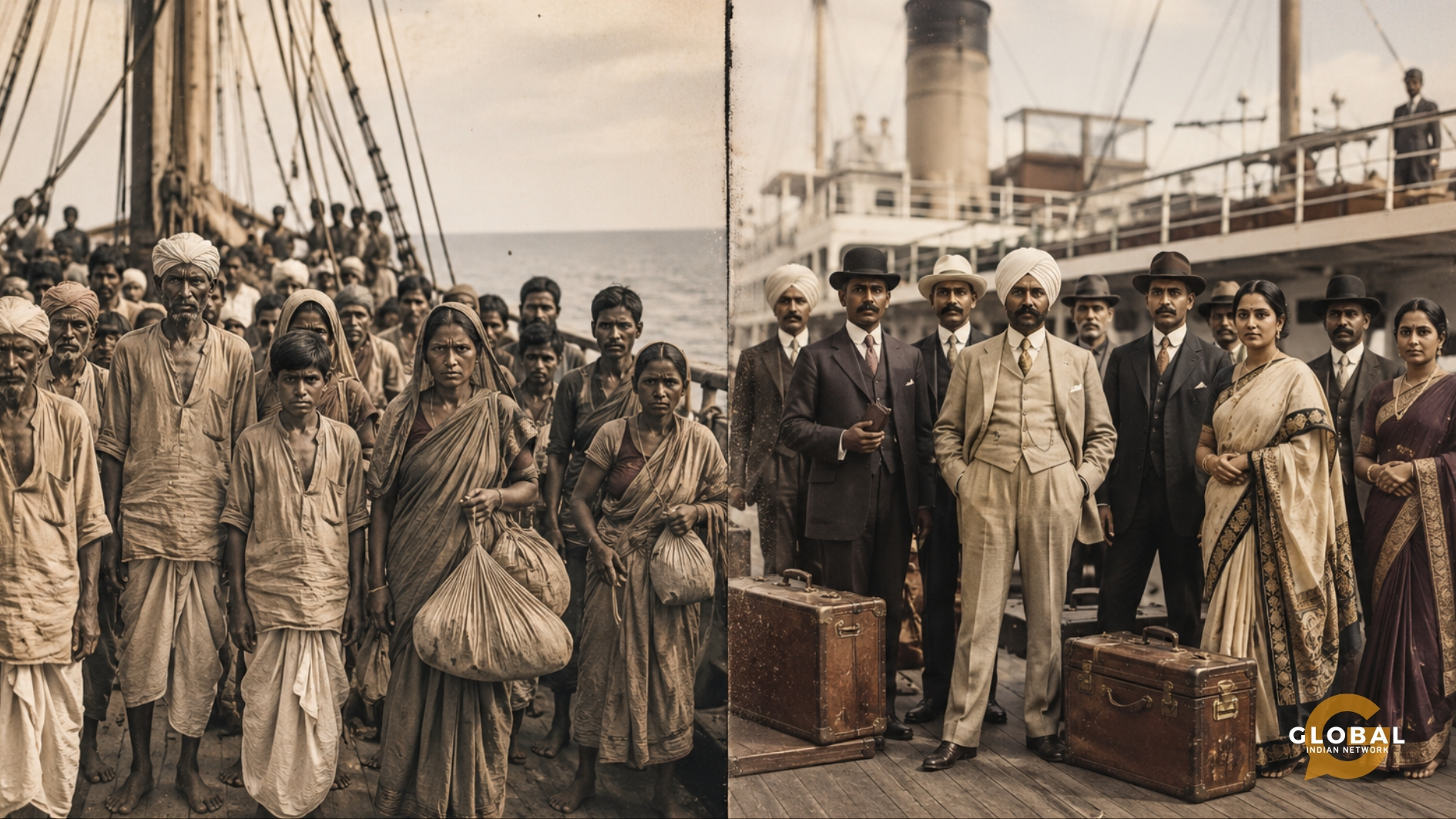

More than a century ago, Indians boarded ships bound for places they had never seen. Some were recruited into an indentured labour system and sent to sugarcane plantations under contracts they had little power to negotiate. Others paid their own fares, carried commercial ambitions and travelled overseas as traders, professionals or independent workers.
They were all part of the global Indian diaspora, but they didn’t experience migration in the same way.
That is the heart of the difference between Girmitiya and passenger Indians. The distinction wasn’t simply about occupation. It reflected two different migration regimes, levels of economic freedom, social positions and relationships with colonial governments. Those experiences eventually produced distinct communities across the British Empire, from Fiji and South Africa to Trinidad and Tobago, British Guiana and Mauritius.
Table of Contents
Who Were the Girmitiyas?
Girmitiyas were Indians who migrated under the colonial Indenture System, particularly during the nineteenth and early twentieth centuries. “Girmit” came from the Indian pronunciation of “agreement,” referring to the contracts that workers signed before leaving India.
The difference between Girmitiya and passenger Indians becomes clearest when we examine the conditions surrounding their journeys.
After slavery was abolished across the British Empire, plantation owners still needed large numbers of workers. The colonial response was the Indian indenture system: workers were recruited in India and transported to colonies where they were contracted to work, often for several years.
The system expanded across sugar-producing territories. Girmitiyas worked on sugarcane plantations, in mines, on railways and in other forms of colonial labour.
The experience could be brutal. Recruiters sometimes misrepresented working conditions, while workers faced low wages, restrictions on movement and harsh discipline. Although indenture was legally different from slavery, historians have long debated the extent to which it functioned as a coercive replacement for slavery.
What Made Passenger Indians Different?
Passenger Indians followed a different migration route. The difference between Girmitiya and passenger Indians was largely rooted in how migrants entered the colony. Passenger Indians generally paid their own passage and arrived outside the contractual labour system. They included merchants, shopkeepers, artisans, professionals and family members joining relatives who had already established themselves overseas.
A South African historical study describes passenger Indians in Natal as free migrants who paid their own fares rather than arriving as contractual workers. Many were Gujarati-speaking Hindus and Muslims who established trading businesses.
That distinction mattered enormously. A Girmitiya could be tied to an employer under an indenture contract. A passenger Indian, while still subject to colonial discrimination and immigration restrictions, generally had greater freedom to choose an occupation and build a business.
So, the difference between Girmitiya and passenger Indians wasn’t simply “poor migrant versus wealthy migrant.” It was fundamentally a difference in the migration mechanism.
Why Did the British Colonies Need Indian Labour?
To understand the difference between Girmitiya and passenger Indians, it helps to understand the economic machinery of the British colonies.
The abolition of slavery created a labour problem for plantation economies. Sugar producers in the Caribbean, Indian Ocean and Pacific wanted a workforce that could replace enslaved labour. India became one of the major sources.
The indentured labour scheme allowed colonial authorities and plantation interests to recruit workers from India and transport them overseas. Fiji is one of the clearest examples. More than 60,000 Indians arrived there as indentured labourers between 1879 and 1916.
But colonial expansion also created commercial opportunities. Ports, railways, towns and growing consumer markets needed shopkeepers and traders. Indian merchants could fill those gaps, often using family and community networks that stretched across the Indian Ocean.
The two migration streams therefore served different parts of the colonial economy: one supplied labour, while the other helped build commerce.

Difference Between Girmitiya and Passenger Indians: Fiji and the Ship Leonidas
Fiji provides one of the best documented examples of the Girmit experience. On May 15, 1879, the ship Leonidas arrived in Fiji carrying the first group of Indian indentured labourers. The arrival marked the beginning of a migration stream that would continue until 1916. The surviving records show individual immigration pass numbers, names, fathers’ names, villages and other personal details.
This wasn’t an abstract migration system. Each person had a paper trail.
The records can contain an individual’s ship name, age, caste, village, next of kin and, in some cases, details of a marriage certificate or employer. More than 60,000 Indian emigration passes from Fiji have now been digitised.
That makes Fiji particularly valuable for understanding how migration became family history.
A descendant today may know only that a great-grandparent was “from India.” By finding an immigration pass number, the family can sometimes identify the person’s village, father, ship and arrival date.
The historical system that once reduced workers to colonial numbers can therefore become a tool for recovering individual identities.
The Role of “Kala Paani” in Migration
Indian migration across the seas also carried a cultural and emotional dimension.
The idea of kala paani, or “black water,” reflected longstanding social and religious anxieties surrounding crossing the ocean. Overseas travel could be viewed as a break from established social structures and, in some contexts, caste expectations.
Yet economic pressure could outweigh those concerns. For some migrants, leaving India meant escaping poverty, debt, family difficulties or limited economic opportunities. Research on Indian migration to Natal shows that potential migrants could view overseas work as a chance to improve their circumstances, even when recruiters failed to fully explain the conditions they would encounter.
The voyage across kala paani therefore represented both loss and possibility. For Girmitiyas especially, the sea marked a dramatic break with the familiar world. For passenger Indians, it could represent a calculated commercial journey.
South Africa Shows the Divide Clearly
The difference between Girmitiyas and passenger Indians becomes particularly visible in South Africa.
Indian indentured labourers began arriving in Natal in 1860 to work in the colony’s sugar industry. Passenger Indians arrived later, including Gujarati-speaking merchants who paid their own passage and established businesses. The groups weren’t always treated equally by either colonial authorities or Indian elites.
Passenger Indians could accumulate commercial wealth and build shops, trading networks and community institutions. Former indentured labourers often remained economically disadvantaged even after their contracts ended.
This created class divisions inside the South Asian community itself. That’s an important part of the story: colonial migration didn’t simply create “Indians abroad.” It reproduced and sometimes transformed existing differences of class, caste, occupation and religion.
Trinidad and Tobago, British Guiana and the Caribbean
The same pattern appeared in the Caribbean. Indians were transported to Trinidad and Tobago, British Guiana and other colonies to work primarily in plantation economies. Sugar shaped these communities profoundly.
Over generations, descendants of indentured labourers created new cultural identities rather than simply reproducing nineteenth-century Indian society. Bhojpuri-derived speech, Hindu and Muslim traditions, food, music and festivals interacted with African, European, Indigenous and other Caribbean cultures.
This is why the South Asian Diaspora cannot be understood as a collection of communities that simply preserved Indian culture unchanged.
Migration transformed culture in both directions. The descendants became Caribbean Indians, Indo-Fijians, Indo-Mauritians and Indian South Africans, among other identities. Their cultures were Indian in ancestry but also unmistakably shaped by their new societies.
Fiji’s Records Reveal the Human Story
The National Archives of Fiji has become especially important for descendants researching these histories.
The original records include immigration passes and registers relating to Indian indentured labourers. The National Library of Australia explains that the National Archives of Fiji remains the custodian of the original collection, which contains 344 volumes.
The records are also connected to the UNESCO Memory of the World Register. In 2011, records relating to Indian indentured labourers in Fiji, Guyana, Suriname, and Trinidad and Tobago were added to the register because of their global documentary significance.
For researchers, this creates something unusual: a colonial labour system can now be reconstructed person by person.
Modern digitisation has made this even easier. The Fiji material can be searched through the National Library of Australia’s Trove database, including records organised by arrival date, ship name and pass number.
Family Histories Are Changing the Way This Past Is Understood
The growing interest in Family Histories has changed how descendants approach Girmitiya history.
Earlier historical accounts often focused on governments, plantation owners and political leaders. Genealogical research asks a different question: Who exactly was the person who made that journey?
A researcher might begin with a family story, find a village name, locate an emigration record and then connect it to marriage or death records.
For Fiji, researchers can combine immigration passes with Fiji Registry of Births, Deaths and Marriages records. Modern civil registration systems provide birth certificates, death certificates and marriage records that can help connect generations. Fiji’s Registrar General system is responsible for registering births, deaths, and marriages.
This is where the difference between Girmitiya and passenger Indians becomes meaningful beyond academic history. Descendants can sometimes identify not just the migration category, but the actual person, family and community behind it.
Why Passenger Indian Histories Also Matter
Passenger migration deserves equal attention because commercial migrants helped create another strand of the global Indian experience.
In Natal, passenger merchants established businesses and trading networks that expanded beyond individual towns. Research on Indian family businesses shows how Gujarati-speaking merchants used commercial relationships to develop enterprises in South Africa and maintain links with Mauritius, East Africa and other parts of the world.
These networks could become multigenerational. A shop established by one migrant could later become a family business. Children could receive education, enter professional careers and expand into new industries.
This creates a different migration trajectory from plantation labour: migration could become an entrepreneurial strategy passed from one generation to the next.
The Two Identities Were Never Completely Separate
It would be misleading to suggest that Girmitiya and passenger communities remained completely isolated.
People married across social categories. Former indentured workers became traders, farmers and business owners. Passenger families employed workers who had once been indentured. Communities shared religious institutions, languages, neighbourhoods and political struggles. The categories also changed over time.
A person could arrive as an indentured labourer, complete the contract and later become economically independent. Their children might enter education or business. Within two or three generations, the family’s social position could look completely different from that of the original migrant.
This is why the difference between Girmitiya and passenger Indians should be treated as a historical starting point rather than a permanent identity label.
From Colonial Records to Modern Diaspora Identity
The historical distinction has implications for the modern Global Indian Diaspora. Today, Indian-origin communities stretch across continents, but their histories aren’t interchangeable. Descendants of Girmitiyas in Fiji or Trinidad may have a very different relationship with India than descendants of nineteenth-century merchants in East Africa.
Some families actively reconstruct their ancestral history through digitised archives, genealogy databases and community projects. Others have lost much of their connection to their ancestral villages.
Initiatives such as the Roots Project and other family-history efforts reflect this growing interest in reconnecting descendants with migration records. The availability of digitised copies has made research possible for people who may never have been able to travel to an archive.
This also changes the meaning of diaspora. It becomes more than population statistics. It becomes a collection of individual journeys.
What This History Means Today
The difference between Girmitiya and passenger Indians also offers a useful lens for understanding modern migration.
Consider two hypothetical Indians moving abroad today. One accepts a temporary labour contract through a recruitment agency. Another arrives with savings to establish a company. Both are migrants, but their bargaining power, risks and ability to choose where they work are dramatically different. The same principle operated under colonialism.
Migration isn’t automatically a story of opportunity. The outcome depends on who controls the contract, who pays the travel costs, what rights migrants have and whether they can change employers. That’s one of the most practical lessons from the indentured labour system.
Conclusion
The difference between Girmitiya and passenger Indians began with two very different migration pathways. Girmitiyas were recruited into a contractual labour system designed to supply colonial plantations and other industries with workers. Passenger Indians generally financed their own journeys and pursued trade, employment, family reunification and entrepreneurship.
But the consequences went far beyond employment. The two groups developed different economic opportunities, social experiences and cultural memories. Their descendants later created new identities in Fiji, South Africa, Mauritius, Trinidad and Tobago, British Guiana and elsewhere.
Perhaps the most powerful development is that the records of this migration are no longer only the property of historians. Immigration passes, ship lists, civil records and digitised archives now allow descendants to reconstruct their own Family Histories.
The ocean once separated these migrants from India. More than a century later, the same journeys and the records they left behind are helping a new generation understand where their families came from and how the modern Global Indian identity was built.
FAQs
Who is called girmitiya?
Between the mid-nineteenth and early-twentieth centuries, Indian indentured workers known as Girmitiyas were sent from British India to various colonies to labor on agricultural plantations, mainly cultivating tea, rubber, and sugar.
Who were the Girmitiya people?
The term “Girmitiyas” refers to Indian indentured laborers whom the British Empire transported to several overseas colonies throughout the nineteenth and early twentieth centuries. They were brought in to address labor shortages following the abolition of slavery.
What does “Girmit” mean?
The term “Girmit” originated as a colloquial adaptation of the word “agreement,” signifying the indenture contracts under which Indian laborers were dispatched to British colonies such as Fiji, Mauritius, South Africa, and the Caribbean throughout the nineteenth and early twentieth centuries.