




A lot of paradoxes, some hidden connections… we have dived into a story that is creating suffering for the citizens. In this case, the shock is ‘electric’ and cannot be ignored.
Power outages are plunging Suriname into darkness, but an absolute blackout is unethical. While citizens are urged to save electricity, top officials at the state energy company stand accused of smuggling $3 million in illegal timber.
Since her inauguration in July 2025, President Jennifer Geerlings-Simons, Suriname’s first woman president and leader of the National Democratic Party (NDP), has faced formidable challenges governing a nation grappling with economic turbulence, persistent corruption, and systemic governance failures. While her administration promised transparency, reform, and equitable resource management, the reality reveals stark cracks.
The current political culture still echoes the age-old adage: ‘I too must eat, but I must eat all.’ Amid ongoing power outages, scandals involving officials of the state energy company, and allegations of resource theft, the Geerlings-Simons government is under intense scrutiny as citizens demand accountability and genuine reform.
We have unearthed details that are likely to create moral outrage. Read on.
Table of Contents
The Rot Within
For decades, Suriname’s economy has depended heavily on its natural resources: gold, bauxite, oil, and timber. These resources should have been pillars of sustainable growth and funds for education, healthcare, and infrastructure. Instead, they have become private cash registers for networks of politically protected profiteers. The energy company’s logging scandal is only the latest chapter in a much longer story of extraction without accountability.
Observers note that the illegal timber trade in Suriname has been expanding for years, often under the radar of weak enforcement agencies. Logs leave ports in containers labelled as “legal exports,” their actual quantities and origins masked by falsified paperwork. Many of those profiting from this trade have deep political connections strong enough to guarantee immunity.
Suriname has a score of 51.51 on the Illegal Deforestation and Associated Trade (IDAT) Risk Index, categorizing it as “Higher Risk.” While the country imposes log export restrictions, enforcement remains weak. Recent commitments to protect 90% of forests are viewed as reactive rather than part of a systemic approach.
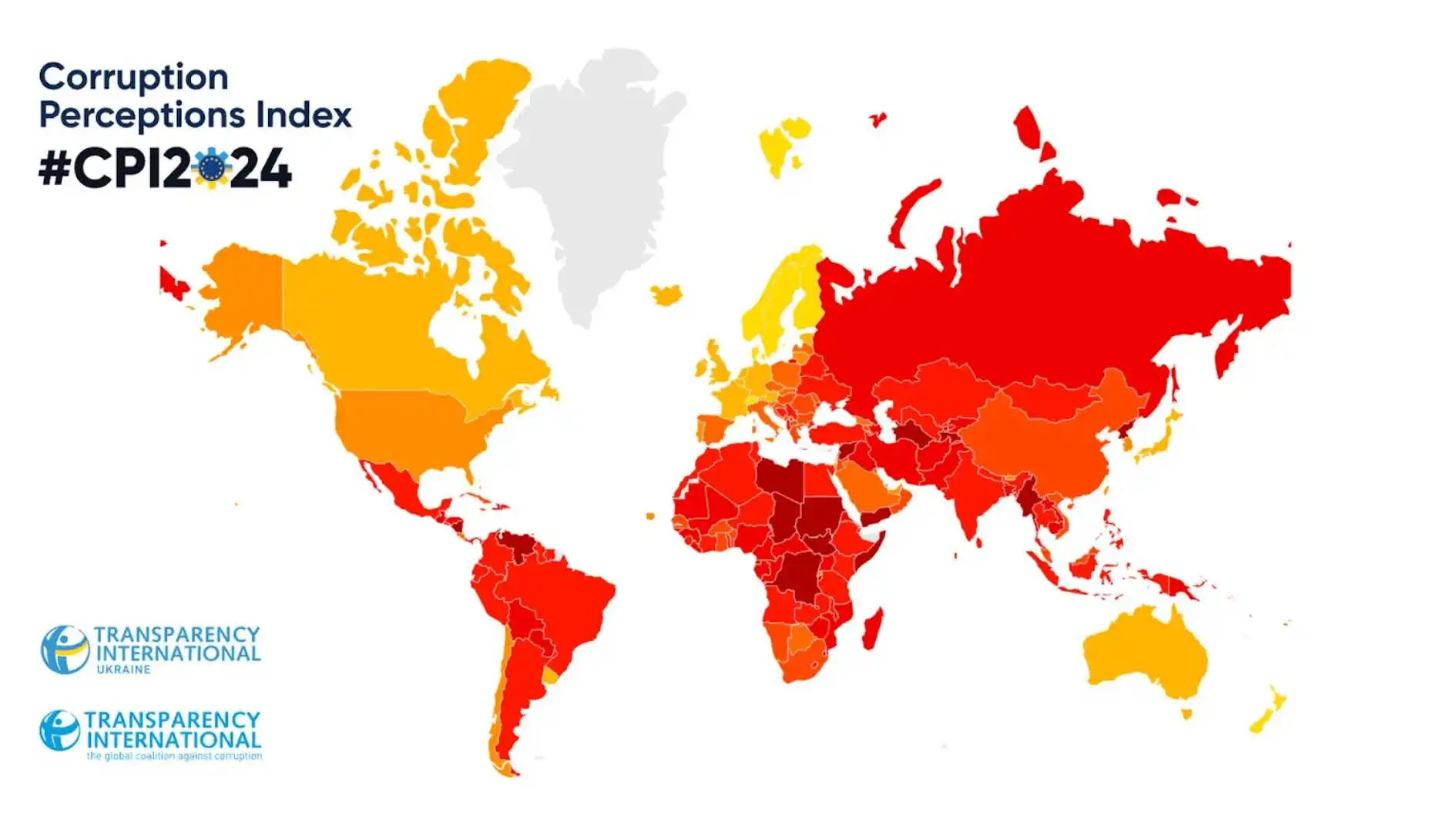
Governance and corruption risk in Suriname remain elevated; a low CPI score signals systemic transparency and accountability issues.
When such corruption is uncovered within the very institution that powers the nation, the symbolism is as devastating as the act itself. The state grid may be short on electricity, but the political establishment runs on boundless power, unchecked, unregulated, untouchable.
The Political Dynamics
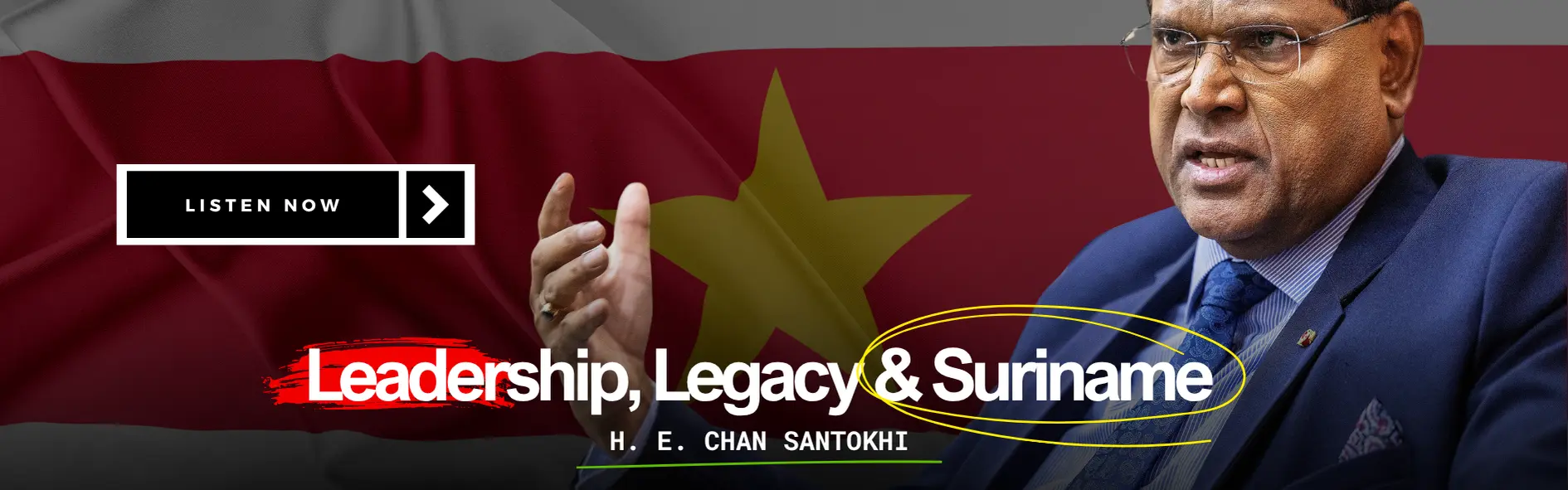
Suriname’s political arena is dominated by entrenched networks, where public office and private gain blend indistinguishably. The administration of President Jennifer Geerlings-Simons, despite its reformist rhetoric, has not yet managed to break free from this legacy. Even as the government calls on citizens to conserve electricity, allegations of elite corruption and resource plundering persist. The opposition, led by former head of state Chan Santokhi, has criticized the ruling party for the widening disconnect between promises and performance, underscoring the urgent need for systemic change.
Suriname’s politics is characterized by a small group of influential figures who seamlessly transition between public office and private business, eroding the distinctions between state, party, and personal interests. This intertwining fosters systemic corruption, evident as directors implicated in scandals remain in power, while political leaders fail to hold them accountable, prioritizing party loyalty over national interests.
Such political patronage corrodes democracy itself. When private interests capture public institutions, elections become rituals without real choice, and oversight becomes a farce. The people’s mandate is replaced by the machinery of mutual protection among elites.
A Crisis of Public Trust
The ongoing blackouts in Suriname have left households and small businesses struggling. Power shortages, worsened by drought-affected hydroelectric plants and aging diesel infrastructure, have disrupted daily life across the country. Refrigerators spoil, classes are cut short, and hospitals increasingly depend on backup generators to maintain essential care. Meanwhile, the national utility’s call to “save power” rings hollow to citizens who see political elites continue to consume state resources with little restraint.
Suriname’s citizens are not naïve. They recognize a pattern, one where those accused of illegal logging and timber theft are often linked to figures implicated in gold-smuggling networks. These activities drain public wealth, costing the country hundreds of millions of dollars each year and devastating its forests and rivers. Such crimes persist under a political machinery that appears largely beyond law or accountability.
Each blackout, therefore, is not merely a technical outage; it is a blackout of morality. Each candle lit in a darkened home becomes a quiet act of defiance, illuminating the resilience of ordinary citizens against a system that profits from keeping them powerless, both literally and figuratively.
Equally troubling is the lack of accountability following repeated scandals involving Suriname’s elite circles. Despite allegations of corruption and resource plunder, no senior officials have faced meaningful consequences. The same establishment urging citizens to conserve energy remains firmly in power, shielded by impunity.
This contradiction underscores a deeper malaise: a political culture that normalizes theft and excuses privilege while imposing austerity on the public. It reflects not only economic mismanagement but also a moral crisis, one that threatens the foundations of responsible governance and deepens public distrust in Suriname’s democratic institutions.
Suriname’s Energy by the Numbers
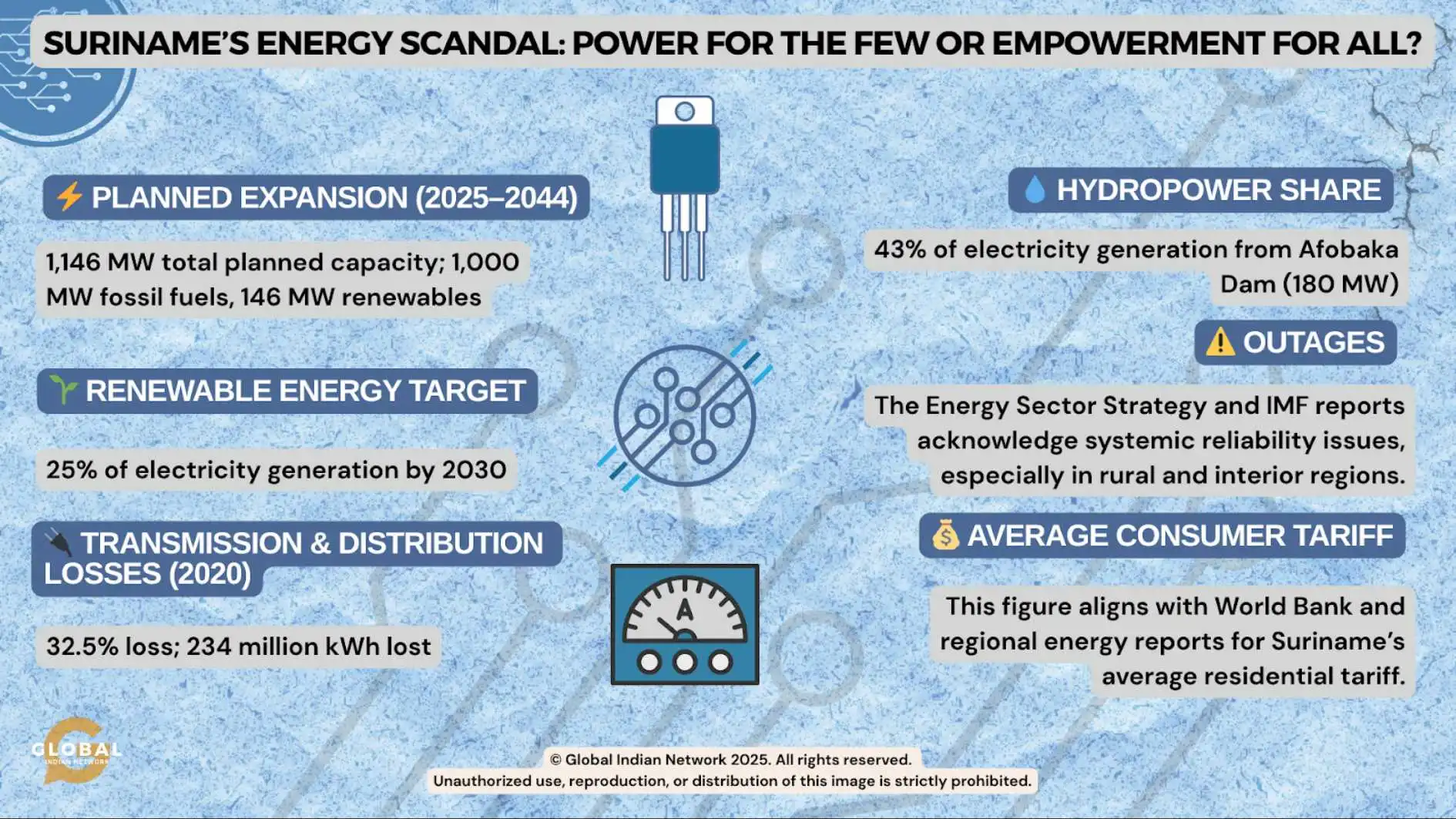
In 2023, the Surinamese government allocated over SRD 1.2 billion (approx. USD 60 million) in subsidies to EBS to offset losses from underpriced tariffs. This represents a significant portion of the national budget and contributes to fiscal pressure.
According to Transparency International’s 2024 report, Suriname’s resource governance index remains among the weakest in the region. Suriname has achieved a relatively low score in implementing the 2019 EITI Standard (58.5 points). The overall score is the average of the three component scores for Stakeholder Engagement, Transparency, and Outcomes and Impact.
As per all relevant energy reports, the breakdown is:
Stakeholder Engagement = ~79 (Moderate)
Transparency = ~48 (Low)
Outcomes & Impact = ~49 (Low)
What it means: Even though stakeholder engagement is moderate, the low scores in transparency and outcomes suggest that resource governance reforms are not yet translating into effective accountability or benefit-sharing.
According to the IMF’s 2024 review, Suriname’s electricity subsidies remain regressive, benefiting wealthier households while straining public finances. The state utility EBS continues to operate underpriced tariffs, compounding infrastructure decay and rural energy exclusion.

What Leaders Say, What Citizens Feel
Understanding the energy landscape demands voices from every corner.
N.V. Energiebedrijven Suriname (State Utility Operator)
We are committed to modernizing the grid and reducing losses, but interior regions remain difficult to service due to terrain and infrastructure gaps.”
— Blue Planet Alliance, 2024 sector overview
Blue Planet Alliance (Energy Equity Advocates)
Suriname’s energy transition must align with equity and resilience, not just expansion. The current trajectory risks deepening inequality.”
— Suriname Energy Sector: Aligning Transition with Equity and Resilience
Local Energy Analysts (Energy Analytics Institute)
Suriname is poised to become a regional energy player, but without transparency and grid reform, the benefits may bypass everyday citizens.”
Cheflin Paulus (Hydrology Expert)
The declining water level in the Brokopondo Reservoir has severely affected hydroelectric power production.”
The voices above highlight the loopholes in the system.
Together, these voices expose the systemic blind spots, terrain challenges, equity gaps, climate vulnerabilities, and transparency deficits that shape Suriname’s energy reliability.

The Challenges
Suriname’s grid leaks energy like a sieve, losing over 200 GWh annually in transmission. That’s enough to power thousands of homes, yet it vanishes into inefficiency.
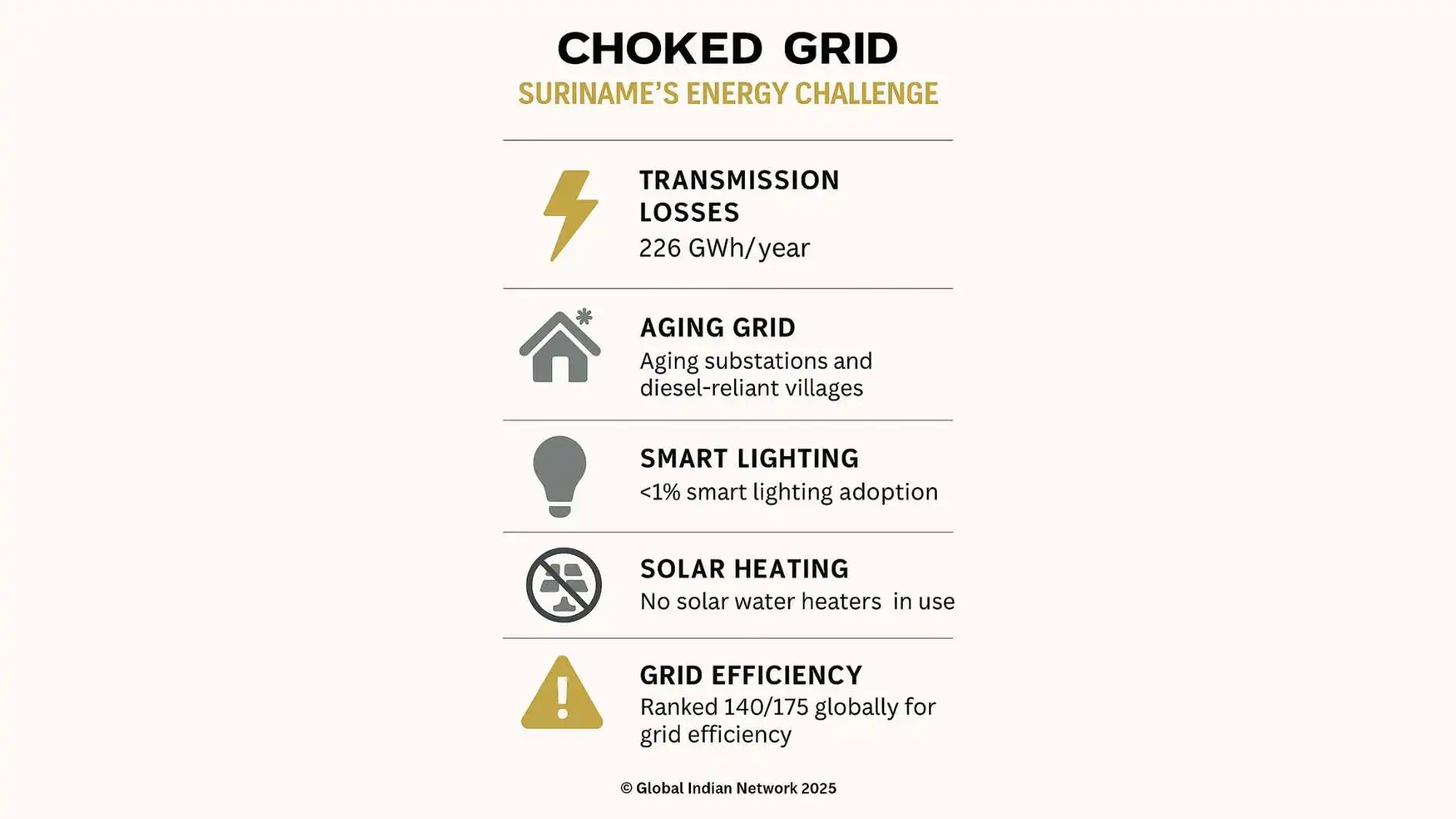
Suriname’s energy backbone is creaking under the weight of time. From diesel-reliant villages to aging urban substations, the infrastructure gap is not just technical; it’s a justice issue.
A Country at a Crossroads and Path Forward
While Suriname plans to invest $300 million in solar, wind, and biomass by 2030, the IMF warns that delays in structural reforms and in removing subsidies could derail progress. Real GDP growth is projected at just 2.3%, a modest figure for a nation rich in natural resources.
Suriname now faces a crucial moral and political test. It must decide whether to continue down the path of decay or begin rebuilding public trust through transparency, reform, and justice.
Accountability is crucial in addressing illegal logging operations, with a call for thorough investigations and prosecution of those involved, including suspension from their positions at the state energy company. The same accountability standards should apply to sectors such as the gold trade, where illicit activities flourish.
The government must also ensure independent oversight of regulatory bodies in forestry, mining, and energy, free from political influence, through merit-based appointments and transparency. Additionally, civil society and the media play a vital role in maintaining vigilance, with protections for journalists and whistleblowers needed to restore public trust.
The IMF urges phased removal of energy subsidies and expansion of digital social safety nets. Without these reforms, Suriname risks deepening inequality and missing its renewable transition targets.
In this moment of crisis and opportunity, the Geerlings-Simons administration stands at a crossroads. Its ability to deliver on promises of transparent governance and sustainable development will determine whether Suriname can finally shift from a political culture of ‘eat all’ to one of shared prosperity. Citizens and opposition alike are watching closely, demanding that energy reform transcend infrastructure fixes and tackle deeper issues of power and governance.

The People’s Power
Paradoxes are challenging to hide. In this case, they are as clear as daylight. It’s the irony that delivers the real shock.
When the lights go out across the country, Surinamers must remember: darkness does not last forever. The real question now is whether the nation’s leaders are ready to face the dawn of accountability or continue hiding in the shadows they created.
At the end, we sum up our findings as:
The grid may lack electricity, but the elite run on endless power.”
But we have questions as well.
What happens when plunderers, politicians, and profiteers form a collective?
Would that path lead to inclusive development?
If Suriname is to truly empower its people, energy reform must go beyond infrastructure; it must confront governance, pricing, and access head-on.
The answer lies with Suriname’s citizens: to question, to demand, and to act.