



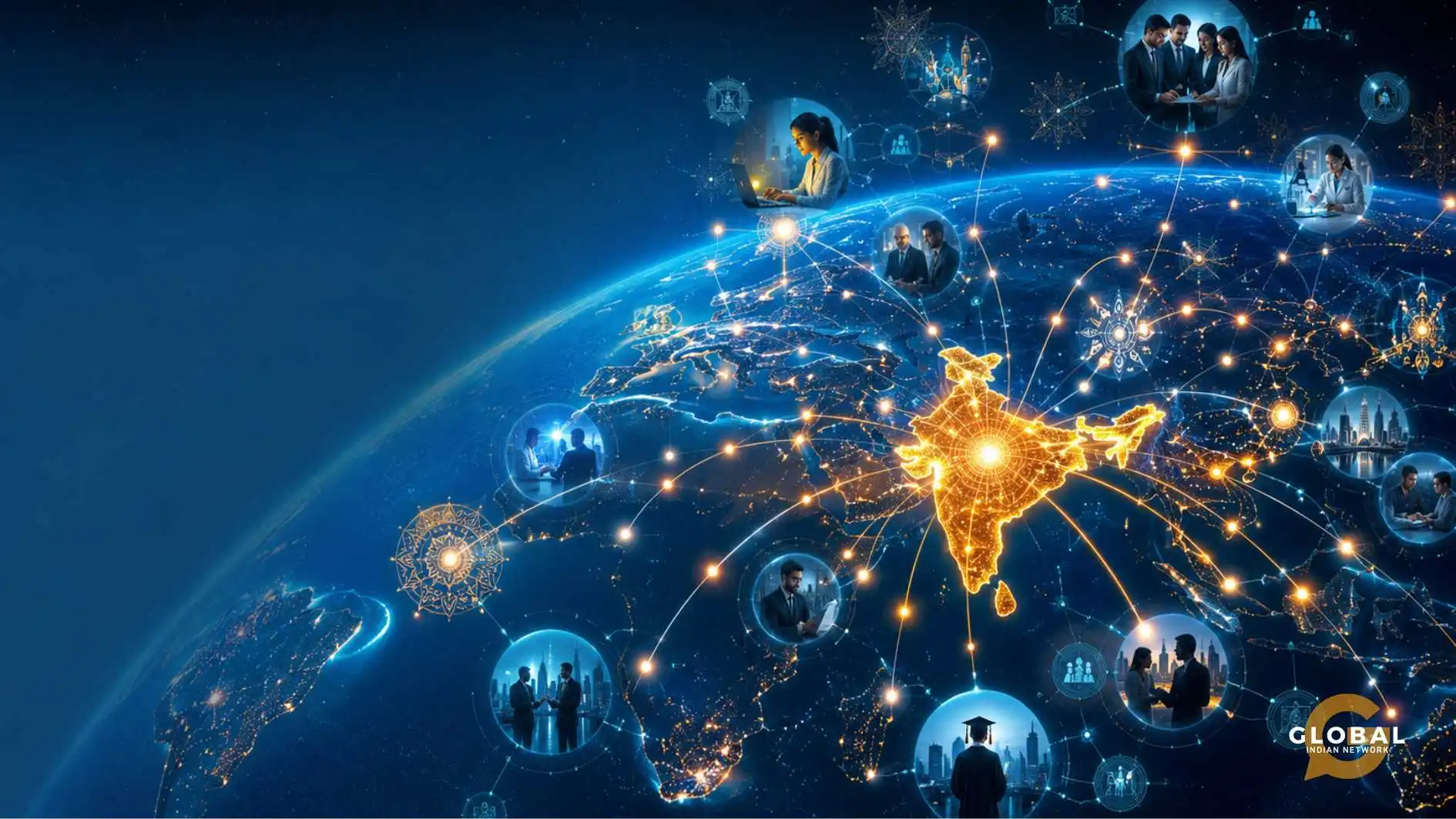

Identity is more complex than ever in today’s technologically, culturally, and politically interdependent world, where migration patterns, innovation, and shared issues all contribute to its growing complexity. This change is symbolised by the concept of a global Indian, a person bound by Indian values and heritage yet engaged in the international arena.
Table of Contents
A Changing Identity
In the last few decades, the definition of being a global Indian has changed considerably. It’s not just geographical or citizenship anymore. Rather, it’s a way to move across various cultures, economies, and ideas, while holding on to the sense of cultural roots.
A global Indian citizen will work across borders, both in terms of education, business, research, and entrepreneurship, as well as in the digital realm. This identity is characterised by openness, flexibility, and the desire to explore opposing viewpoints.
This concept of a global Indian is also closely linked to the large Indian community worldwide. People of Indian ancestry reside, work, and contribute in North America, Europe, the Middle East, Africa, Asia, and Oceania. They can have different nationalities and live in different cultures, yet still maintain strong ties to India through family, traditions, language, business networks, community activities, and so on. Their experiences illustrate how cultural identity can remain strong even as they adapt to new global environments.
People are expected to understand global systems and be sensitive to their cultural heritage as the world becomes increasingly interconnected. This balance is what makes up the modern global Indian and influences his/her contribution to society.
A Global Indian Mindset
The essence of a global Indian mindset is openness and responsibility. Success is now defined by more than just individual achievement; it also encompasses the capacity to make a positive difference in communities and industries.
There are a number of traits that may be associated with this perspective:
- Cultural Fit and Cultural Attitude
- Ensuring good practice for diversity and inclusion.
- Commitment to lifelong learning
- Strong ethical foundations
- The capacity to work with others across national boundaries.
- Understanding of the world’s opportunities and problems
The attributes enable people to succeed where innovation and collaboration are valued.
The modern global Indian understands that what they do locally can affect the world far and wide. Business, sustainability, technology, and education decisions can often go beyond borders.

Talent Without Borders
Digital technology has revolutionised the way talent moves and generates value. Global Indians can participate in the activities of international organisations, research institutes, start-ups, and creative industries from anywhere.
Indian-origin professionals have excelled in various fields, including scientific research, academia, finance, and healthcare. Their impact demonstrates the power of expertise to transcend borders and make a global impact.
The Indian community has contributed immensely to taking Indian talent to the world. Whether as CEOs of multinationals and research institutes, as entrepreneurs of successful start-up ventures, or as citizens in public service, the diaspora has contributed to India’s international standing. Their achievements also open avenues for knowledge sharing, investment, mentorship, and collaboration between India and international markets.
The workplace values qualities such as critical thinking, creativity, communication, and adaptability. The Indian Global Citizen brings these capabilities with them while remaining rooted in their social and cultural obligations.
The growing significance of remote collaboration has further enhanced this. Teams are now global, and people have to cross geographical, linguistic, cultural, and working-style gaps.
Responsibility and Influence
It is not just opportunity; it is also responsibility, being a global Indian. Increased opportunities for global access mean greater responsibility for positive social involvement.
This responsibility is manifested in several aspects:
| Area | Contribution |
| Education | Sharing knowledge and mentoring future generations |
| Innovation | Developing solutions for complex challenges |
| Sustainability | Supporting environmentally responsible practices |
| Healthcare | Advancing research and improving access to care |
| Social Impact | Encouraging inclusion and community development |
| Diaspora Engagement | Strengthening cultural, economic, and professional connections between India and the world |
In addition to professional achievements, many members of the Indian diaspora engage in other activities, such as service to educational programs, philanthropy, disaster relief, and community development initiatives in India. This is an example of how global influence can be utilised to produce meaningful contributions at both the local and global levels.
Global Indians know that influence comes with responsibility. Empathy, integrity, and a long-term view are the qualities of leadership needed in today’s world.
With the climate, technology, and the economy changing rapidly, the need for responsible decision-making is growing. One of the traits of global citizens is to think beyond their self-interest.
Preserving Cultural Roots
A major characteristic of a global Indian is the ability to hold on to cultural roots while also gaining international experience.
For many diaspora communities, keeping cultural roots alive is an important aspect of life outside India. Younger generations are keeping their ties to their heritage alive through festivals, language courses, cultural groups, and community events. These initiatives help preserve the cultural significance of Indian traditions on the global stage and promote understanding and appreciation of Indian culture.
No one loses their cultural identity as a result of exposure to the world. It reinforces the appreciation of language, traditions, values, and history in many instances. Studies on transnational Indians tend to emphasise that there is still cultural continuity despite the global mobility.
This equilibrium needs to be worked for. It means respecting traditions while embracing new ideas and perspectives. The intent is not to exclude the world but to enter into it with purpose.
Cultural confidence and global engagement are not contradictory terms. A global Indian citizen shows this. They are not rivals; they are allies.
The Future of Global Indians
New leadership and collaboration will be required in the future. AI, climate change, demographic change, and economic transformation will transform societies everywhere.
As the Indian community grows, the influence of the Indian diaspora will only continue to increase in shaping the future of global Indians. International networks are growing more powerful and can serve as a means of connecting nations, offering a bridge for innovation, trade, education, cultural exchange, and diplomatic cooperation among diaspora communities. Relevant experiences gained in the world provide insights that can help solve common problems and create opportunities for future generations.
Future generations of global Indian professionals will be expected to:
- Apply knowledge of computing to address complex global problems
- Build inclusive organizations
- Promote sustainable growth
- Foster international cooperation
- Promote responsible innovation
People are growing more fond of crossing cultures, cultures’ perspectives and ideas. The Indian Global Citizen can play a key role in shaping this emerging reality.
Today, being a global Indian is more than just crossing borders. It’s about bringing values, knowledge, and responsibility into a world where collaboration is paramount. It embodies purpose-led progress, confidence tempered with humility and integrity, and ambition with purpose.
Global Indian is not a geographic term but rather a way of interacting with the world. The Indian Global Citizen embodies the possibilities of resilience, adaptability, and meaningful contribution, of tradition and innovation, of local identity and global citizenship.

Conclusion
A global Indian is a strong expression of cultural identity, awareness, and purpose. Today’s world is characterised by changing circumstances and growing interdependence, and success is no longer limited to personal accomplishment but involves the power to generate value across communities, industries, and borders.
The global Indian community and the wider Indian diaspora exemplify how cultural heritage and global engagement can coexist, creating lasting contributions that benefit both India and the international community.
A global Indian is a person who can adapt, take on responsibility, and is committed to constant improvement, yet will not lose sight of timeless values. As the world becomes more complex and collaboration increasingly vital, the significance of global Indians will grow. They are citizens of the 21st century, a blend of tradition and innovation, local and global.