




The role of India in global supply chains is increasing and changing world trade, investment patterns, and the daily lives of the global Indian and Brown community. As multinational companies shift away from relying on just one country, India is becoming an important center for production, logistics, and talent. It connects Asia, the Middle East, Europe, and North America.
Table of Contents
From Back Office To Global Factory
For years, India was known as primarily the world’s back office with IT services, business process outsourcing, and skilled professionals. Over the last decade, that profile has changed as policy reforms, infrastructure improvements, and industrial incentives have started to draw India further into manufacturing-led global supply chains. This transition influences the perception of the role of India in global supply chains by investors, the government, and the diaspora.
Key sectors such as electronics, pharmaceuticals, textiles, and automotive parts are now central to the role of India in global supply chains, and India has shifted for the first time from being primarily a net importer of high-value goods to a producer and exporter of the same. For global Indians working in tech, logistics, consulting, and finance, this structural change is opening up new cross-border careers and start-up niches, and possibilities for collaboration directly linked to the role of India in global supply chains.
China+1 and The Diversification Moment
Geopolitical tension, pandemic disruptors, and boardroom risk management have compelled most companies to have a strategy of China+1, where India is becoming the place of choice as the +1. The role of India in global supply chains is favourable to companies interested in diversification due to lower tariffs in specific segments, competitive labour costs, and a large domestic market.
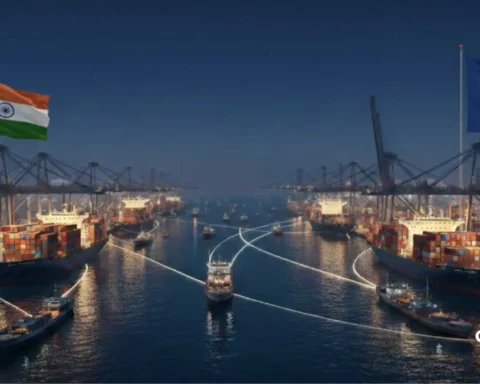
The geopolitical location of India, which gives access to more than 100 nations via both coasts through ports, assists in placing the role of India in the global supply chains as a crossroad between Indo-Pacific, Gulf, and European trade routes. This translates to additional India-connected trade deals, logistics requirements, and supply chain head office roles by the global Indian community in hubs such as Singapore, Dubai, London, and Toronto due to the growing role of India in global supply chains.

Policy Push: Make in India and PLI
Government policies like Make in India and the Production Linked Incentive (PLI) scheme have become the key pillars in empowering India with the global supply chain. The 14 sectors of mobile phones and semiconductors to pharmaceuticals and solar modules covered by the PLI schemes compensate through the scaling of production and exports to the companies, strengthening the position of India in the global supply chains as a manufacturing partner, not as a market.
Even the sectors supported by PLI have brought tens of billions of dollars of exports, which demonstrates that selected incentives could be turned into tangible benefits of the role of India in global supply chains. To diaspora entrepreneurs who have in the past channeled manufacturing via East Asia, such policies render it easier to locate factories, assembly plants, or sourcing activities in India and better connect with the role played by India in global supply chains.
Infrastructure, Logistics, and Digital Rails
An increase in highways, freight corridors, ports, and airports, as well as the enhancement of the Logistics Performance Index of India, is slowly making India more significant in the global supply chains. Improved multimodal connectivity decreases turnaround times and landed costs, which is essential to sectors that require time sensitivity, such as electronics and fast fashion, that rely on a robust role of India in global supply chains.
The digital infrastructure, including UPI, e-invoicing, and GST systems, introduces transparency and efficiency, facilitating supply chains that are compliance-intensive in the pharmaceutical industry, chemicals industry, and medical equipment industry. These digital rails also assist the small and medium enterprises (SMEs) to enter the game of India in the global supply chains with the assistance of platforms such as Amazon Global Selling, which connects the Indian sellers to the global buyers.
Diaspora as Connectors and Multipliers
The Indian diaspora, which consists of 30-35 million people, serves as a living bridge that enhances the role of India in the global supply chains. Huge remittance inflows of more than 130 billion dollars per year stabilise the external account of India and assist in financing imports of raw materials and capital goods needed to maintain the role of India in world supply chains.
In addition to monetary gains, diaspora professionals in C-suites, supply chain management, trade agencies, and multilateral organizations tend to raise the presence of India in the global supply chains by selling Indian destinations in boardrooms and policy discussions. To the global Indian community, this forms a virtuous circle: as their professional influence increases, so does the contribution of India to global supply chains, and as this contribution increases, the opportunities of global Indians and Brown professionals are again increased in terms of jobs, investments, and mobility on a worldwide scale.
What This Means for Global Indians
To the emigrant workers in the Gulf, more diversified and tech-based trade with India implies improved job prospects in logistics, ports, construction, and services relating to the rise in India in the world supply chains. For second-generation Indians in the US, the UK, Canada, and Australia entering careers in supply chain analytics, sustainable sourcing, and trade law, the growing importance of India to global supply chains makes India a domestic homeland into a professional opportunity.
India is the next stage of the role of the Indian in global supply networks: literally by investing in Indian start-ups in manufacturing, greentech, and digital logistics, the residing diasporas can co-create cross-border value chains. This increases both emotional and financial connections, and the role of India in global supply chains is less an abstract macro narrative but a lived eventuality that determines where global Indians work, invest, and envision their futures.
Challenges To India’s Supply Chain Ambitions
Even with the potential of the role of India in global supply chains being enormous, infrastructure gaps, regulatory complexity, and shortages of skills continue to restrain the potential of the role of India in global supply chains. The reliability of the power, logistics bottlenecks within the hinterland states, and different regulations across the states can increase the transaction costs and water down the attraction of the role of India in global supply chains by some investors.
The process of labour skilling must also keep up with the high-tech industries, such as advanced electronics, batteries, and semiconductors, in case the role of India in global supply chains is to climb further up the value ladder and not be stagnated in the low-margin assembly process. Once again, the global pool of talent, Indian, can come to the rescue: engineers, managers, and academics in foreign countries can introduce knowledge, partnership, and standards that can enhance the contribution of India in global supply chains in the long term.
Role of India in Global Supply Chains: A New Phase for World Trade
The importance of India in global supply chains is becoming a key element in the way the world trade will be restructured in the age of friendshoring, regionalisation, and digital business. The position of India in the global supply chains is a combination of market size, skills, and political stability, which is difficult to imitate as companies are looking to find reliable, democratic, and demographically young partners.
To the Indian and Brown world at large, this turn implies that their motherland is no longer a marginal producer but an actor in the system that shapes jobs, prices, and opportunities in other continents by its policies, capacity, and diplomacy. It is thus important to remain involved in discussions on trade policy, industrial strategy, labour rights, and sustainability, since they will not only determine the status of India in global supply chains, but also the lived fortunes of global Indians everywhere.
Conclusion
The growing role of India in global supply chains is changing the country from a services-focused economy to a center for manufacturing, logistics, and innovation. This shift is actively altering world trade patterns. For the global Indian community, it opens new opportunities to take charge in trade, technology, finance, and public policy. It also strengthens connections through remittances, investment, and ideas between their adopted homes and India.
As India’s role in global supply chains continues to develop, global Indians will see how events in Indian factories, ports, policies, and ecosystems directly affect their careers, savings, and identities abroad. Engaging with this change is essential. It plays a key part in building a fairer, more connected future for Brown communities worldwide.
FAQs
Which countries are the top destinations for these exports?
Services exports grew 8.65% from April to August 2025, playing an important role in total exports of USD 346.10 billion. By October 2025, combined exports reached USD 491.80 billion, an increase of 4.84%. This dual strength helps Brown communities by creating stable jobs in IT, consulting, and back-office support around the world.
How have electronics and engineering goods performed lately?
Electronic goods exports increased by USD 5.51 billion from April to August 2025. This growth was driven by efforts that raised production sixfold over the past decade. Engineering goods also grew by 5.86%, reaching USD 49.24 billion, with major markets in the US, UAE, and Germany. Diaspora professionals can take advantage of these trends to form partnerships in design, logistics, and quality control internationally.
How does this impact the global Indian diaspora?
Strong export growth keeps remittances over USD 130 billion each year. This money supports education and businesses back home. It creates opportunities for leadership roles, startups, and trade advocacy for second-generation professionals living abroad. For Brown families, this results in stable careers in logistics and technology, linking personal success to progress in their homeland.