




Are we witnessing the world’s momentum stall?
In some ways, this stalemate is misleading. While the grand forums stall, the real engine of diplomacy has shifted into smaller, more agile spaces: direct, one-on-one agreements between nations. Faced with complex modern challenges, major international organizations like the United Nations and the World Trade Organization seem mired in gridlock, unable to produce the decisive action the world needs.
The bilateral deals are where tangible progress is being made across trade and technology. This post will explore the most important truths about this new era of diplomacy, revealing how it works, who is winning, and what it means for the future of global relations.
Table of Contents
Consensus Paralysis
The fundamental problem with large-scale multilateral institutions is “consensus paralysis.” The need to get over 100 nations to agree on any single issue often leads to years of negotiation, resulting in watered-down compromises or, more frequently, a complete stalemate. But this is not the only factor. The system is also fractured by intense geopolitical rivalries, like U.S.–China tensions and the Russia-Ukraine conflict, and hampered by outdated frameworks designed for a post-WWII world struggling to address modern challenges like AI ethics and cybersecurity.
A critical example of this institutional gridlock is the World Trade Organization’s Appellate Body – its highest court for resolving trade disputes. It has been non-functional since 2019, leaving over 600 disputes unresolved and undermining the global trade system it was designed to protect. In this environment, waiting for consensus is a luxury few can afford.
Nations can no longer afford paralysis by consensus.”
– Global Indian Network

A Living Cycle
Many people assume that a diplomatic agreement is finished once the treaty is signed. The reality is that a successful bilateral deal is a continuous, living process that requires constant management. It’s not a single event but an ongoing cycle designed to ensure the agreement remains relevant, effective, and trusted by both parties.
This cycle consists of five distinct stages:
- Negotiation: Bargaining & Discussion.
- Agreement: Signing the Deal.
- Monitoring: Tracking Progress & Compliance.
- Implementation: Executing the Terms.
- Resolution: Handling Disputes.
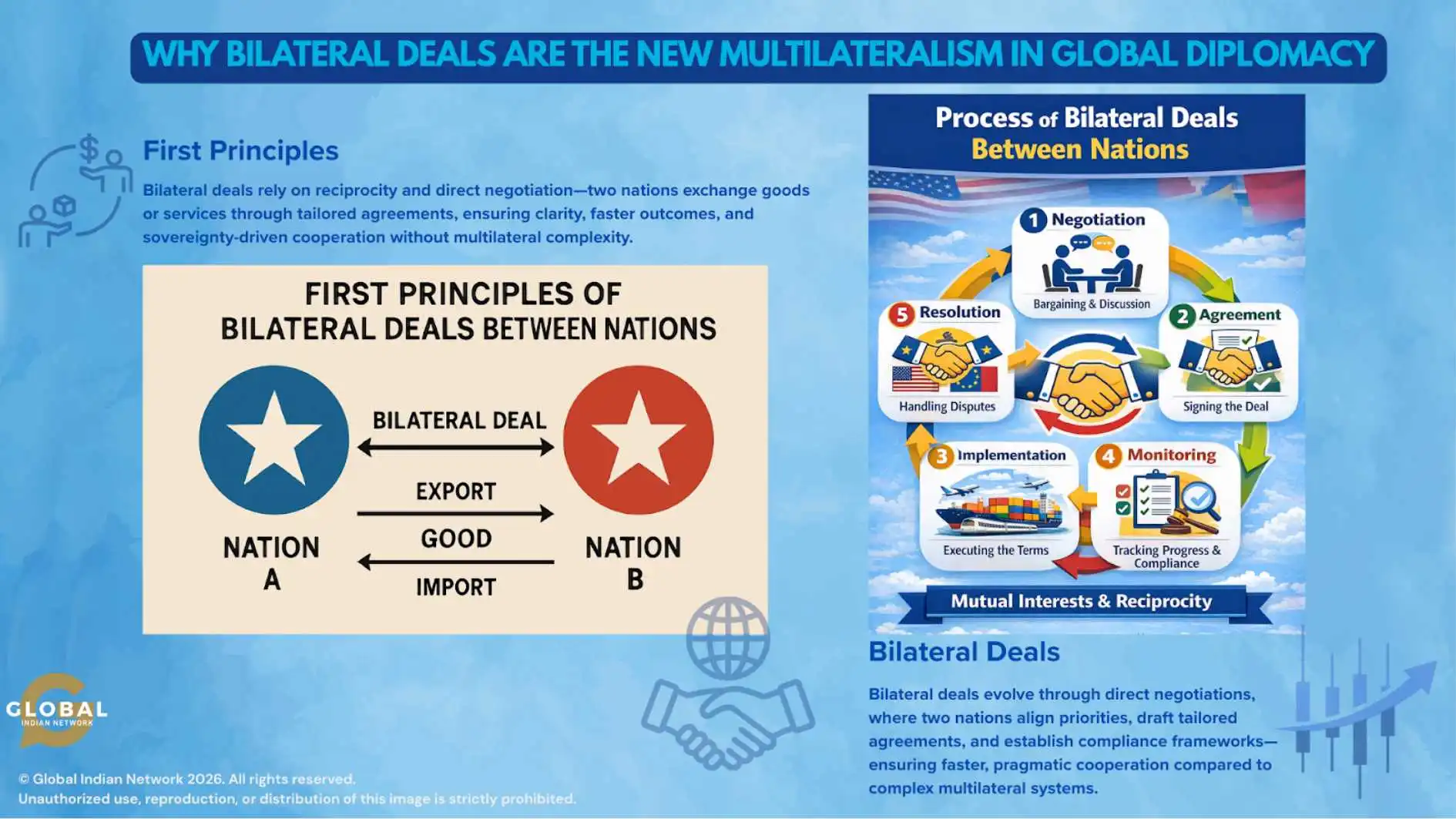
Underpinned by the principles of mutual interest and reciprocity, this cyclical process ensures agility and accountability, allowing nations to adapt to changing circumstances and resolve conflicts directly without sacrificing the core integrity of their agreement.
India’s Playbook
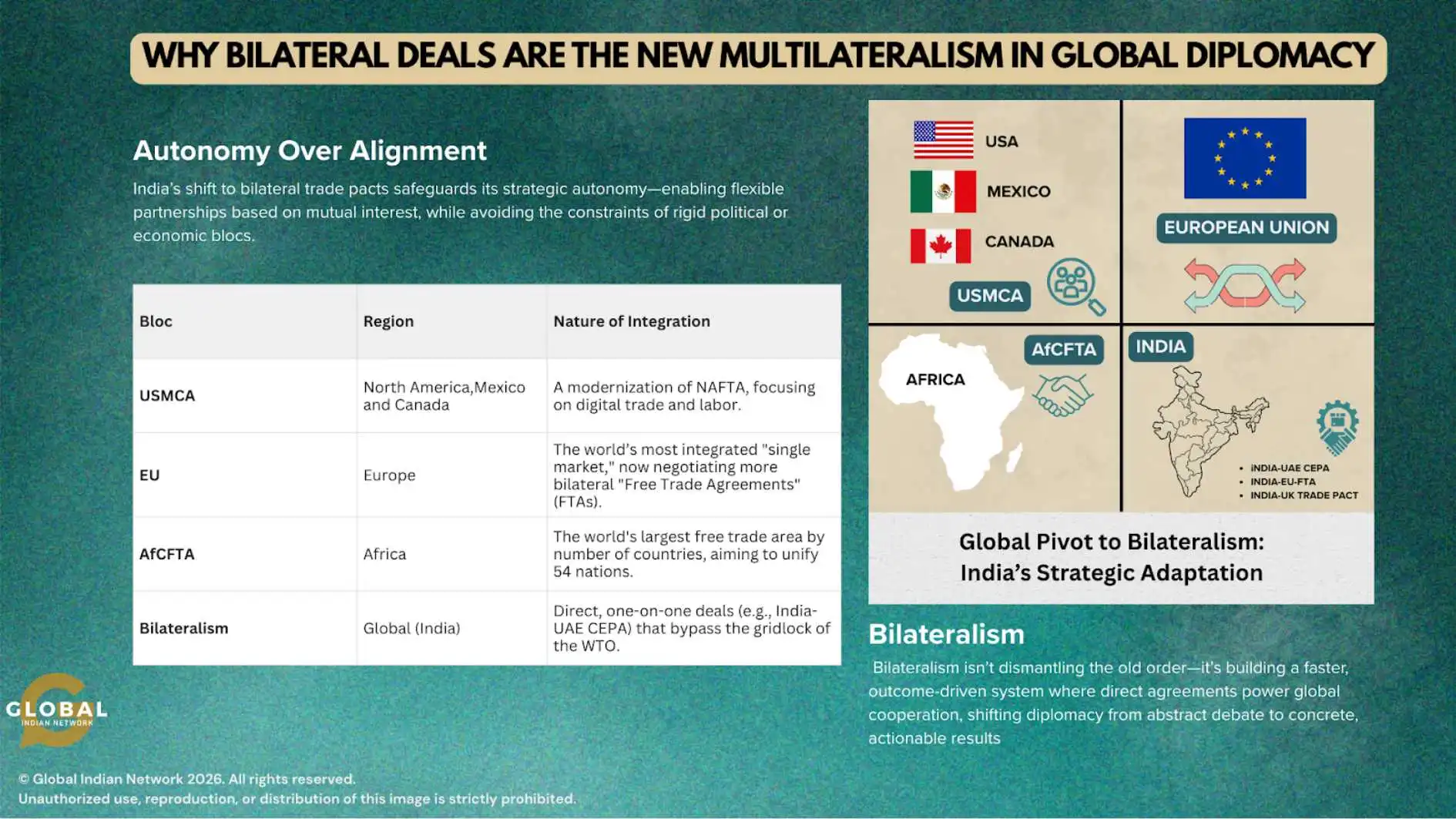
India is not just adapting; it is scripting the playbook for bilateralism, proving that autonomy and agility can coexist with global ambition. By bypassing stalled global talks, India has secured a series of high-impact wins that deliver tangible results for its economy and its people.
| Partner / Group | Agreement | Impact |
| UAE | CEPA | Aiming to double bilateral trade to $200 billion by 2032. |
| UK | Trade Pact | Projected to boost trade by $34 billion annually. |
| EFTA | Investment | $100 billion investment commitment to create 1 million jobs. |
This strategy allows India to maintain “strategic autonomy.” Instead of being locked into rigid political or economic blocs, it can choose its partners based on mutual interests, maximizing opportunities and reinforcing its independent standing on the world stage.
Global Trend
India’s pivot is not happening in isolation; it is part of a worldwide trend. The USMCA (U.S.–Mexico–Canada Agreement) replaced a decades-old multilateral pact with a more direct trilateral framework. The European Union is increasingly pursuing one-on-one trade deals with individual ASEAN nations. Even continent-wide initiatives like the African Continental Free Trade Area (AfCFTA) blend broad multilateral ambition with bilateral execution to make progress. These examples confirm that the shift to bilateralism is a global strategic adaptation.
The Biggest Risk Is a ‘Spaghetti Bowl’ of Rules
The primary argument against a world dominated by bilateral deals is the risk of creating what economist Jagdish Bhagwati termed the “spaghetti bowl” effect. This describes a messy, tangled web of thousands of individual agreements, each with its own unique rules, standards, and compliance requirements. For businesses operating globally, navigating this complexity can become a significant barrier to trade.
Beyond this core issue, two other key risks emerge:
- Exclusion: Smaller nations with less bargaining power may be sidelined by larger economies or pressured into accepting unequal terms in a “might makes right” scenario.
- Transparency: Unlike multilateral forums, which have established protocols for public oversight, bilateral deals are often negotiated behind closed doors, limiting public scrutiny.
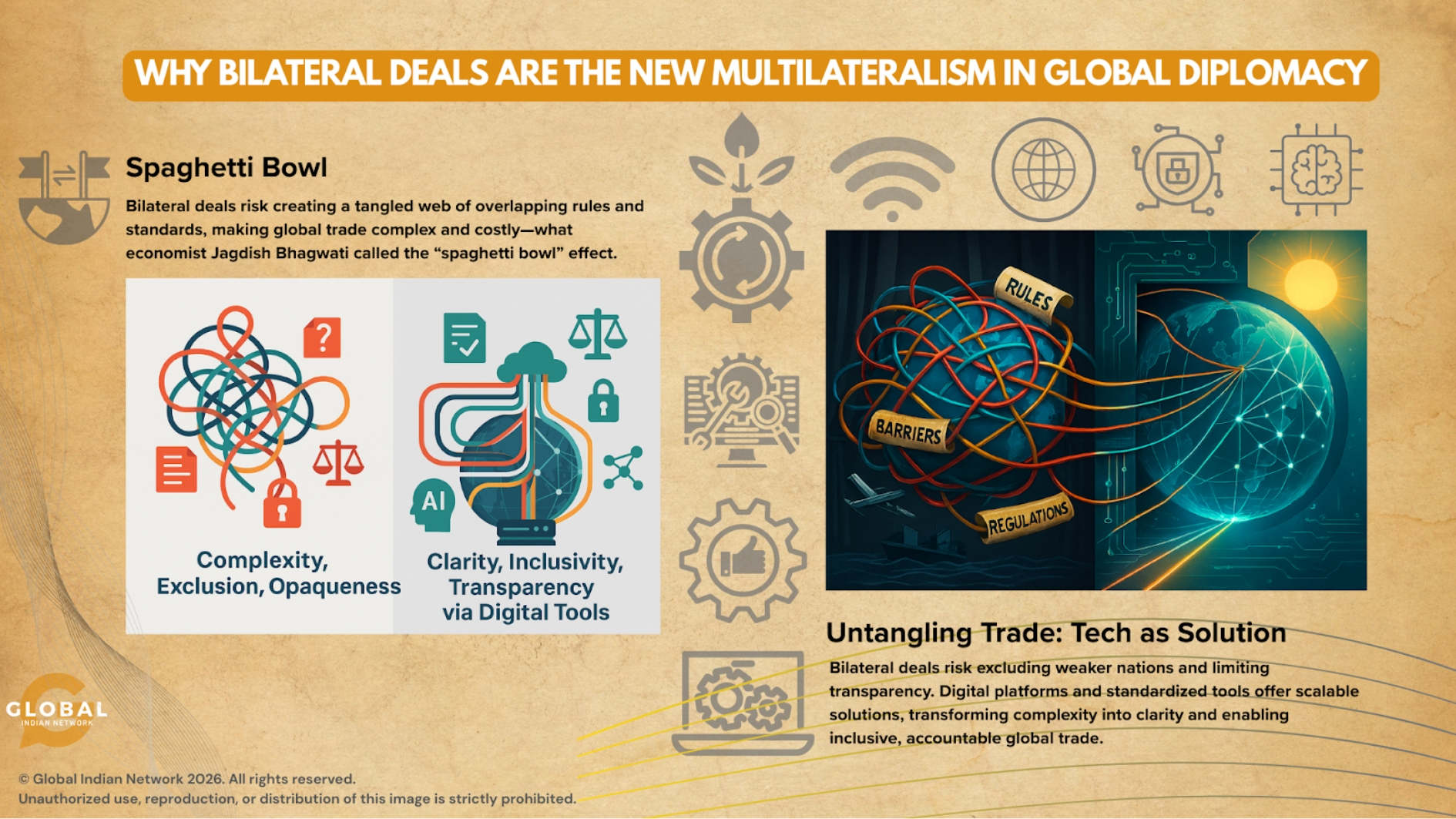
Digital trade platforms and standardized compliance tools can untangle complexity, making bilateralism scalable without chaos.
The Future is a Hybrid
The rise of bilateralism does not signal the death of multilateralism. Instead, it points to a new, hybrid model of global governance in which each approach plays a distinct and complementary role. The future of diplomacy is not a choice between one or the other but an integration of both.
In this hybrid system, the roles become clear:
- Multilateral forums like the Paris Climate Accord will continue to be vital for setting broad global “norms,” principles, and universal standards that carry international legitimacy.
- Bilateral deals will function as the practical “delivery mechanism,” providing the speed, precision, and flexibility required to implement those norms and achieve specific, measurable results.
This approach strategically reframes the potential chaos of the previously mentioned effect. What could be seen as a tangled mess of rules is, in fact, a flexible system of modular, issue-based diplomacy perfectly suited to a fragmented world.
Conclusion: Navigating the New Global Fabric
Bilateralism is not dismantling multilateralism – it is installing a hybrid fabric where global norms meet local delivery. The future of diplomacy lies in weaving these threads together.
This shift will shape everything from international trade and technology standards to travel and cultural exchange. Understanding this new architecture is no longer just for diplomats – it is essential for anyone navigating the modern global economy. As diplomacy moves from the big table to countless small rooms, who will be responsible for weaving all the individual threads into a coherent global fabric?We at the Global Indian Network are mapping this debate to bring transparency to all concerned, essentially, the global community. Stay with us.