



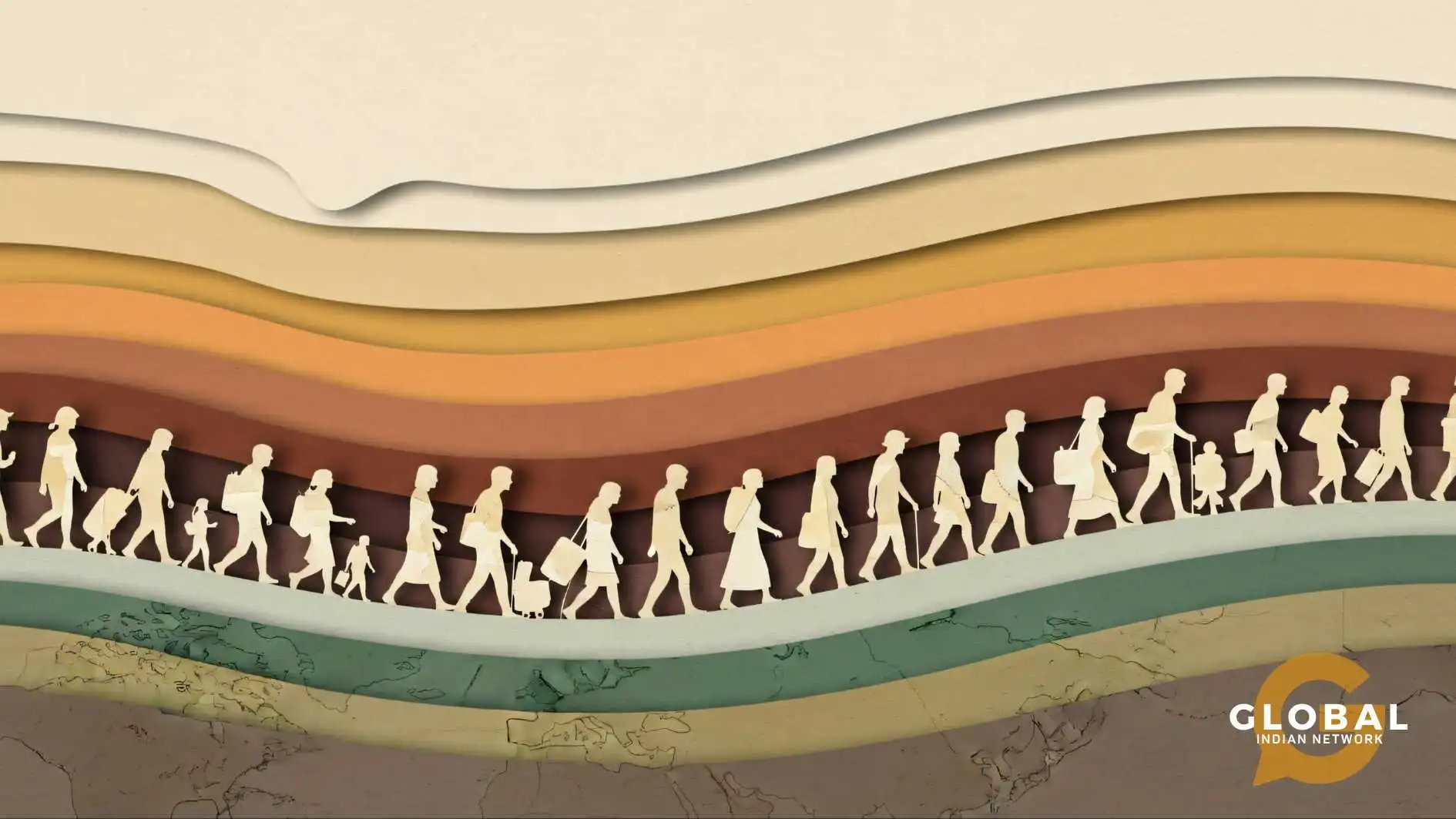

Migration patterns in the Global South are changing economics, politics, and daily life in Asia, Africa, Latin America, and the Middle East. For the global Indian and Brown community, these changes influence where people migrate, how remittances are sent, and how identity, power, and opportunity are dealt with in a fast-changing world.
Table of Contents
What the Global South Means for Indians
The Global South is the broad term that is used to refer to low- and middle-income nations of Asia, Africa, Latin America, the Caribbean, and some parts of the Middle East that have a common history of colonialism, underdevelopment, and unequal incorporation into the global economy. These states are not only consumers of power in the new world order anymore: they are participants in trade, climate diplomats, migration governors, and South-South collaborators too.
To the Indian people, commencing with a global Indian community, it is imperative to know more about the Global South since Indian migrants do not merely migrate towards the US, UK, and Europe but also migrate in large numbers within the Global South, particularly to the Gulf, Southeast Asia, and Africa. This implies that migration patterns in the Global South are directly connected with Indian livelihoods, remittance flows, and political influence.

Migration Patterns in the Global South
The migration patterns in the Global South are becoming more and more indicative of the fact that migration is no longer South to North but rather South to South. Research has estimated that South-South migration is on a par with South-North migration, with close to fifty percent of the migrants in third world nations being in another third world country.
Migration patterns in the Global South are evident in major corridors: India-Gulf, India-Southeast Asia, Bangladesh-India, and Nepal-India, where millions of people go to work, trade, and even pursue education. These migration patterns in the Global South define the world around us: who constructs the cities of the Gulf, who works in African hospitals, who operates the small businesses of Kenya, Mauritius, or Malaysia.
Labour, Remittances, and the Brown Worker
The construction, domestic work, manufacturing, and services are the main factors that have facilitated labour mobility as a characteristic of migration patterns in the Global South. GCC countries harbor millions of Indian, Bangladeshi, Pakistani, and Nepalese workers, who constitute one of the largest South-South migration flows in the world.
The Global South migration patterns have become a lifeline to the home economies through Remittances. Remittances do represent over one-fifth of GDP in certain countries of the Global South, usually well beyond state expenditures on education and health, a trend that is observable in countries such as Nepal and Tajikistan. In the case of India, diasporic remittances, particularly to the Gulf and other Global South destinations, are important in terms of household consumption, social mobility, and regional development.
India, Diaspora Power, and the New Order
The Indian diaspora is the largest on Earth, counting tens of millions of people living overseas, and a large percentage of them, once again, are found in Global South nations, including the UAE, Saudi Arabia, Qatar, Malaysia, South Africa, and Mauritius. According to official estimates, of the GCC alone, about 6 million Indians are employed in semi-skilled and low-skilled jobs that provide the basis of the local economies.
The new world order is becoming multipolar, and the newly emerging powers, the global South, India, China, Brazil, South Africa, and others, are now having more influence in trade regulations, finance, technology, and security. This new order is the result of and the determinant of migration patterns in the Global South during negotiations of labour agreements, regulations on remittances, and policies on diaspora engagement by states. Research and panels on changes in world order point out that states are now employing migration and diaspora in smart ways as a part of diplomacy and soft power.
To the global Indian and Brown community, this will be translated into increasingly formalized migration channels, electronic remittance systems, and new platforms on which the voice of the diaspora can be heard in bilateral relationships, whether in Gulf capitals or African regional hubs. Meanwhile, migration patterns in the Global South require more protection, including greater consular protection, labour rights, and gender-sensitive policies to make sure that migrants are addressed as people with rights and not as economic units.
Why Global Indians Must Watch These Patterns
Migration patterns in the Global South are changing the human landscape of the 21st century. The Indian diaspora and the larger Brown community are central to this shift. As power spreads and a new global order emerges, South–South movement, remittances, and diasporic networks will increasingly impact national economies and the identity, culture, and political voice of global Indians.
For communities from Dubai to Durban, Toronto to Thiruvananthapuram, critically engaging with migration patterns in the Global South is ultimately about protecting dignity, increasing opportunity, and making sure that a changing world order reflects the dreams of Brown lives across borders.
FAQs
What are Migration Patterns in the Global South?
Migration patterns in the Global South refer to the movement of people mainly between countries in Asia, Africa, Latin America, and the Middle East. This movement often happens for work, education, or safety. These flows are not only from South to North; a significant portion is South to South, where migrants move between developing countries that have shared histories and similar income levels.
Why should the global Indian community care about Migration Patterns in the Global South?
The global Indian community plays a key role in these movements. Millions of Indians live and work in Gulf countries, Southeast Asia, and Africa. Changes in migration patterns in the Global South impact jobs, remittances, labor rights, and how Indians are viewed and treated in these areas.
How big is South–South migration compared to South–North migration?
Research suggests that South-to-South migration is nearly as large as, and in some estimates slightly under half of, all migration from the Global South. This means that migration patterns in the Global South are just as important as movement to countries like the US or Europe, but often get less media attention.