


Across vast stretches of Africa, a haunting silence prevails, as if entire communities have vanished. The grim reality is that the population in some areas is shrinking, with lives lost to conflict, famine, and disease, leaving ghostly emptiness behind.
The value of human life is slipping through our fingers like grains of sand, eroding steadily as time marches on. In an era marked by astonishing technological advances and global interconnectedness, one would expect our reverence for life to deepen. Yet paradoxically, violent conflicts rage on, humanitarian crises multiply, and unequal empathy fractures our shared humanity.
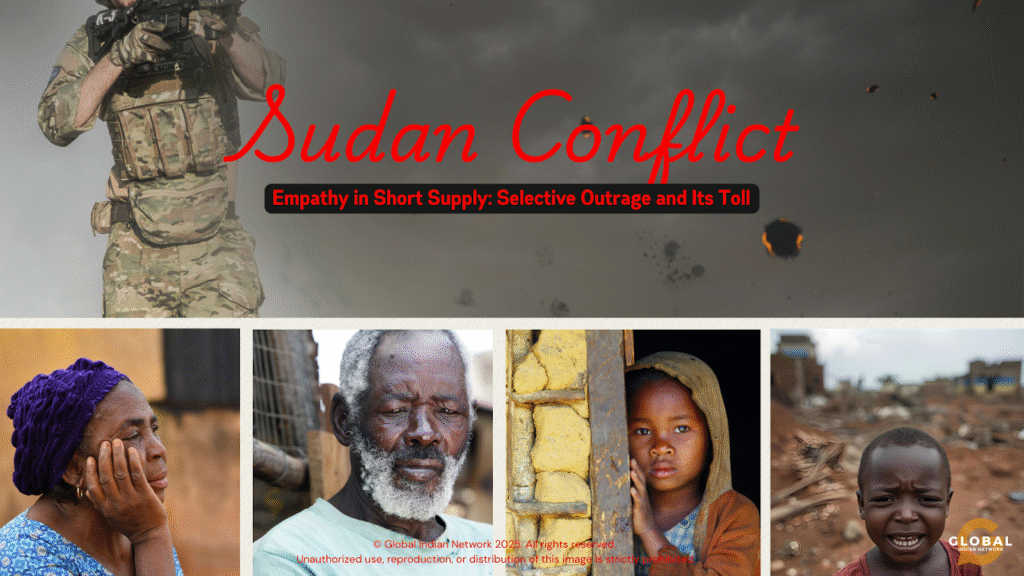
The war in Sudan offers a painful testament to this erosion, a place where millions of lives are reduced to statistics, where black Muslim civilians endure unspeakable atrocities met with surprising global silence. The gradual erosion of human dignity in Sudan compels us to ask: how did we arrive at a world where some lives merit urgent protection and outcry – and others, despite equal suffering, barely stir a whisper?
This article explores this unsettling reality through the lens of global Indians, urging reflection and a renewed commitment to universal human values before it fades beyond repair.
Table of Contents
The Scenario: Ongoing Conflict in Sudan
The conflict in Sudan, which reignited in April 2023 between the Sudanese Armed Forces (under General Abdel Fattah al-Burhan) and the Rapid Support Forces (RSF led by General Mohamed Hamdan Dagalo – known as Hemedti), has led to widespread devastation. The international response to Sudan’s civil war is marked by selective attention and a muted reaction, even from communities such as the Indian community abroad, contrasting sharply with the attention given to other global crises like Palestine.
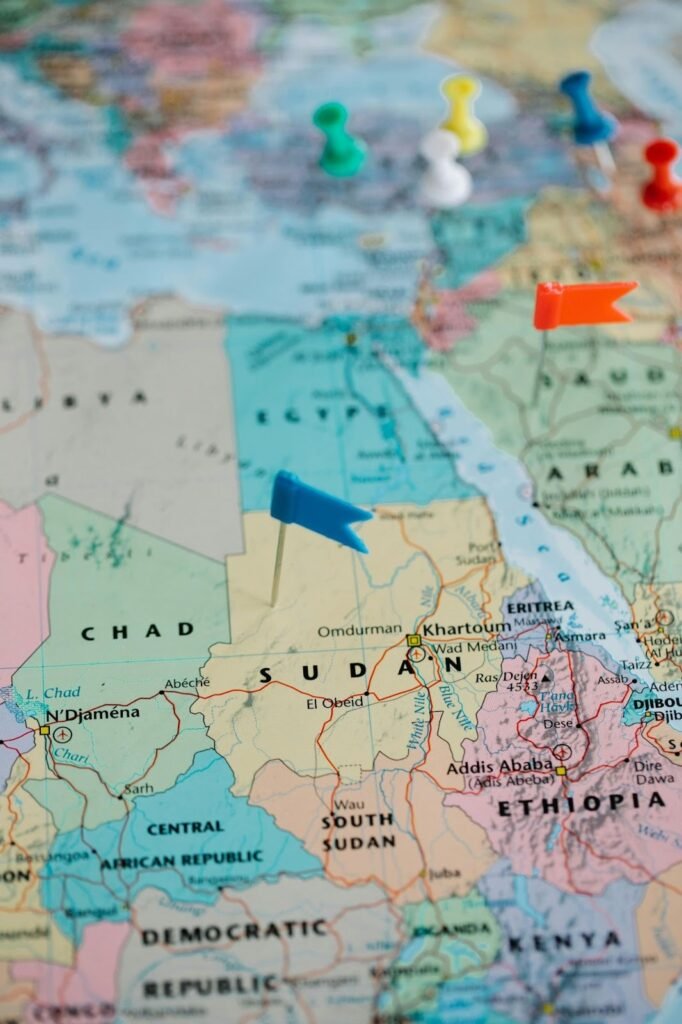
With over 14 million people displaced and tens of thousands killed, Sudan now faces the most significant internal displacement crisis in the world. Civilians endure indiscriminate attacks, brutal human rights violations, and acute shortages of food, medicine, and basic services. The country’s economy has collapsed, inflation soars, and famine threatens millions.
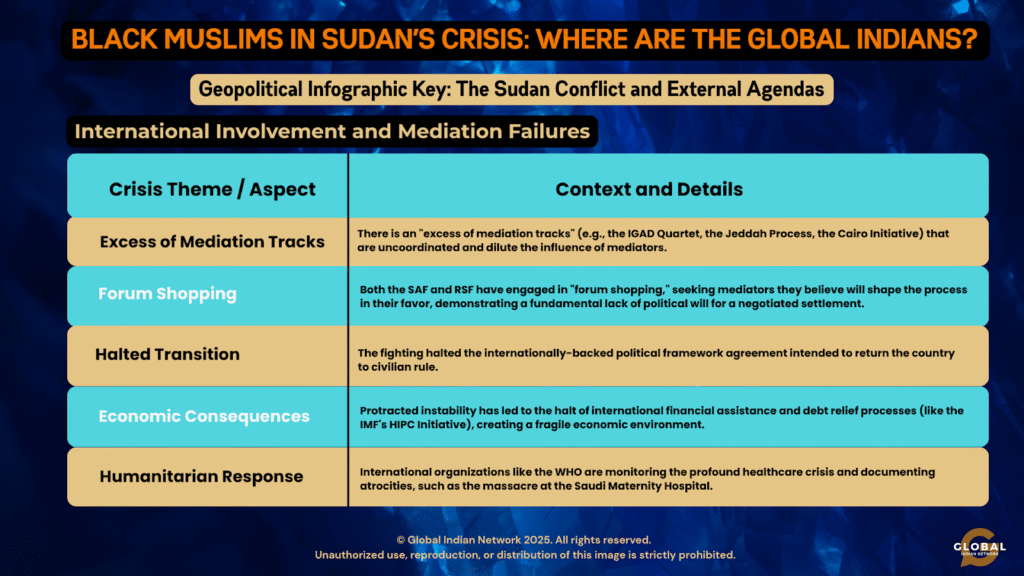
Despite the catastrophic humanitarian toll, international diplomatic efforts have had limited success, with outside powers sometimes exacerbating the violence through vested interests and arms supplies.
Note: The 14 million displaced people in Sudan are comparable to the entire population of the Indian state of Bihar or a small country like Tunisia, emphasizing the vast scale of the humanitarian crisis. This comparison highlights the enormity of displacement, with a population size large enough to represent either a country or a significant Indian state in transition.
The Timeline
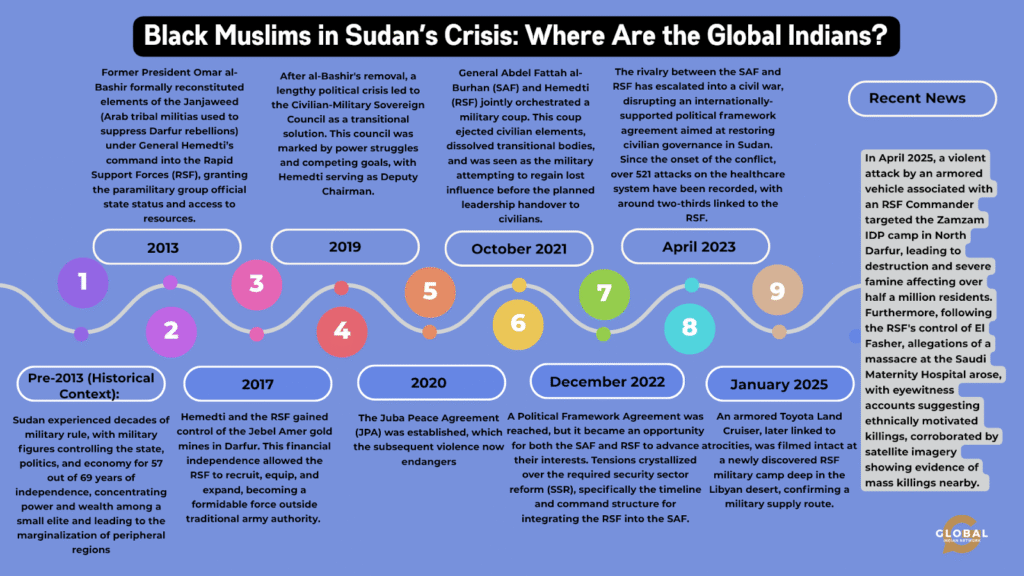
A war does not suddenly happen. The brewing starts much before the first shot is fired. Below, is a geopolitical timeline detailing the Sudan crisis from the pre-2013 marginalization to January 2025 and beyond. It traces the evolution of the RSF’s power from its role in the Janjaweed to its role in the 2019 transition. Key events include the October 2021 coup and the start of the April 2023 civil war, concluding with recent news on RSF atrocities.
The Brutal Statistics
At the Global Indian Network, we dig deep to unearth statistics that provide the clarity needed. Here is what we found:
• Over 30 million people in Sudan require humanitarian and protection assistance.
• This figure represents almost two-thirds of the population.
• The conflict between the Sudanese Armed Forces and the Rapid Support Forces primarily drives the crisis.
• The conflict escalated in April 2023, leading to thousands of fatalities and injuries.
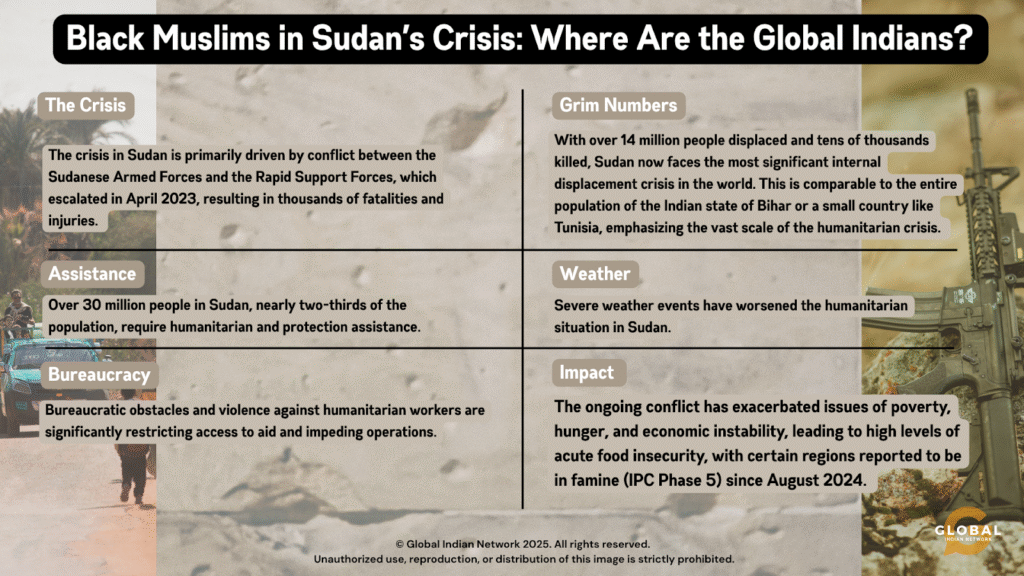
• The ongoing conflict has worsened pre-existing problems of poverty, hunger, and economic instability.
• Severe weather events have worsened the humanitarian situation in Sudan.
• High levels of acute food security have been reported, with some areas experiencing famine (IPC Phase 5) since August 2024.
• Bureaucratic obstacles and violence against humanitarian workers are severely limiting access to aid and hindering operations.
Not moved yet? Brace yourself for more.
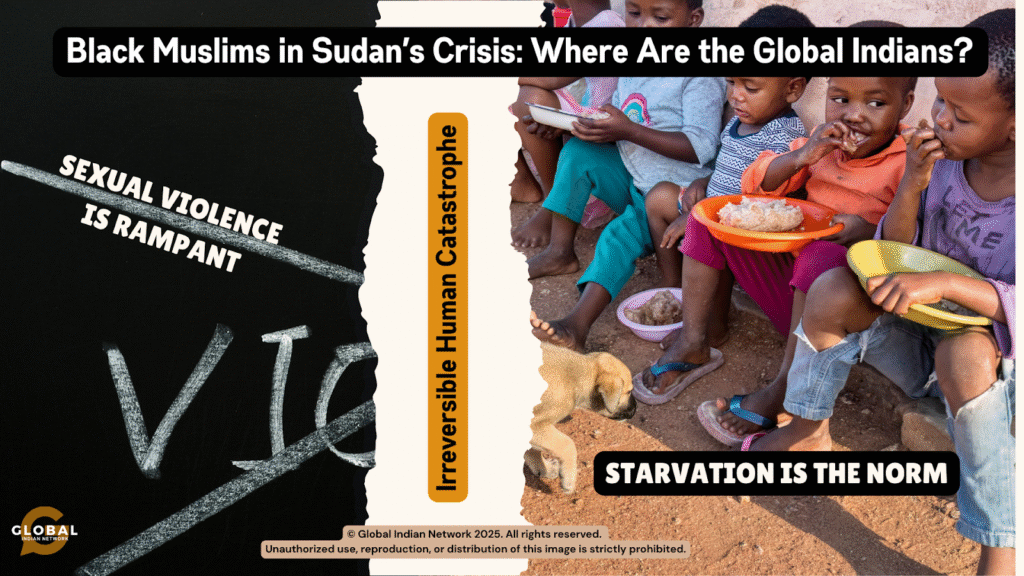
Irreversible Human Catastrophe
Amid the cataclysm, the people of Sudan bear an unbearable burden. Women, children, and displaced families face horrors daily – from sexual violence to starvation to the trauma of displacement. Humanitarian agencies struggle to provide aid amid violence, with relief workers often barred or targeted. Information blackouts and media suppression worsen the crisis by limiting global awareness.
The world’s marginal response to this reality is an indictment of global priorities and the politics of attention. For global Indians, as for all global citizens, this should be a clarion call to expand their circle of concern beyond narrow communal solidarities and stand firmly against injustice wherever it exists.
Proxy War and Gold Control
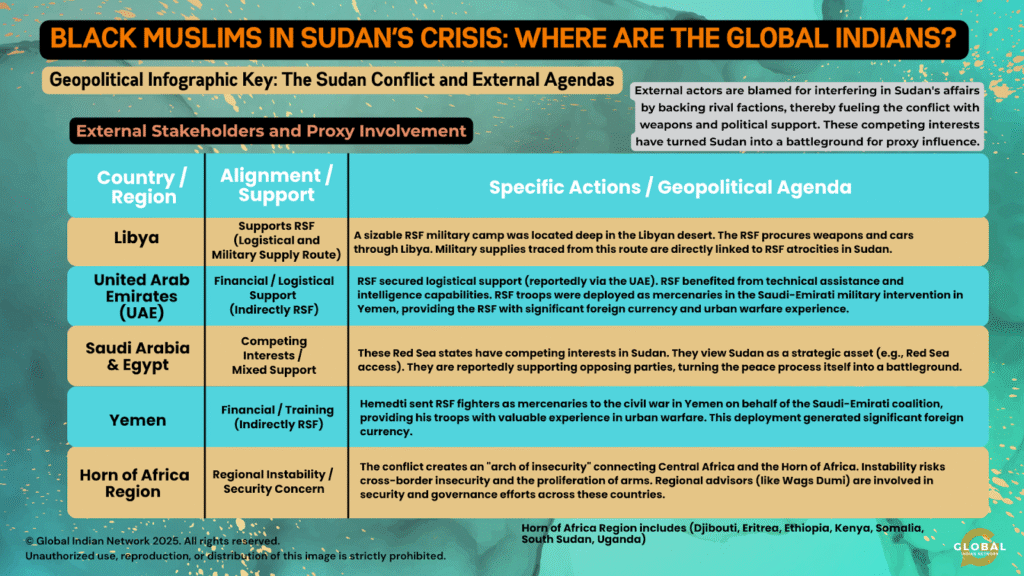
The ongoing power struggle in Sudan is fundamentally driven by the SAF and RSF’s conflicting objectives for political and financial dominance, with a key focus on resource control, notably the country’s rich gold reserves. The conflict is being prolonged and intensified by the active participation of regional powers (including the UAE, Egypt, and Saudi Arabia) through the provision of military and economic assistance. This foreign involvement has transformed the internal crisis into a destabilizing proxy conflict with persistent security and economic consequences for the region.

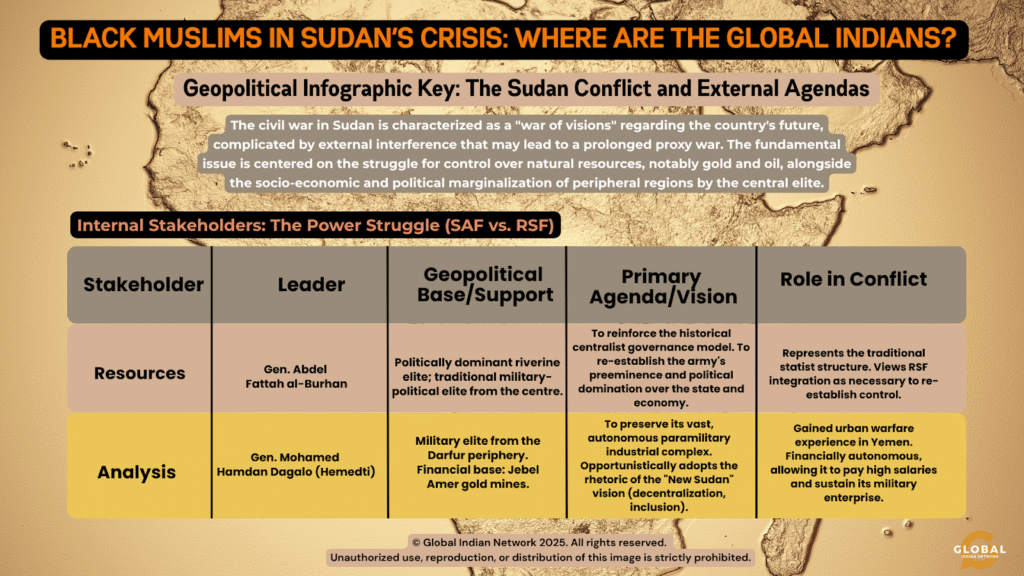
Geopolitical Infographic Key: The Sudan Conflict and External Agendas
The ongoing civil war is viewed as a “war of visions” for Sudan’s future state architecture. It is complicated by significant external interference, risking a descent into a long-term proxy war. The core structural cause remains the control of natural resources (gold and oil) and the subsequent socio-economic and political marginalization of the periphery by the dominant central elite.
India’s Official Stance on Sudan
What has been India‘s role?
India’s official stance on Sudan is shaped by pragmatism and caution, as well as by deep historical and economic ties. India’s investments in the region, especially in oil and infrastructure, plus tens of thousands of Indian nationals trapped in the conflict zone, have driven the government’s priority towards evacuation and citizen safety.
Operation Kaveri, launched to rescue Indians stranded in Sudan, saw naval ships and airlifts brought into action, coordinated with international partners. Economically, India is a major consumer of Sudanese resources and has longstanding relationships dating back to Sudan’s independence. Yet its diplomatic response has remained measured, avoiding strong public denunciations or interventionist policies.
Important Voices
The Sudan crisis has prompted diverse international reactions, particularly from India. A comprehensive perspective incorporates insights from Indian diplomats and Sudanese activists, creating a more nuanced and empathetic understanding of the situation.
The Sudanese Ambassador to India expressed profound gratitude to India for its humanitarian assistance amid the turmoil. He described how the militia’s campaign deliberately targeted medical infrastructure, with 80% of hospitals rendered non-functional, making India’s aid indispensable.
The Indian government actually supplied 25 tons of medicines by a special air force flight right after the outbreak of war,”
– Sudanese Ambassador to India Muhammad Abdalah Ali Eltom
From the Indian diplomatic side, the Ministry of External Affairs spokesperson Randhir Jaiswal emphasized the importance of respecting international diplomatic norms amid escalating violence in Sudan.
India has raised serious concerns over the worsening security situation, particularly following attacks on diplomatic premises in Khartoum.”
– Ministry of External Affairs spokesperson Randhir Jaiswal
Stories of Survival, Connection, and Courage
Sudanese civil society voices, though harder to access due to the violent conflict, implicitly call for broader global solidarity beyond state diplomacy. Their plight demands amplification by global Indians and others worldwide who have the platforms and privileges to do so. Sudanese activists and citizens caught in the relentless crossfire underscore the human cost beyond numbers: families torn apart, education halted, and fundamental rights obliterated. Their realities remind the global Indian diaspora of the need for empathy beyond borders and identities.
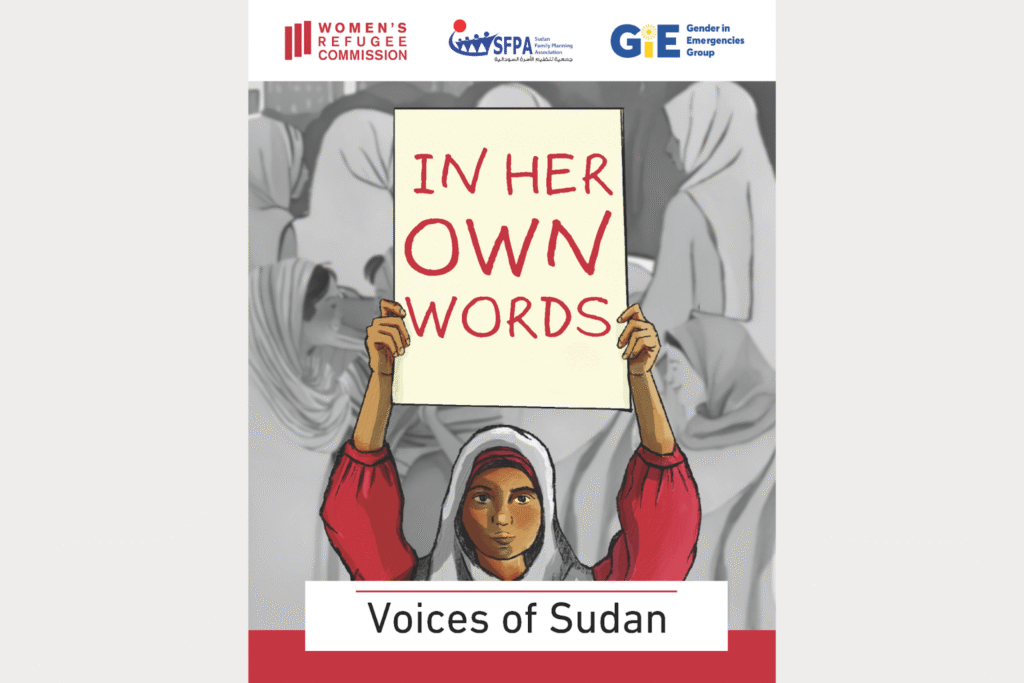
Here are stories that could give an insight into the tales of millions of others.
Sudanese Stories
- Arafa, 25, was at home with her two children during the outbreak of fighting in Khartoum, where her husband was killed. She fled with her children, enduring a lengthy journey by bus and on foot before reaching Egypt as a refugee.
- Ardjoune Oumda Yahya and her eight children escaped from Zamzam camp in North Darfur to Eastern Chad, facing nearly two weeks of extreme hunger and fear during their journey.
Indian Stories
- The Indian community in Sudan has a history of over 150 years, dating back to the arrival of trader Luvchand Amarchand Shah from Aden in the early 1860s.
- In April-May 2023, thousands of Indians were evacuated from Sudan during Operation Kaveri.
Organisation Stories
- The International Rescue Committee (IRC) reports that over 12 million people have been displaced due to the war in Sudan. The report includes the narrative of Khamissa, a 70-year-old grandmother, who rescued her grandchildren and walked for days to reach an IRC health centre.
- Médecins Sans Frontières (Doctors Without Borders) refers to first-person accounts from refugees who arrived from Ardamatta, detailing their experiences of war and displacement, particularly a mother with her child.
The humanitarian actors emphasise not only the numbers but the complex conditions – collapsed health systems, mass displacement, and severely limited resources.
We at the Global Indian Network spoke to David Wamugo Wagacha, a Conflict Security Researcher with a focus on the Horn of Africa. He told us,
The Sudan conundrum is due to vested interests of various local and external parties. At stake are land control and use and extractive resources, such as gold. access to international waterways and ports; and historical identity issues also add to it.”
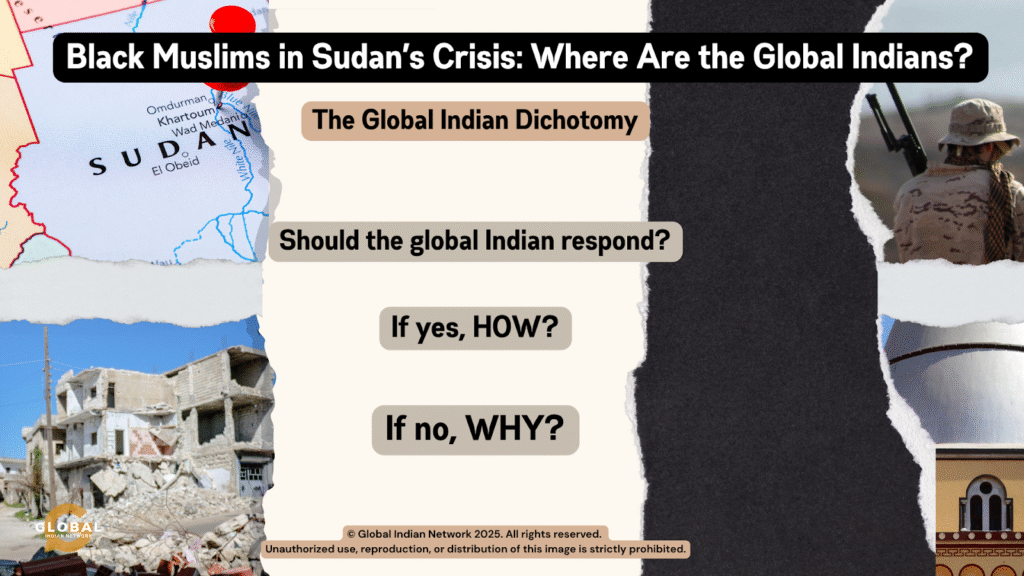
The Global Indian Dichotomy
We call out the selective exclusion of underprivileged communities worldwide.
How can the global Indian community extend its compassion to Sudan with the same strength shown elsewhere?
Should the global Indian respond?
If yes, HOW?
If no, WHY?
The measured approach contrasts with the passionate global Indian activism witnessed around the Palestine conflict, which shares ethnic and religious ties with many in the Indian Muslim collective.
When brown Muslims in Palestine suffer, the global Indian community mobilizes loudly and convincingly. But when black Muslims in Sudan face indiscriminate killings and genocide, the response is subdued. This painful disparity underscores selective empathy shaped by identity politics and geopolitical narratives. The silence is not just a failure of global attention but a profound challenge to the ideals of universal justice and humanitarianism that global Indians have often championed.
As a progressive platform, we raise questions where required to advance overall human well-being worldwide. The question the Sudan saga raises is a difficult but necessary one:
Is the differential response to Sudan’s black Muslim suffering a reflection of racial and religious biases?
An Opportunity
From a kinship-group perspective, this moment is an opportunity for the global Indian community to broaden the scope of its advocacy and activism. If solidarity is to transcend convenient ethnic and religious affinities, then issues like Sudan must be front and center, not just as distant crises but as urgent moral imperatives.
Global Indians occupy influential economic, cultural, and political roles worldwide; their voices could amplify the Sudanese plight, press for fair humanitarian aid, and push for broad, unbiased global engagement. The community’s response could serve as a bridge of empathy, expanding the narrative from identity politics to shared humanity and holding space for all oppressed peoples regardless of race or religion.
Reflective Questions for the Global Indian Community
If the shared faith and ethnicity of Palestinians galvanized an empathetic and vocal global Indian response, why has the suffering of Sudan’s black Muslim population not stirred comparable action?
This is not a question of blame, but of possibility. For many, the opening is in plain sight.
Our probe intends to challenge global Indians to embody their ideals with courage, compassion, and unwavering commitment to justice on the world stage. The tragedy unfolding in Sudan demands nothing less.
Call to Action for Indian Policymakers
From a global Indian perspective, the contrast in response (or the lack of it) demands reflection:
Why does the suffering of Sudan’s black Muslim population not ignite the same outcry as that of other conflicts?
The proposed approach intertwines official diplomacy with grassroots human experiences, highlighting the complexities and aspirations of the Sudan crisis from a global Indian perspective. It underscores India’s role and advocates a fair global conscience, grounded in compassion, pragmatism, and self-reflective activism.
A strong concluding call to action for Indian policymakers on the Sudan crisis should emphasize urgent humanitarian leadership, strategic diplomatic engagement, and a principled stance on global justice. It could be framed as follows:
Indian policymakers must recognize Sudan not only as a strategic partner but also as a test case for India’s commitment to responsible global leadership and ethical foreign policy in an era of complex conflicts. Beyond the immediate priority of evacuating Indian nationals and safeguarding economic interests, India should catalyze sustained diplomatic effortsworking alongside the African Union, the UN, and international partners—to push for an inclusive ceasefire and peace dialogue.
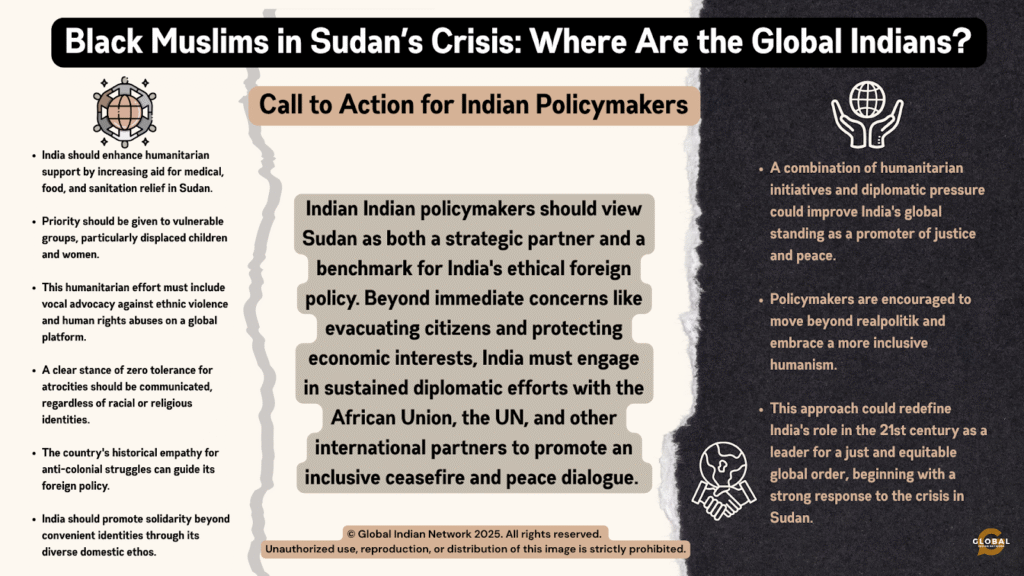
India must elevate its humanitarian support with increased aid for medical, food, and sanitation relief inside Sudan, prioritizing vulnerable groups like displaced children and women. This humanitarian approach should be coupled with vocal advocacy on the global stage against ethnic violence and human rights abuses, signaling zero tolerance for atrocities irrespective of racial or religious identities.
Importantly, Indian policymakers should lead by example in reshaping global empathy frameworks, calling out selective attention to crises based on race or religion and affirming that India stands for universal justice and dignity for all oppressed peoples. India’s unique historical empathy for anti-colonial struggles and diverse domestic ethos can inspire a forward-looking foreign policy that champions solidarity beyond convenient identities.
The Sudan crisis is a profound opportunity for India to assert itself as a principled, humanitarian power bridging divides with action and voice. It should transform compassion into coordinated action, ensuring that neither India nor the global community turns a blind eye to the black Muslim tragedy unfolding in Sudan. This is not only a diplomatic imperative but a moral one, demanding courage, conscience, and leadership from New Delhi.
India’s diplomatic approach balances humanitarian efforts, such as sending supplies and evacuations, with a policy of non-interference. However, as the crisis in Sudan escalates, India may need to reassess its stance. By merging humanitarian actions with diplomatic pressure on conflicting parties, India could enhance its global image as a proponent of justice and peace in complex geopolitical contexts.
This call to action enjoins Indian policymakers to rise beyond realpolitik calculations and embody the inclusive humanism that can redefine India’s role on the world stage in the 21st century. It challenges India to be a beacon for a more just, equitable, and empathetic global order, starting with a robust, compassionate response to Sudan’s urgent crisis.
Conclusion
In conclusion, the Sudan crisis, from a global Indian perspective, reveals both a humanitarian disaster and a test of conscience. India’s role remains focused on citizen safety and measured diplomatic engagement, but the global Indian community’s response offers a crucial space for leadership. By asking why some lives provoke global uproar while others languish in silence, the community can embrace a broader, more inclusive approach to justice and activism. The global Indian voice could be a catalyst for heightened awareness, pressure for peace, and empathetic solidarity with all victims of conflict, irrespective of race or religion.
Despite its flaws, humanity holds the remarkable potential to dream of a world free of discrimination and racism. But what if we choose not to dream? If apathy wins and the saga of injustice continues unchecked, then progress becomes a distant illusion. To achieve the transformative change required, we must elevate our collective consciousness, seeing ourselves not as separate factions but as an interconnected whole.
Carl Sagan eloquently reminded us, “The cosmos is within us. We are made of star-stuff.”
This poetic truth reveals that beneath all superficial divisions, we share the same ancient cosmic heritage. Recognizing this profound unity can spark the empathy and courage needed to dismantle the walls of prejudice. It is only by awakening this shift in awareness that we can ignite real change, honor every human life equally, and create a future where the value of all lives is cherished without exception.
The choice to dream and act rests with us. Each one of us.