




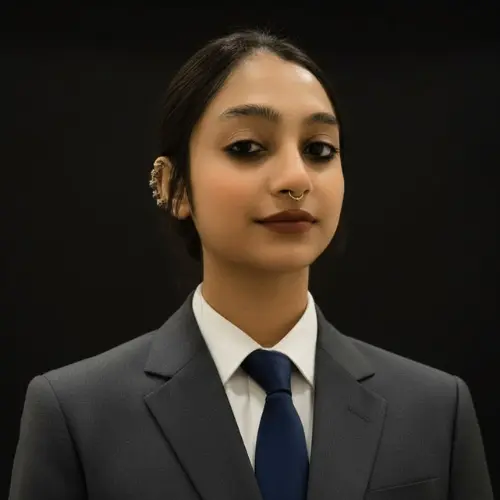
Aishwarya Rai. A name you thought belonged only to cinema, Sanjana Thakur pries it open. She rethreads it into a daughter’s hunt for a mother inside a shelter where care is chosen like a specific fruit at a bazaar. The absurdity is deliberate. Beneath it, a wound. When Sanjana Thakur chose to name her story Aishwarya Rai, she cracked open an icon that has for decades been shorthand for unattainable beauty, the dream-face stamped across hoardings and media glam alike.
In her story, this name becomes grotesque, even hilarious, because it is placed inside the unlikeliest of arenas- a shelter where young women select the mothers they wish to be raised by, what she calls “reverse adoption”. What does it mean to audition mothers? What does it mean to treat maternal care as something you can customize and discard? It is at once satirical and sorrowful, asking whether our cultural obsessions with appearance and idealized roles have corroded even the most fundamental relationships. The tale contorts absurdity till it turns intimate, till the jest frails under the tremor of its weighted disguise.
Table of Contents
Who is Sanjana Thakur?
Sanjana Thakur was born in Mumbai twenty-six years ago, and though the city remains her first landscape, her education carried her far beyond it. Childhood there meant learning to read human expressions as quickly as traffic lights, a skill that stayed with her long after she left. Her schooling carried her out of that noise and into the halls of Wellesley College, where she studied English and Anthropology. From there, she moved again, this time to Texas, entering the MFA program in Fiction at the University of Texas at Austin. That journey-Mumbai’s compact streets, Massachusetts’ academic rush, and Texas’ horizons has shaped her into someone who belongs everywhere and nowhere at once.
Mumbai lives in Thakur’s prose like a second pulse. Even after years in America, studying anthropology and literature at Wellesley, then immersing herself in the rigors of an MFA program in Austin, her work does not abandon the city. It slides into her sentences through the bittersweet violence of monsoon downpours and the grief of apartment corridors. And yet, this is not nostalgia. She does not write as one yearning for return.
Instead, she writes as one haunted by distance, by the absurdity of living between two worlds that cannot reconcile. This in-betweenness is fertile for her fiction. It becomes a stage where cities transform into phantoms, where the memory of a place exerts as much force as the place itself. To read her is to enter a geography of dislocation, where home feels close enough to touch yet impossible to inhabit fully.

Satire Sharpened Into Elegy
Critics may attempt to label Thakur’s work as satire, fabulism, or postmodern irony, but the truth resists compression. Her stories refuse genre obedience. They’re not comic. They’re not tragic. They are both, at once, like laughing while your throat still tastes of salt. A mother obsessed with celebrity cheekbones. A daughter making a choice no child should make. Ridiculous, yes.
But that ridiculousness is how pain slips in without knocking. It sneaks through the side door of absurdity, wearing the mask of humour, only to strip it away when you’re least prepared. The laughter becomes uneasy, tinged with the knowledge that something darker is pressing against its edges. Her fiction thrives in that unstable middle ground, where irony magnifies affliction, where the grotesque can be tender, and tenderness itself can turn uncanny.
Her work has appeared across journals that are themselves eclectic, such as Granta, The Rumpus, The Adroit Journal, The Hindustan Times, The Southampton Review, and Michigan Quarterly Review.
Why, For Sanjana Thakur, Winning A Prize Isn’t, But Detonating A Door Is The Real Act
The Commonwealth Short Story Prize is, of course, prestigious. The headlines emphasize it- Sanjana Thakur, winner, chosen from thousands. But to reduce her achievement to the medal alone would be simply lazy. Indian writing in English has too often been pushed into predictable grooves that include myth retellings, partition epics, nostalgia, and a predictable mystery. Thakur’s victory announces a different possibility- that Indian fiction can be surreal, can be experimental without alienating, can be humorous without being trivial, and sagacious without pretension. She has widened the corridor for those who follow, proving that global recognition can come to those who refuse to conform to global expectations.
The Echo of the Global Indian Community: A Diaspora Reading Between Worlds
Across continents, the global Indian community reads writers like Sanjana Thakur with a peculiar ache; an ache born not of nostalgia but of dissonance. For those who left home and those raised in its shadows abroad, her fiction mirrors the quiet dislocations that colour their everyday lives. The diaspora knows too well the feeling of being stitched between geographies, fluent in multiple worlds yet claimed fully by none. Thakur’s work becomes a compass not pointing anywhere but reminding them that the journey itself is the geography. For global Indians, her stories are less literature and more a long-distance pulse returning home.
Conclusion
In another time, readers expected guidance and clarity, but Sanjana offers none of these. What she delivers instead is a reminder that literature is not a mirror, but a weapon, and sometimes the sharpest weapons look like feathers that tickle your feet. To read her is to accept defeat. You will not master her pages, you will not walk away with a tidy explanation. You are left holding fragments, jagged and unarranged.
That is her refusal, and her gift.
She denies your neatness with complete ease.

FAQs
What is the prize for Sanjana Thakur?
Sanjana Thakur received the overall 2024 Commonwealth Short Story Prize, which included a £5,000 cash award.
What is the Commonwealth short story of Sanjana Thakur?
The winning piece is titled “Aishwarya Rai”.
How old is Sanjana Thakur?
Sanjana Thakur is 26 years old.
Where can readers find “Aishwarya Rai” to read for themselves?
The story “Aishwarya Rai” is available online through Granta, which published all the regional winning entries of the 2024 Commonwealth Short Story Prize.