


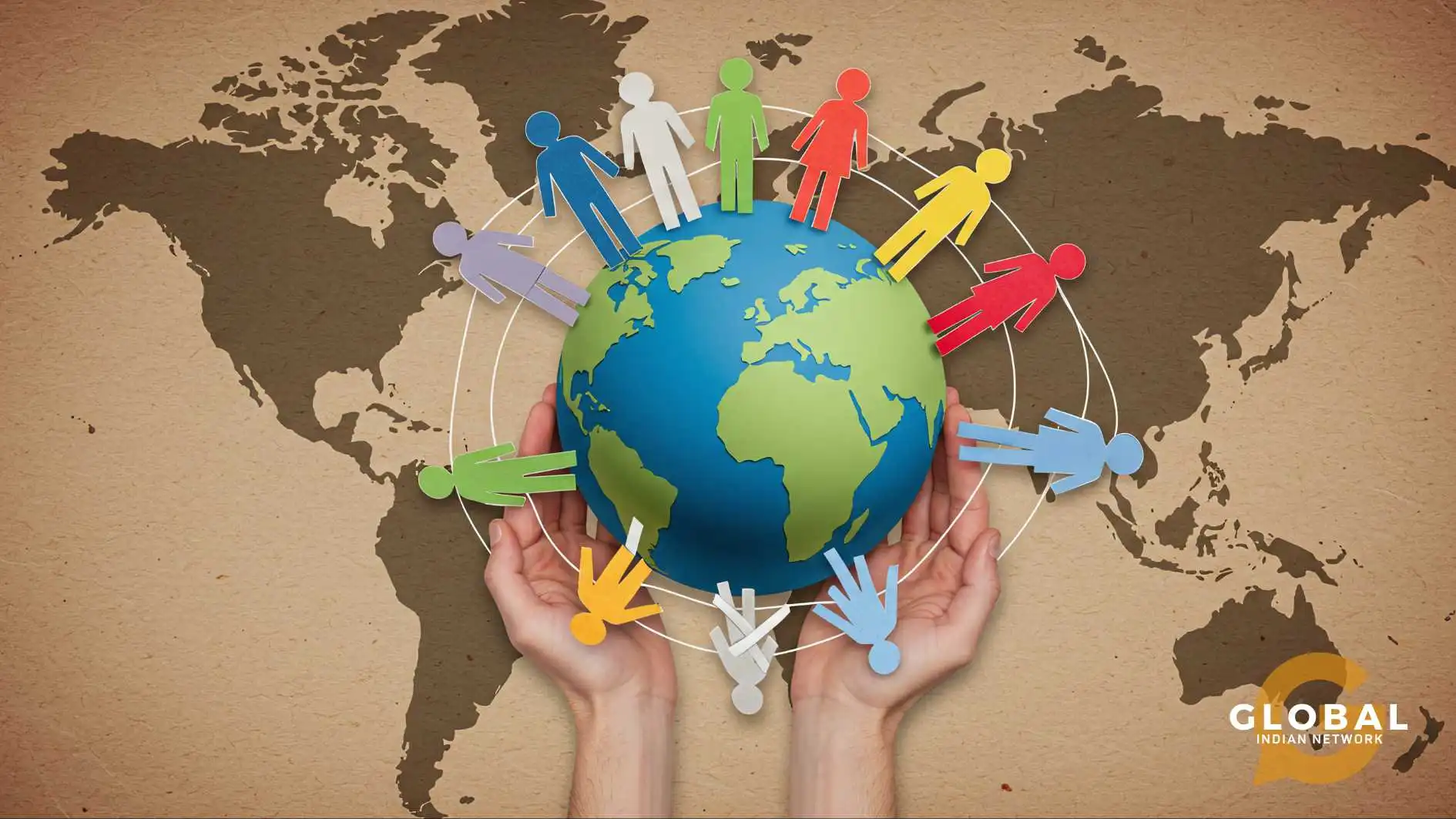

World migration reshapes global religion. The world’s migrant religious composition offers an important view for understanding faith, identity, and movement among diaspora communities, particularly global Indians. Indians and Brown migrants in the Gulf, North America, Europe, Africa, and Asia-Pacific deal with temple-building, mosque networks, and the identity of the second generation in this changing landscape. This situation shows how religious minorities from India contribute to significant changes in the world’s migrant religious makeup, affecting Brown lives everywhere.
Table of Contents
World’s Migrant Religious Composition: The Big Picture
Christians dominate the world’s migrant religious composition at 47% followed by Muslims at 29%, Hindus at 5%, Buddhists at 4% and Jews at 1%, with 13% being religiously unaffiliated. This world’s migrant religious composition is the result of colonialism, flows of labor, refugee crises, and post-1960s immigration reforms in the West.
For global Indians, the world’s migrant religious make-up is reminiscent of history (indentured labor to the Caribbean and Africa, Gulf migrations from Kerala and Uttar Pradesh, skilled IT/medical outflows to the US, UK, Canada, and Australia). Hindus, a population of 15% of the world’s population, are under-represented in the migrant religious landscape of the world since the vast majority of them remain in South Asia and especially in India, the leading emigrant-sending country on the planet.
Yet, the transportation of religious diversity that this world offers points to South Asian diasporas creating thriving infrastructures, Gurdwaras in Canada, Hindu temples in the US and in Fiji, mosques in the Gulf, that turn suburbs into a transnational faith center for Brown communities. Global Indians maintain these spaces in the face of economic pressures and thus create cultural continuity and community resilience in the changing migrant religious landscape of the world.
Christians, Muslims, Jews, and Where Global Indians Fit
The number of migrants outstrips the world average of Christians, and the highest level of migration is among Jews, 1 in 5 of whom live outside the country. In India’s context within the world’s migrant religious composition, Christians (2% of the population) comprise 16% of Indian-born emigrants, and Muslims (15% at home) form one-third abroad.
This skew in the world’s migrant religious composition places global Indians at the heart of faith-driven migration narratives. Kerala nurses and Hyderabad IT workers embodied Indian faces in the Gulf and the West, and diversified the religious makeup of migrants in the world into other stereotypes, other than a Hindu-dominant one.
In the case of the global Indian community, the global migrant religious formation requires an inclusive advocacy where Goan Catholics, Telugu Christians, and Gujarati Muslims are part of the global image of India. Such groups use faith networks as an element of mutual support, which shapes policy and belonging in host countries.
Mapping Faith and Power: Host Countries and Gatekeepers
Host countries shape the world’s migrant religious composition by attracting co-religionists, Israel for Jews, Saudi Arabia for Muslims, and the US/Germany for Christians. Borders reflect faith preferences, amplifying certain streams in the world’s migrant religious composition.
Global Indians face complex realities, including Hindus/Sikhs as religious minorities in the West, and Muslims as victims of Islamophobia or kafala in the Gulf. Religion is a weapon of politics, whether it is Christian migrant refugees or Muslim migrant suspicion, which has a direct impact on Brown migrants in the migrant religious amalgamation of the world.
The Indian-origin politicians use temples, mosques, churches, and gurdwaras to lobby, provide charity, and construct narratives, transforming religion into political power in the migrant religious makeup of the world. Such a strategic application will assist global Indians to avoid discrimination not only in regard to caste, but also in regard to minority rights, whereby the voices of the community are heard worldwide.
Lived Realities: Faith, Belonging, and Global Indian Diaspora
Daily life embodies the world’s migrant religious composition through prayer accommodations, holidays, and interfaith bonds for Indian families. Gurdwaras offer langar and legal assistance, mosques facilitate organization, and temples also offer language and matrimonial services.
Second-generation global Indians are bargaining the turban in European schools, hijabs in US campuses, tilaks in Australian offices, and the religious symbols in the race battles. Statistics highlight the migrant religious make-up in the world: the Indian emigrants are 41% Hindu in a foreign country as opposed to 80% in the mother country, with minorities being over-represented.
The migrant religious make-up of this world works with divergent images of Indians, Punjabi Sikhs in Canada, Tamil Hindus in Malaysia, East African Gujarati Muslims, which confront the monolithic notions and make the diaspora solidarity stronger. It promotes communalism, race, and cross-South Asian alliances discourses among Brown youth.
Conclusion: Why This Matters for Global Indians
The world’s migrant religious composition equips diaspora strategists with insights on minority over-representation and faith’s governance role abroad. It breaks down the myths of Indian = Hindu to all the Brown faiths in the story of migration. Community organizers rely on this migrant religious makeup of the world to predict vulnerabilities, build anti-Islamophobia or caste discrimination alliances, and lobby visa/citizenship controversies.
In conclusion, Christians and Muslims lead the world’s migrant religious composition, with Hindus, Buddhists, and Jews carving influential niches. To global Indians, such a migrant religious makeup of the world is an indication of power structures, both Gulf labor reforms and Western asylum, a call to confront.
The brown communities should use this knowledge to defend a variety of streams, create transnational relations, and write the migration future in their own language, and every religion of the Indian diaspora will flourish beyond borders. The world’s migrant religious composition is not just data; it’s a blueprint for global Indian resilience and influence.
FAQs
What defines the world’s migrant religious composition?
The world’s migrant religious composition shows the religious makeup of international migrants. According to 2020 data, 47% are Christians, 29% are Muslims, 5% are Hindus, 4% are Buddhists, 1% are Jews, and 13% are unaffiliated. This composition reflects migration patterns shaped by history, economics, and policy. It directly influences faith communities for global Indians living abroad.
Why are Christians the largest migrant group?
Christians make up the largest group among the world’s migrants due to colonial histories, labor migration from Latin America and Eastern Europe, and refugee movements to Western countries. In Brown communities, Indian Christians from Kerala contribute to this trend, representing 16% of Indian emigrants even though they account for only 2% of India’s population.
How do Indian minorities fit into the world’s migrant religious composition?
Indian emigrants tend to be minorities: Muslims, who are 15% in India, represent one-third of those living abroad. Christians account for 16%, while Hindus drop from 80% to 41% of the diaspora. This part of the global migrant religious makeup changes the way people view Indians, from Gulf nurses to US professionals.