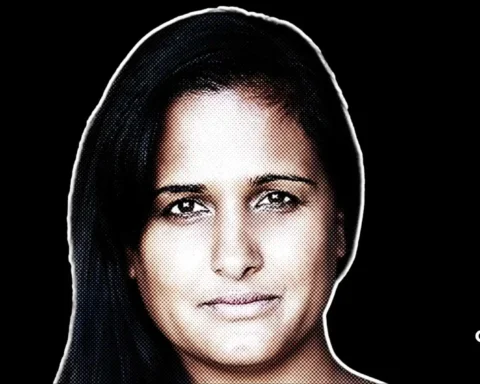





Indira Varma’s career resists categorisation. She is a woman of many worlds, both on and off screen- a performer equally at home in Shakespearean tragedy, political thrillers, galaxy-spanning sci-fi sagas, and intimate period dramas. Her talent is harboured in a multicultural upbringing and honed through fearless role choices, and has earned her a reputation as one of the most adaptable and compelling British actresses working today.
Table of Contents
A Heritage that Shaped Indira Varma’s Art
Born on 27 September 1973 in Bath, Somerset, Varma grew up in a household where artistry was part of daily life. Her father, an Indian illustrator from Hyderabad, and her mother, a Swiss graphic designer with Genoese Italian heritage, exposed her to a broad visual and cultural vocabulary from a young age. Her childhood was filled with influences that consisted of a Swiss-Indian coalition of a homely warmth from the Indian side, a sharp precision of the Swiss, and their fusion of culture.
These layers of different nationalities were deepened by travel. The Varma family took trips that were both adventurous and grounding, like exploring India’s Ajanta and Ellora caves, summering in Switzerland’s mountains, tasting authentic fondue by Lake Geneva, and the sensory variety of street markets in Asia. These, according to her, were formative experiences that helped her in character building and taught her to appreciate the unfamiliar and to adapt to any setting, instead of luxury time-passes.
Discovering Indira Varma’s True Self
Varma’s early interest in performance wasn’t immediately obvious. She first explored mime and physical theatre as a teenager before stepping into acting. Youth theatre in Bath offered her the chance to experiment with characters, voices, and physicality. This passion took her to London’s Royal Academy of Dramatic Art (RADA), where she honed her skills and graduated in 1995.
Just months out of drama school, Varma landed her first major film role in Mira Nair’s Kama Sutra: A Tale of Love. It was a bold debut, sensuous and artistically challenging, that made clear she was unafraid of risk. Then she proceeded to act in Jinnah and Bride & Prejudice.

Breaking Through on Screen
From there, Varma built a screen career that defied pigeonholing. She became known to international audiences with the role of Niobe in HBO’s Rome, where she portrayed a woman torn between love, duty, attachment, and survival in the politically treacherous Roman Empire. Later, as Ellaria Sand in Game of Thrones, she pursued both seduction and vengeance, capturing global attention in a series famed for its complex female characters.
Her screen presence extended to acclaimed series such as Luther, Patrick Melrose, Obsession, and Obi-Wan Kenobi, where she entered the Star Wars universe with characteristic gravitas. She has also lent her voice to video games, notably Dragon Age: Inquisition, and narrated audiobooks, including works by Terry Pratchett, proving that her command over an audience isn’t limited to physical performance.
The Power of the Stage
While television and film have made her a household name, the theatre is where Varma’s versatility often burns brightest. Her stage credits span classical and contemporary works, from Twelfth Night to Harold Pinter plays. And this theory was proved to me when I watched her act in Macbeth, “We will proceed no further”. In 2020, she won the Olivier Award for Best Supporting Actress for her performance in Present Laughter, alongside Andrew Scott.
Her performances are noted for balancing emotional truth with theatricality and bringing intimacy to grand venues and boldness to small ones. The gravity she owns is beyond description. I wonder how one can hold such a command on stage.
A Voice Beyond Acting
Indira Varma’s creative gifts don’t stop at acting. She’s also a passionate storyteller and writer. In her book, Lest We Forget: How Three Sisters Braved the Partition, she went deep into a painful chapter of South Asian history, not through cold facts or dates, but through the lived experiences of women who endured unimaginable hardships. What makes her work stand out is the way she breathes life into these stories, honouring the power, fear, hope, and fortitude of ordinary people caught in extraordinary times.
It’s clear that Varma cares deeply about shining a light on voices that have long been ignored or silenced in mainstream history. Storytelling isn’t just about recounting events for her; rather, it’s about connecting us to the humanity behind them, reminding us of the might of memory and empathy. Through her writing, she invites readers to feel, remember, and understand, making history personal and profoundly relevant today.
Curiosity of a Playful Spirit
Describing herself in three words- ‘competitive, curious, silly’, Varma embodies a rare combination of professionalism and frolicsome. She believes in ‘the courage to fail’, inviting projects that challenge her skills rather than simply maintain her profile. This willingness to experiment keeps her work fresh.
She also speaks candidly about her own life. In interviews, she’s discussed navigating the entertainment industry as a woman of colour, confronting casual racism, and rejecting the limitations others try to place on her career. Her openness has made her a relatable figure to many aspiring performers.
Conclusion
In this industry of a certain ‘type’, Indira Varma moves fluidly between genres, mediums, and roles. She is as convincing in the intimacy of a theatre monologue as she is in a large-scale fantasy battle. Her life, which is shaped by travel, heritage, and fearless curiosity, mirrors her art: impossible to reduce to a single identity.
Indira Varma’s career continues to evolve, but one thing is certain: she belongs to that rare group of performers whose work transcends categories. Whether in the brightness of a stage spotlight, the action and cut of a cinematic frame, the voice in our headphones, or the language that captures another dimension of history, she reminds us of the boundless possibilities of artistry.

FAQs
What ethnicity is Indira Varma?
Indira Varma is of Indian and Swiss-Italian descent. Her father belongs to an Indian family, whereas her mother belongs to a Swiss one.
What is Indira Varma known for?
She is known for her versatile acting career across film, TV, and theatre. Some of her famous roles include Ellaria Sand in Game of Thrones, Freya in Luther, and Niobe in Rome. She’s admired for playing strong and varied characters with depth.
Are there any Indian actors in Game of Thrones?
Yes, Indira Varma, who has Indian heritage, appeared as Ellaria Sand in Game of Thrones.
What season of Game of Thrones is Indira Varma in?
Indira Varma appears in Season 6 of Game of Thrones as a key character in the later storylines.