


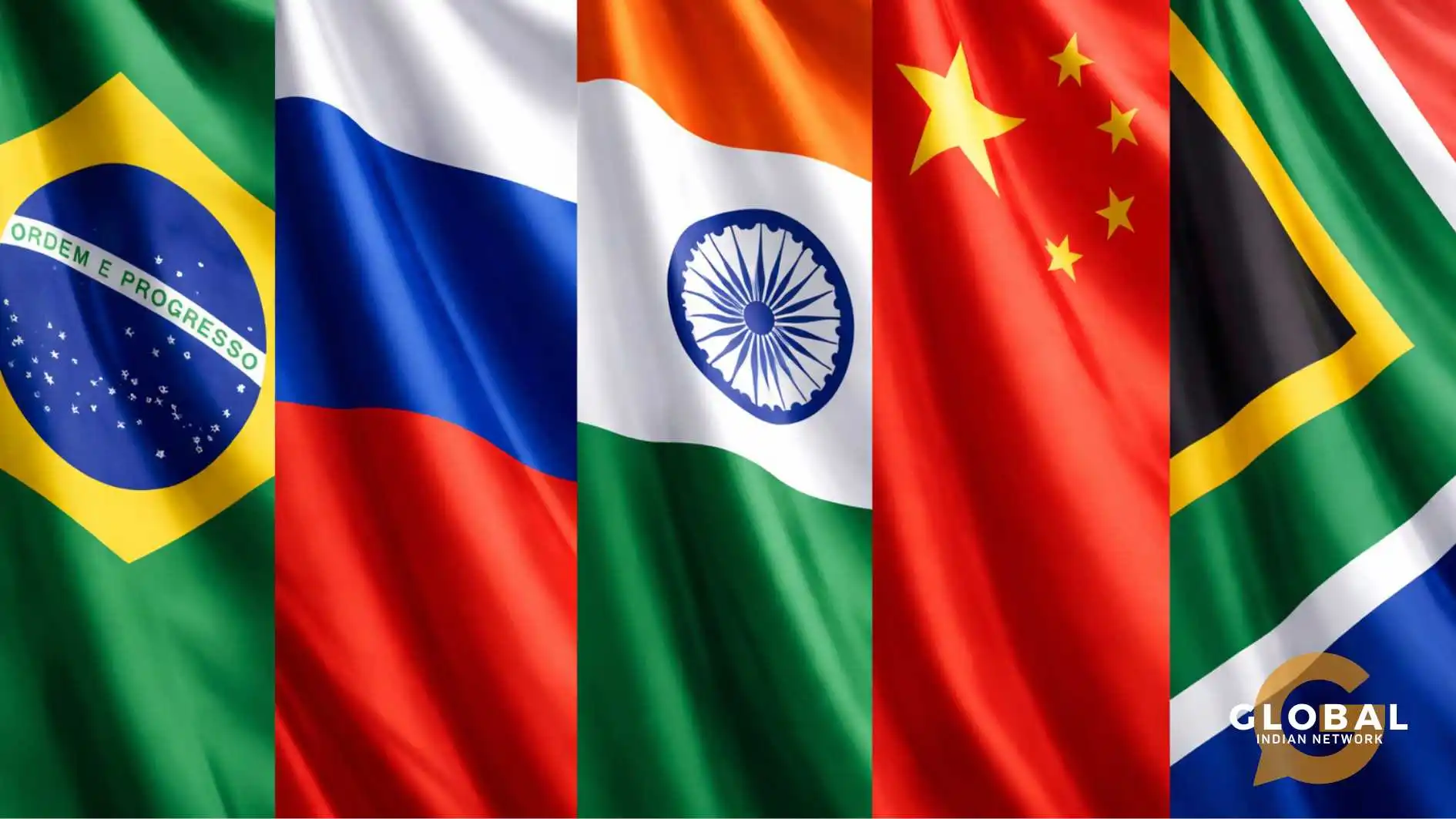

The current moment for BRICS expansion, with India as an important player, is a key juncture between hopes for greater South-South cooperation and concerns about potential dilution and geopolitical tensions as BRICS expands. At the same time, India expects to achieve economic resilience while also worrying about becoming overstretched in a multipolar world.
Table of Contents
BRICS Expansion and India: Expansion Overview
Initially composed of Brazil, Russia, India, China, and South Africa, the BRICS were set to add Egypt, Ethiopia, Iran, Saudi Arabia, the UAE, and Indonesia as full members by 2026. This increase in BRICS expansion and India now reflects close to half the world population and 37 percent of global GDP in PPP terms, which makes this BRICS more representative of the Global South.
The inclusion of such energy powerhouses as Saudi Arabia and Iran increases the bloc’s oil production to 45 percent, which contributes to the prospects of stable supplies and de-dollarization initiatives. However, this expansion leaves one optimistic as India seeks to leverage the power of unity without sacrificing strategic independence.
Economic Benefits
The BRICS expansion and India present new opportunities for diversified trade. Through the New Development Bank (NDB), almost $10 billion for Indian infrastructure, such as metro and high-speed trains, was approved. Trade in local currencies, including rupee-ruble transactions, to achieve bilateral trade of 100 billion dollars by 2030, with Russia protected against dollar fluctuations and SWIFT attacks.
Intra-bloc markets absorb demand shocks from slowdowns in the West, thereby increasing exports of Indian pharmaceuticals, IT services, and agri-products. Fintech and AI talent in India are being leveraged in BRICS digital cooperation, thereby strengthening innovation ecosystems in the Global South.
| Benefit | Impact on India | Example |
| Energy Security | Discounted oil from Russia, stable fertilizers | Reduced inflation post-Ukraine crisis |
| Financial Access | NDB loans outside IMF conditionalities | Metro projects in Chennai, Mumbai |
| Market Diversification | 40% global PPP economy | Pharma, IT exports to new members |
Strategic Gains
The growth reinforces South-South collaboration, making BRICS expansion and India a response to Western hegemony through alternative mechanisms such as the Contingent Reserve Arrangement. India uses its relationships with new entrants such as the UAE and Egypt to maintain balanced supply chains, which aligns with Atmanirbhar Bharat.
AI, 5G, and space technology agreements minimize risks of sanctions, and energy partnerships will secure predictable prices in the context of global disruptions. This fosters resilience because India is a follower of East-West relations, which enhances its multipolarity.

BRICS Expansion and India: Key Challenges
The agendas are overshadowed by China’s dominance, with a GDP 5 times India’s, aggravated by border issues such as the Galwan border dispute, leading to theories of strategic overreach in BRICS expansion and India’s politics. The misalignment between Russia and China, and between India and the Quad-EU, does not help build cohesion.
Tangible outcomes are constrained by institutional frailties, such as the absence of a secretariat and the underutilization of mechanisms, and intra-trade remains dollar-heavy. Consensus-based decisions slow the pace, leaving India at risk of being isolated between the camps.
India’s Balancing Act
India pursues a pragmatic approach to energy, digital, and trade issues, without anti-West discourse. The UPI-SPFS connections and diversified alliances with Brazil in agriculture and Russia in energy address imbalances in Chinese trade.
The technological knowledge of the Indian diaspora worldwide helps strengthen BRICS innovation, thereby subtly contributing to soft power. This strategy is a supplement to G20 and SCO interactions and represents ambition tempered by caution.
BRICS Expansion and India: Future Pathways
To make the most of BRICS expansion and India’s potential, focus on local currency growth, collective renewable energy, and cultural exchange with members such as Indonesia. Pilot NDB guarantee funds in 2026 have the potential to trigger investments, which lead to fair growth.
However, there is a danger of overreach when the focus is lost; India needs to champion clear parameters. Amid geopolitical shocks, this turn challenges the promise of a resilient Global South.
Conclusion
To sum up, BRICS expansion and India represent a turning point toward optimism and strength in South-South collaboration, enabling economic diversification, energy security, and Global South dominance through the NDB and local-currency trade. Still, it risks strategic overextension in the context of China’s preeminence, structural weakness, and geopolitical divisions.
India is to perform a balancing act between pragmatism and autonomy to secure its interests and promote equitable development in a fractured world order. In the end, it is all about reforms, with a keen focus on ensuring that any anxieties are converted into practical hope for multipolar strength.
FAQs
What is the role of India in BRICS expansion?
India plays a significant role in the expansion of BRICS while also serving as a “bridge” between countries that use Western Systems and the Global South.
Is India included in BRICS?
There are currently ten member nations of BRICS (Brazil, China, South Africa, Egypt, Ethiopia, India, Indonesia, Iran, Russia, and the United Arab Emirates), which is an intergovernmental organization.
Is India hosting BRICS in 2026?
The 18th BRICS Leaders’ Summit will be held in India in 2026, and India will assume the BRICS rotating presidency from Brazil on 1st January, 2026.