


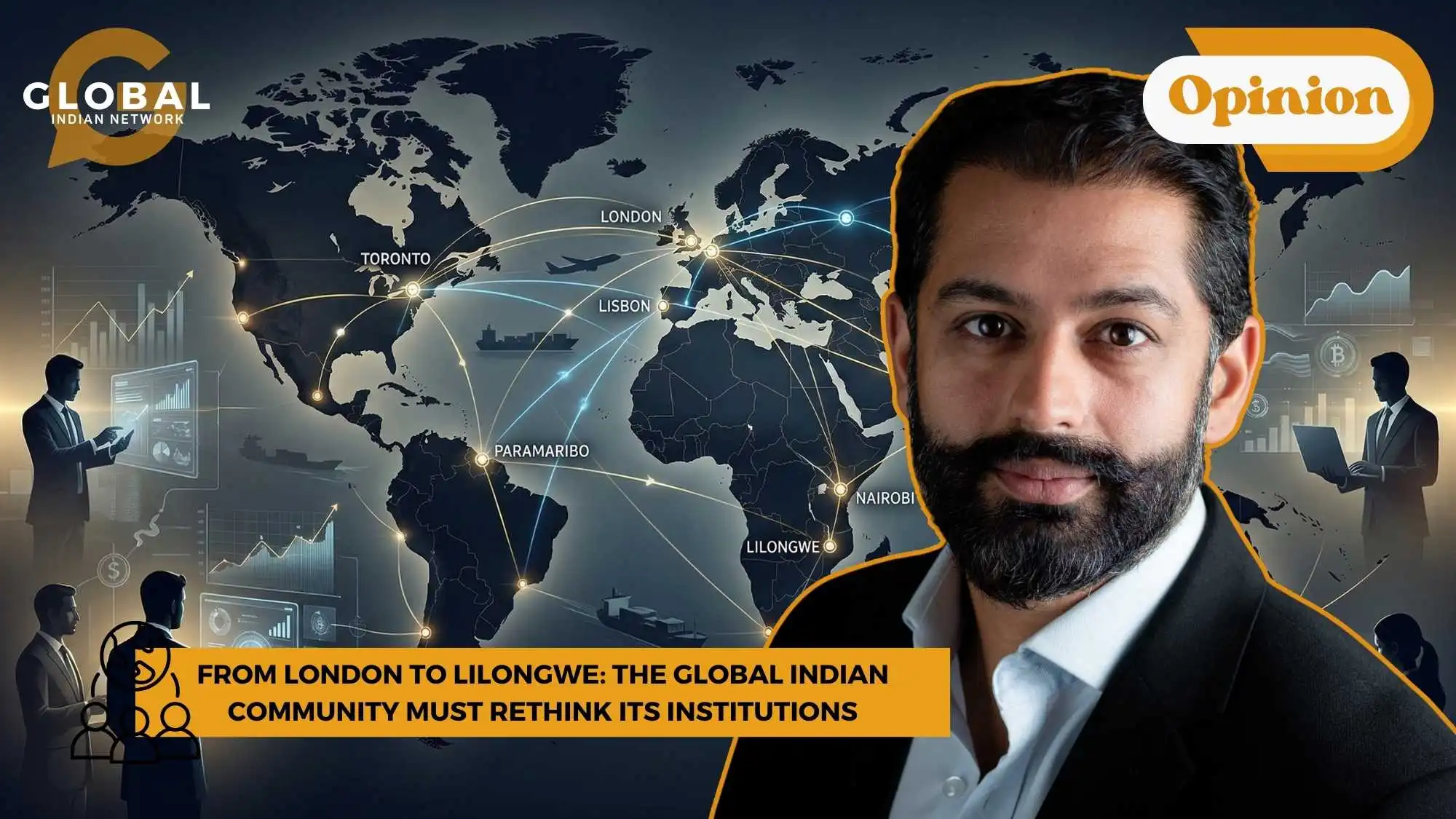

From London to Lilongwe, from Singapore to Suriname, the global Indian community now forms one of the most remarkable economic networks on the planet. Across continents, entrepreneurs and professionals of Indian origin are building companies, creating jobs and shaping the future of the societies they call home. Yet while the community has grown in influence, the institutions meant to connect it too often remain small, fragmented and symbolic.
Across the world, organisations claiming to represent the global Indian community have multiplied in recent decades. Their intentions are often noble. They promise to connect businesses, represent entrepreneurs, influence policy and build bridges between markets.
But too often the result is something far more limited.
In Britain, organisations such as the Asian Business Association have positioned themselves as voices for Indian and South Asian entrepreneurs, often working alongside respected institutions like the London Chamber of Commerce and Industry. The expectation is that these structures will help unlock trade opportunities, amplify business voices, and connect the community with government decision-makers.
Yet many entrepreneurs quietly ask the same questions.
What has actually changed? Is the community better connected to global markets? Are British Indian entrepreneurs finding new pathways into emerging economies? Are policymakers hearing coordinated and strategic proposals from these organisations? Or are we simply witnessing another cycle of dinners, panels and photographs that create the appearance of influence without delivering real outcomes?
This pattern is not confined to the United Kingdom.
In Portugal, initiatives such as the Portugal India Business Hub were created with the stated aim of strengthening economic ties between two dynamic markets. On paper, the idea makes sense. Portugal has positioned itself as a gateway to Europe, while India represents one of the fastest-growing economies in the world.
But again, the same question arises. Where is the sustained impact?

Too often, these initiatives begin with enthusiasm and strong branding but struggle to translate ambition into action. Without serious engagement with markets, sustained leadership and a genuinely global outlook, these organisations risk becoming symbolic platforms rather than engines of real economic cooperation.
And that is where frustration begins to grow.
Because the global Indian community is not small, fragmented or lacking in ambition. Quite the opposite. It represents one of the most entrepreneurial and internationally connected populations in the world.
What it lacks is a coordinated infrastructure.
Instead of operating as a truly global network, the community often finds itself divided into smaller institutional tribes. Associations form around cities, professions or social circles. Each claims a role in representation, yet few operate at the scale or with the strategic clarity required to connect markets meaningfully.
And when representation becomes performance rather than delivery, trust inevitably begins to erode.
There is also a more uncomfortable reality that many entrepreneurs quietly acknowledge. In some cases, community organisations have become platforms for personal visibility rather than engines of collective progress. Titles are awarded, committees are formed, and photographs with dignitaries circulate widely on social media. Yet beyond the symbolism, the underlying economic infrastructure often remains unchanged. The danger is not that individuals lack good intentions. The danger is that institutions begin to reward visibility over delivery, prestige over outcomes and proximity to power over the hard work of building real networks between markets.
There is another uncomfortable truth that many people recognise, but few are willing to say out loud.
Across the world, organisations representing the global Indian community have slowly drifted into something closer to social clubs than engines of economic influence. Events are organised, awards are handed out, photographs are taken, and speeches are made about unity and representation.
But often the impact stops there.

In many cases, these gatherings resemble what one might jokingly describe as a large Indian wedding. Everyone knows everyone, the same familiar faces circulate through the room and the language of community pride fills the air. Yet once the evening ends, very little changes in the real world of trade, investment or policy influence.
That reality should not be ignored.
The global Indian community deserves institutions that do more than celebrate identity. It deserves platforms capable of connecting entrepreneurs, investors and policymakers across continents in ways that produce measurable results.
Perhaps part of the problem begins with language itself.
For decades, people of Indian origin living outside India have been described as a diaspora. But that word carries an assumption of separation, a community defined by distance from somewhere else.
That description no longer reflects reality.
Today, Indians across the world form something much larger. A global Indian community. A network of entrepreneurs, professionals, investors and thinkers whose influence stretches across continents.
From East Africa to the Caribbean, from Southeast Asia to North America, the global Indian community has built businesses, institutions, and partnerships that shape economies far beyond the borders of India itself.
Yet while the community has grown in scale and confidence, the institutions designed to connect it have not evolved at the same pace.
There is another question that must now be asked, and it may be the most important one of all. The future of the global Indian community cannot be built solely around the idea of ethnicity.
Identity may have been the starting point for many early associations. But the world we operate in today is far more interconnected.
Entrepreneurs of Indian origin are embedded within the economies of the countries they call home. They employ people from every background, operate across industries and contribute to the prosperity of entire regions.

The real question today is not simply how members of the community support each other. It is how they contribute to the broader societies in which they operate.
How are businesses of Indian origin improving the communities around them? What initiatives are they championing that strengthen the wider economic ecosystem? How are they collaborating with partners from different backgrounds to build new opportunities?
These questions move the conversation beyond identity and toward responsibility. Because the global Indian community is not isolated from the societies in which it lives. It is deeply integrated within them.
At the same time, entrepreneurs and investors across the global Indian community are increasingly connected to the wider global value chain.
Capital flows between London, Singapore, Nairobi, Toronto and Mumbai. Businesses expand across continents. Partnerships form between markets that once had little direct connection.
Yet the structures meant to facilitate this cooperation remain limited.
Entrepreneurs in one country often have little visibility into opportunities in another. Investors searching for new markets lack credible platforms that provide real insight. Policymakers frequently engage with fragmented voices rather than coordinated networks.
If the global Indian community is to fulfil its potential, this must change.
What is required now is genuine dialogue across borders. Conversations about markets, regulation, investment and collaboration that move beyond ceremonial gatherings and networking dinners.
The scale of the community demands nothing less.
This conversation is also taking place at a moment of wider global uncertainty.
Across many countries, political discourse is becoming more polarised. Communities are increasingly viewed through the lens of identity rather than contribution. Even in countries such as the United Kingdom, the tone of public debate has begun to shift in ways that divide rather than connect.
At times, it can feel as though societies are drifting into opposing camps within the same nations.
In such a climate, the role of business communities becomes even more important.

Entrepreneurs and business leaders have the ability to bring people together through shared economic opportunity. They create jobs, build partnerships, and demonstrate that prosperity is something that benefits entire societies.
But for that to happen, institutions representing business communities must be willing to act with purpose.
It is no longer enough for chambers of commerce or community organisations to speak about unity in speeches while operating within narrow circles.
Action must follow words.
Real initiatives must emerge that strengthen social cohesion, encourage collaboration across communities and create opportunities that extend beyond any one group.
Because business leadership today is not only about profit. It is also about civic responsibility. The global Indian community has achieved extraordinary success across the world. Yet with that success comes a responsibility to organise itself in ways that reflect the scale of its influence.
This means asking difficult questions of the institutions that claim to represent it.
Are they delivering measurable outcomes? Are they connecting markets in meaningful ways? Are they helping entrepreneurs navigate the realities of a rapidly changing global economy? Or are they simply reinforcing the comfort of familiar networks?
The answers to those questions will determine whether the next generation of institutions truly serves the community it represents.
Because the opportunity ahead is enormous.
Across continents, entrepreneurs of Indian origin are facing remarkably similar challenges. Navigating regulatory environments, scaling businesses internationally, attracting investment and building partnerships in increasingly complex global markets.
Imagine the potential if those experiences were connected through genuine dialogue and collaboration. Instead of fragmented voices, the global Indian community could become one of the most coordinated economic networks in the world.
Not through symbolism but through action.

At a time when the world often appears to be moving toward division, there is also an opportunity to move in the opposite direction.
Communities that have built influence across borders have the ability to demonstrate that cooperation is still possible. That business can bring people together. That shared challenges can create shared solutions.
The global Indian community represents one of the most remarkable tapestries of talent, enterprise and cultural exchange in the modern world.
But that tapestry must be woven with purpose.
It must move beyond symbolic representation toward genuine collaboration, open conversation and institutions that deliver real impact.
Because the global Indian community does not need more organisations that celebrate what we already are.
What it needs now are institutions courageous enough to build the future that the global Indian community has already earned.
Let us know your thoughts. If you have burning thoughts or opinions to express, please feel free to reach out to us at larra@globalindiannetwork.com.