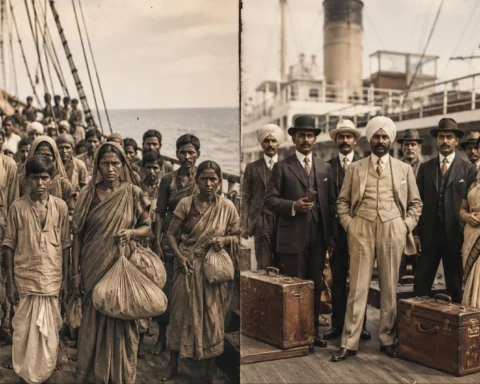




Economic exploitation under the British Raj was a deeply rooted system that drained India’s wealth and impoverished its people. This economic oppression turned India from a prosperous and self-sufficient civilization into a colony serving British imperial interests. It is important to understand these mechanisms because their effects continue to impact the global Indian community, shaping economic challenges and experiences of the diaspora even today.
Table of Contents
Economic Exploitation Under the British Raj
Economic exploitation by the British Raj followed a sequence of planned policies and institutional structures that ensured the maximum transfer of wealth from India to Britain. British people came with oppressive land revenue systems like Zamindari, Ryotwari, and Mahalwari that collected exorbitant taxes on the peasants, whether they could pay or not. Such a system of heavy taxation caused rural poverty through massive debts and famine, which continued to affect the agricultural populations. This was accompanied by the reorganization of the Indian economy to sell raw materials such as cotton and indigo to Britain at low prices, and import finished products at high prices, leading to an imbalance in trade which killed the old Indian industries and artisans.
This movement encouraged deindustrialization and joblessness. Manufactured British commodities flooded Indian markets, driven by the Industrial Revolution’s efficiency. The British monopolized trade in unfair manners, such as dastak (free trade passes) and home charges, thus resulting in an endless drain of the Indian financial resources with minimal investment back home. The outcome was a gradual dismantling of the Indian economic fabric to fill the British treasury at the expense of permanently creating economic imbalance in India as well as among Indians in the rest of the world.
On a global scale, to the Indian diaspora, this kind of economic exploitation during the British Raj highlights the origins of various socio-economic inequalities against the Indians in foreign lands. The poverty and industrial deterioration of the colonial period compelled a sizeable portion of the population to find means of livelihood abroad, and this shaped the migration trends, the socio-economic and communal structures. The recognition of this historical exploitation is beneficial in boosting the diasporic identity, focusing on resilience in the conditions of adversity and the view of the global economic realities that the Indian communities face today.

Mechanisms of Wealth Drain
The economic colonization schemes of the British Raj were complex and sneakily effective. The land revenue systems made the most out of the peasants who were bonded in debt and, in most cases, lost their land. The British encouraged the commercialization of agriculture at the expense of food plants, resulting in farmers producing cash crops rather than food, and exacerbated food insecurity, leading to periodic famines, including the catastrophic Bengal famine of 1943.
The other process was the intentional deindustrialization of India. The British laws and tariffs only allowed Indian merchants to export finished goods and inundated the market with cheap British industrial goods. The failures of the traditional Indian handicrafts and textile industries resulted in massive unemployment, affecting the lives of the artisans and weavers of Indian handicrafts.
The “Drain of Wealth” was arguably the most critical facet of economic exploitation under the British Raj. This was by transfers of India earnings in the form of home charges, such as salaries and pensions of the British officials in India, in the form of British military maintenance costs, and profits remitted by British firms. Estimates have pointed out that the revenue in India has been siphoned in the same manner at almost a third. This left the Indian economy as a source of raw materials and a captive market for British goods, which essentially curtailed the ability of India to grow on its own.
To the world Indian community, these processes justify the legacy of economic predicaments. The exhaustion of resources in the past caused economic development and increased wealth inequalities that most of the diaspora communities are still trying to end. It is this entrenched exploitation that will give us a clue to the international Indian desire to have an economic say and justice.
Impact on Indian Society and Economy
The economic exploitation under the British Raj drastically reshaped India’s social and economic landscape. The peasants were the worst sufferers of high land taxes, as they lost their lands and were relegated to the economic sidelines, as famine increased as a result of forced production of cash crops.
Artisanship and cottage industries were destroyed, resulting in poverty and distress in society. The country’s economy failed, and the cities were incapable of accommodating the jobless population, which contributed to migration and social unrest. British firms also monopolized Indian markets to a large extent and hindered local entrepreneurship.
The economic policies discouraged industrial development in India intentionally so as to keep the British economic supremacy. These historical aspects play a significant role in helping the diaspora to comprehend their social transgressions and economic complexities in the past, which they have passed down or observed. The collective memory of the global Indian community has the consciousness of the oppressive elements of the colonial economic policies on the Indian potential and prosperity.
Colonial Legacies for the Global Indian Community
The consequences of economic exploitation under the British Raj resonate in multiple ways for the global Indian community. Historically, the waves of migration were driven by the economic hardships and ruin of the indigenous industries. In the economic status, Indians lived in the world as they usually settled in difficult economic settings that were not close to their homeland and the burden of colonial exploitation was passed on to their economic status.
Further, the economic development path of India and other former colonies in the post-colonial era took decades before its time due to the economic bleeding caused by British rule. This historical recognition plays a vital role for the Indians all over the world in ensuring that they have a collective determination to address historical injustices by educating, engaging in entrepreneurial ventures, and participating in politics.
It is against this backdrop that the global Indian community always negotiates its identity and economic status, keeping in touch with this history, pressurizing the need to be heard on the legacies of colonialism in their countries of origin as well as in India towards sustainable growth and equitable development.
Conclusion
Economic exploitation under the British Raj was a calculated and multifaceted system that drained India’s wealth, impoverished its people, and systematically dismantled its economy for British benefit. This historical exploitation is one of the reasons why the socio-economic realities and challenges of the global Indian community need to be comprehended in India and the rest of the world.
The need to identify this legacy in addition to recognizing historical wrongs is vital to the empowerment of global Indian identity and collective future aspirations. It solidifies the need to be economically independent and self-reliant as a permanent objective, with historical foundations in firm resistance to colonial oppression.
To read more about the economic policies and effects thereof, see the analysis on British economic policy in India and the drain of wealth theory, using resources like the Economic impacts of British rule in India and perspectives on the drain of wealth theory, which provides an in-depth discussion of these complicated dynamics.
FAQs
What was the main goal of economic exploitation under the British Raj?
Economic exploitation under the British Raj involved systematic policies like heavy taxation, deindustrialization, and wealth drain to transfer India’s resources to Britain.
How did land revenue systems enable economic exploitation under the British Raj?
Land systems such as Zamindari and Ryotwari, under economic exploitation under the British Raj, imposed crushing taxes on peasants, leading to debt, land loss, and rural poverty.
What was the Drain of Wealth in economic exploitation under the British Raj?
The Drain of Wealth during economic exploitation under the British Raj siphoned India’s revenue through home charges, military costs, and British profits, crippling local growth.
What societal impacts stemmed from economic exploitation under the British Raj?
Economic exploitation under the British Raj triggered famines, poverty, and social unrest by prioritizing cash crops over food and dismantling traditional economies.