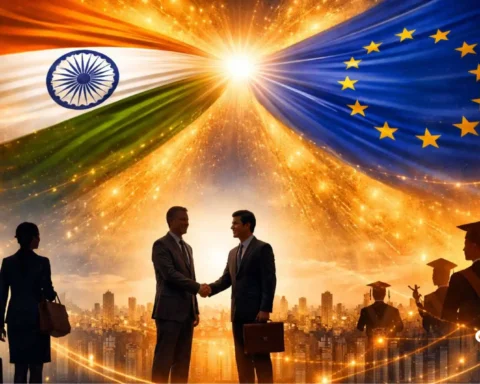




Trade accords in modern times influence lives in ways that extend well beyond boardrooms and policy tables. The India-EU FTA is an opportunity on a personal level to the global Indian and Brown community, comprising entrepreneurs in London, textile families in Surat, IT consultants in Berlin, and farmers exporting in Punjab.
It is not merely the measure of the volume of trade. It concerns work, income security, diaspora entrepreneurship, and the way the global Indian communities connect to the future economy of the world.
The India-EU FTA is becoming one of the most critical economic bridges of this decade as the talks move on.
Table of Contents
Why the India-EU FTA Matters
There is already an established trading relationship between India and the European Union, and the volume of bilateral trade is approaching 130 billion annually. Europe has become one of the leading export markets in India in terms of fashion, pharmaceuticals, food products, as well as engineering goods. In its turn, the suggested India-EU FTA (Free Trade Agreement) is based on this premise, as it is expected to reduce high tariffs, simplify customs procedures, and establish more foreseeable market access, which only benefits Indian exporters who have to cope with unpredictable global circumstances.
Indeed, such agreements have historically increased employment in the supply chains, as observed by insights of global trade bodies such as the World Trade Organization, in terms of factory workers in industrial centers such as Gujarat or Tamil Nadu, logistics teams in the ports of Mumbai to carry out shipments, and even in the less obvious support services to these activities. For Indian businesses, it will not only save them money but also help them gain a firmer hold in the high-end market, leading to long-term stability and expansion without the burn of trade uncertainties.
Unlocking New Income Streams
At present, numerous Indian products entering Europe are subject to 8-20 percent tariffs. These expenses are silently consuming the profits of small exporters and family businesses.
The India-EU FTA aims at eliminating or drastically reducing these barriers. That would release billions of dollars for industries. The savings in money on tariffs are usually deposited in:
- Hiring workers in India
- Growing corporations by diasporas.
- Betting on technology and marketing.
According to the World Bank, extensive trade relationships have the potential to enhance bilateral trade by 40 percent in the long run. This growth can be life-changing for Indian households that are reliant on export-based income.

The Services Boom and Indian Professionals
Although the goods trade is in the headlines, the real heavyweight of the Indian economy in the international arena is in services, with India leading in the global ranking in the field of IT consulting, fintech innovations, medical outsourcing, creative design, and even exports of education services, where it has been contributing an overwhelming part of its economic impact.
The India-EU FTA includes India-EU talks on simpler professional movement, digital trade regulations, and qualification recognition. This could mean:
- Quick work permits for Indian tech employees.
- Less complicated cross-border consulting deals.
- Access to European clients has improved for startups.
The European Commission Trade portal of the European Union shows that trade transactions are progressively becoming more focused on digital services. For young Indians studying and working in Europe, this would provide better remunerated, long-term global employment.
Why Small Indian Businesses May Benefit the Most
The backbone of the Indian economy is small and medium enterprises (SMEs), which hire millions of people and provide the innovation that drives India, either through handloom weavers in Rajasthan or tea planters in Assam or jewelry craftsmen in Mumbai or organic food producers in rural India, but already have international customers but no access to it due to high intermediary fees and red tape.
The India-EU FTA promises to level the playing field by drastically cutting tariffs, simplifying customs clearances, and enabling direct access to discerning European consumers, which translates to fatter margins, quicker scaling, and the ability to reinvest in quality upgrades or community initiatives.
According to OECD studies, it was observed that smaller companies have the highest growth rates with the least time being taken after liberalization of trade, usually compared to larger corporations, since they adapt quickly to new markets. In these family inheritances, it is not about figures, but about keeping rural lifestyles viable, giving local artisans a boost, and integrating Indian business into the global economic life cycle with new energy.
Beyond Trade: A Strategic and Cultural Partnership
The India-EU FTA is also an indicator of the change of power in the globe.
India is becoming a reliable partner in manufacturing and services as European countries diversify their supply chains away from China. The main areas of growth are renewable energy, electric vehicles, pharmaceuticals, and electronics manufacturing.
The new factories, increased demand, and increased job security could soon be enjoyed by Indian professionals in the European industrial corridors.
Better still, there is already experience of deep people-to-people trust. Brides of commerce. The Indian diaspora networks in Europe have taken decades to establish. India-EU FTA is merely a formalization of what communities have been doing for years on an organic basis.
Conclusion
The India-EU FTA stands as a pivotal deal delivering tariff relief, job creation, and expansive market access that resonates deeply with India’s vibrant industries and workforce.
Attention to the diaspora networks is only brief, highlighting the natural people-to-people connections that are already present, but the actual narrative is based on domestic economic impetus and strategic benefits.
FAQs
What is the India-EU FTA?
The India–EU FTA is a proposed free trade agreement that seeks to reduce tariffs and regulatory barriers and to facilitate trade in services between India and Europe, thereby improving business operations for Indian communities worldwide.
Why does the India-EU FTA matter to the global Indian community?
It can reduce export costs, boost diaspora businesses in Europe, and create stronger job opportunities for Indians working across trade, technology, and manufacturing sectors.
Will the India-EU FTA help small Indian businesses?
Yes, by reducing tariffs and simplifying customs procedures, the agreement could enable family-run exporters, farmers, and artisans to sell directly to European markets and grow more quickly.