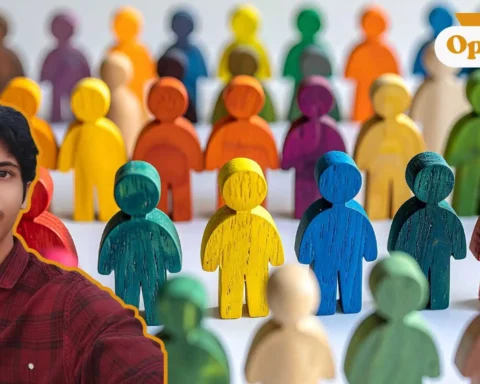





One of the many prominent themes of George Orwell’s dystopian novel 1984 is the establishment of the new language Newspeak. Created by the ironically named Ministry of Truth is a reiteration of language that limits thought by deconstructing and eliminating vocabulary; in essence, it is the manipulation of language to the extent that the formation of thought outside of what “The Party” (the authoritarian heads of Orwellian society) deems dissentful. As the world has progressed from the 20th century, it has become abundantly clear that Newspeak, much like Orwellian life itself, is not limited to the pages of 1984.
The Construction of Newspeak
In Orwell’s book, Newspeak is introduced as a new form of language to make the very blasphemous sin of thoughtcrime an impossibility due to the language’s limited vocabulary,ambiguity, and contradiction. To anyone who has read the book, it is quite self-evident what the actual purpose of Newspeak is. The limited range of vocabulary and inbuilt self-contradictions serve to limit critical thinking and analysis, thus making the only acceptable truth what “The Party” deems to be true.
It is for this exact reason that Newspeak is built on the foundation of another Orwellian concept, Doublethink: the ability to hold two contradictory opinions at the same time. Doublethink goes further, granting the “thinker” the ability to deny reality using elements of logical thinking, further bolstering whatever ideology they have.
The Post-literate Society
A post-literate society, as has been defined by many social scholars and commentators, is one where visual and audio forms of media replace written texts as the primary source of information. The unintended consequence of this is two-fold. One is the decline of deep critique that comes with reading as opposed to watching. The other is that most audiovisual sources of information are filtered to hold attention. In practice, this is people getting their information from short-form content like YouTube Shorts or TikTok.
So in essence, a post-literate society is one that is handicapped from critical thought due to its lack of reading, and the information it does receive is that which has been filtered and distilled to where it is more often than not, inaccurate. The detriment of this does not need to be stated, as many argue that the current political climate in many countries is a direct result of society moving towards post-literism.
The Ministry of Truth
The Ministry of Truth is the fictional propaganda arm of The Party in 1984, another utilisation of irony in the book, as the ministry does everything but propagate the truth. While the Ministry of Truth does not exist in our reality, elements of it certainly do exist. With much of the world’s information streams monopolised in the hands of a few tech and social media giants, it is not beyond reason to be skeptical of the information we receive via social media.
In 2022, an investigation by Amnesty International found that Facebook’s algorithms amplified posts with hate speech towards the Rohingya community in Myanmar. This contributed to the violence and genocide against the Rohingya community, highlighting that the dangers of having the sources of information being limited to a small group of rich individuals are not just misinformation but also mass violence.
Conclusion
It is no secret that social media companies aim to keep people attached to their cellphones. The manner in which they do this has been greatly discussed. However, the emerging effects are uncharted, from altered brain chemistry and warped world views to genocide; the impacts that they have seem to cascade and morph. This is coupled with the fact that we live in a society that often cites reels and TikToks as its source of information.
Let us know your thoughts. If you have burning thoughts or opinions to express, please feel free to reach out to us at larra@globalindiannetwork.com.