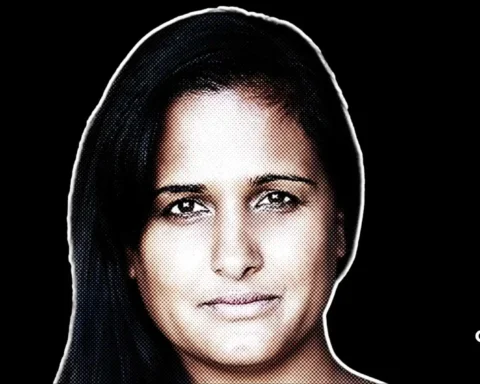





Parminder Nagra was born on October 5, 1975, in Leicester, England, to Sikh parents who had immigrated from Punjab, India. Growing up in a multicultural neighbourhood, she experienced the delicate balance between her family’s traditional values and the broader British culture around her. Leicester, with its thriving South Asian community, provided a rich backdrop for her childhood.
Her parents, who emphasized education and discipline, instilled in her a strong sense of responsibility. Yet, Nagra’s natural inclination towards performance emerged early. She often entertained relatives and friends with small skits and recitations, hinting at the confidence and stage presence she would later bring to the screen. Those early experiences, though seemingly ordinary, laid the foundation for a career that would later bridge cultural divides.
Table of Contents
Parminder Nagra’s First Steps into Acting
While in school, she developed a love for performance and joined local youth theater groups, which gave her a space to explore different characters and stories. What started as a hobby quickly became a calling. She appeared in small productions at Leicester Haymarket Theatre, where her commitment and natural talent stood out to directors and peers alike.
Unlike many who chase fame, Nagra’s focus was on perfecting herself. She decorated the roles that challenged her and allowed her to grow as a performer. This period was crucial, teaching her the discipline of rehearsal, the art of collaboration, and the patience required to sustain a long-term acting career.
Breakthrough with Bend It Like Beckham
The turning point came in 2002, when Parminder Nagra landed the lead role of Jess Bhamra in Gurinder Chadha’s Bend It Like Beckham. The film was a cultural phenomenon. Nagra played a young British-Indian woman torn between her love for football and her family’s conservative values. The movie resonated deeply with audiences worldwide, grossing over $76 million and becoming a landmark in British cinema. For Nagra, it was a life-changing moment. She went from small theatre productions to red carpets and national representation.
In 2003, she was cast in the iconic medical drama ER as Dr. Neela Rasgotra, a role she played for six years. This was significant not only for her career but also for television history. At a time when diversity on American TV was limited, Nagra’s character became a rare example of a strong, complex South Asian woman in primetime television. Her performance earned her critical acclaim, and she quickly became a fan favourite.

Beyond ER: Parminder’s Challenges and Growth
Off-screen, Parminder faced the complexities of balancing public visibility with personal authenticity. She has openly discussed the challenges of being pigeonholed and the importance of seeking roles that reflect real, diverse experiences. Nagra became an advocate for diversity in film and television, emphasizing that representation matters not just on-screen but in the stories told and the teams behind them.
She mentors young actors, participates in panels about inclusivity, and supports initiatives aimed at giving minority communities greater access to the arts. Nagra’s approach is pragmatic; she not only critiques the system but also actively contributes to change. Her journey reflects a dual commitment to pursuing personal artistic fulfillment while creating opportunities for others who might otherwise remain unheard.
Reinvention with D.I. Ray
In 2003, Nagra was cast as Dr. Neela Rasgotra in ER, one of the most-watched television shows of its era. While TV salaries vary, main cast members on ER were reportedly earning hundreds of thousands of dollars per season, and her multi-season role would have provided both financial stability and industry credibility. Nagra’s tenure on ER lasted from 2003 to 2009, during which she evolved from a supporting character to a central figure. Her portrayal of Neela was lauded for its authenticity, blending vulnerability with resilience.
Yet, Hollywood wasn’t always welcoming. Nagra encountered the familiar challenge of typecasting. Roles for women of colour, especially South Asian actors, were often limited or stereotypical. While she achieved recognition and financial success, she had to consistently navigate the industry’s narrow lens, choosing projects that allowed her to grow rather than simply capitalize on fame. Her ER experience, therefore, was both an artistic triumph and a lesson in perseverance, a period that tested her resolve and reinforced her commitment to meaningful representation.
Reflecting on her time on the long-running hit ER, Nagra admits she still feels a sense of awe, “I look back at that and think ‘wow’ because every so often I catch it streaming, and a lot of those episodes were like movies. All you hope to do going forward is have a little bit of that in the work you go on to do. I always get nervous before we start something, wondering if I know how to act anymore. I used to be the youngest on set, and now I wonder ‘How did this happen?’ But, on set, I know what works on camera; I do have a lot of experience, more than I give myself credit for. I want longevity. If you’re proud of what you do, that’s the goal.”
Conclusion
Parminder Nagra’s presence in film and television has rewritten the expectations of who gets to tell a story and how it’s told. She moves through her roles with an honesty that makes ordinary moments feel something. Her influence can be felt in the questions she raises rather than the answers she gives. Writers, directors, and fellow actors respond to that energy, and slowly, the industry begins to accommodate the complexity it once ignored.
Parminder demonstrates domination instead of claiming it. The mark she leaves is not a legacy in the traditional sense but a possibility of richer, truer storytelling. The impact is invisible until you notice the world has shifted, and when you do, it’s undeniable.
FAQs
What is Parminder Nagra doing now?
Currently, Parminder continues to work in television and film. She recently starred in the British crime drama DI Ray, where she plays Detective Inspector Rachita Ray, and she remains involved in projects that highlight diverse stories and complex characters.
Who is Parminder Nagra in Agents of S.H.I.E.L.D.?
Parminder Nagra plays Ellen Nadeer in Agents of S.H.I.E.L.D., a politically influential character who challenges the organization and represents complex moral and ideological perspectives in the storyline.
Who is the female S.H.I.E.L.D. agent?
In the series, several female agents play significant roles, including Daisy Johnson (played by Chloe Bennet) and Melinda May (played by Ming-Na Wen). Parminder Nagra’s character, Ellen Nadeer, is not an agent but a key political figure in the show.
Who is Parminder Nagra in Psych?
Parminder Nagra appeared in Psych as a guest star in a single episode. She played a character that contributed to the central mystery, showcasing her versatility in a comedic-detective setting.