


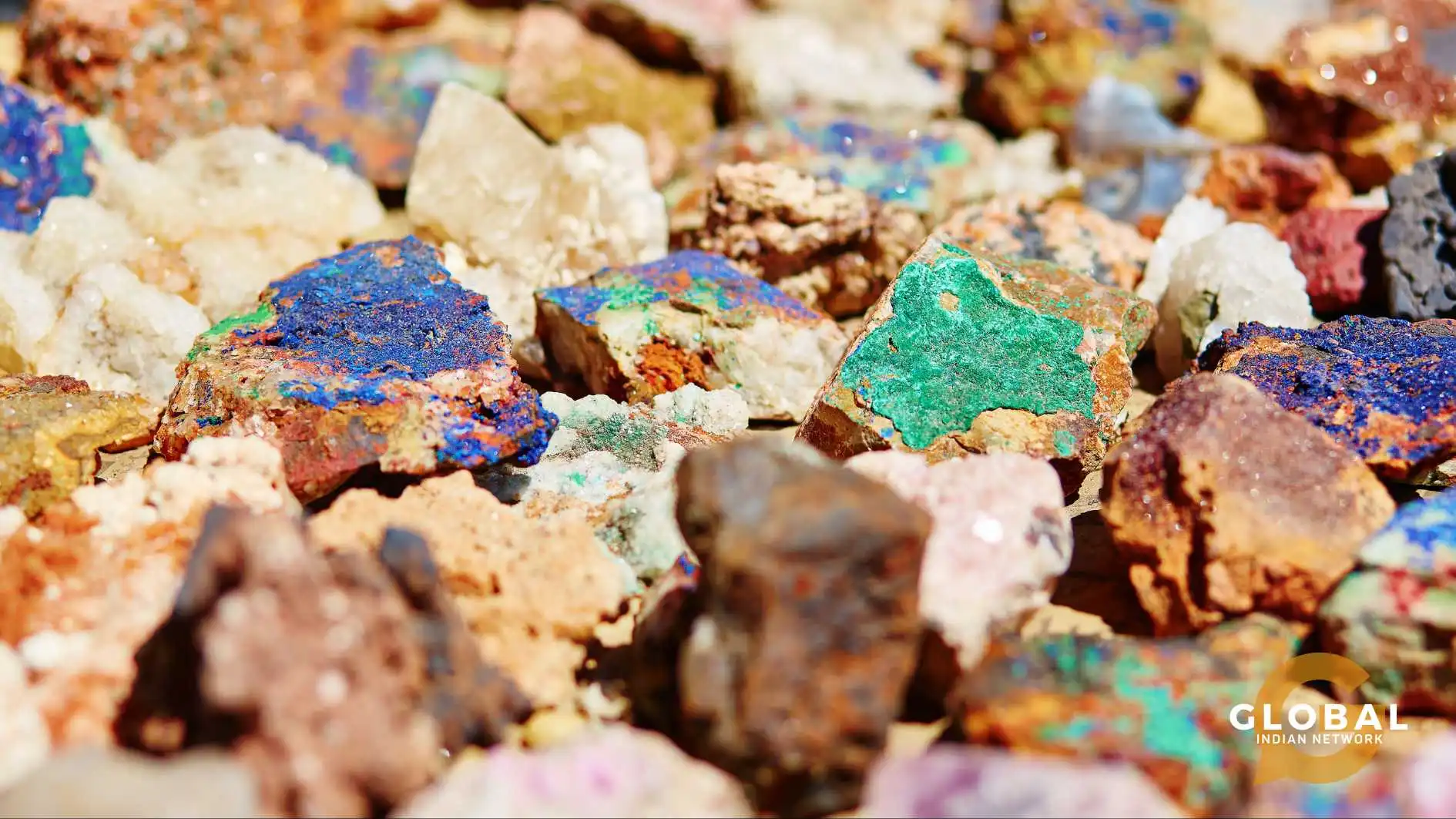

The critical minerals supply chain between India and the UK is creating an important democratic partnership for clean energy security. The two countries are working together to map out, secure, and improve the flow of lithium, cobalt, nickel, and rare earths. This collaboration lowers dependence on major suppliers and creates economic opportunities for the global Indian community. For professionals of color worldwide, this represents real opportunities in green jobs, ethical technology, and a resource map where Indian voices take the lead.
Table of Contents
Why the Critical Minerals Supply Chain between India and the UK Matters
Batteries, wind turbines, solar panels, semiconductors, and defence and medical technologies that are important in the modern economy all run on critical minerals, including lithium, cobalt, nickel, and rare earths. In India, the acquisition of these inputs is essential to achieving climate goals, hastening EV adoption, and other electronics manufacturing systems that can create employment opportunities for a youthful populace both at home and in the diaspora. In the case of the UK, they have supported both industrial and climate resilience ambitions in a competitive and post-Brexit world where stable allies such as India are becoming more strategic.
Here, a green economy depends on the critical minerals supply chain between India and the UK as a basis to connect the mines, the processors, the manufacturers, and the recyclers in the geographies that are democratic. To global Indians living in London, Bengaluru, Toronto, Dubai, or Singapore, it is the invisible infrastructure that determines the career prospects, investment choice, and the cost of the devices and EVs people use on a daily basis. This supply chain construction will have an impact on not only corporate balance sheets but also the lived experiences of brown communities on a warming planet.

India, UK Ties and New Infrastructure
In the past couple of years, India and the UK have continuously developed their collaboration framework to anticipate technology safety, sophisticated manufacturing, and robust supply chains. The larger 2030 Roadmap and the technology security statements that follow emphasize the necessity to collaborate on critical minerals with semiconductors and high-end research. Built into that framework is a commitment to make the critical minerals supply chain between India and the UK more transparent, diversified, and sustainable.
One of the most important signs of this new age can be the collaborative Critical Minerals Supply Chain Observatory, which is funded by both governments and located in universities and research centres in both nations. Its purpose is to map, monitor, and stress-test the critical minerals supply chain between India and the UK, tracking flows from exploration and mining to refining, manufacturing, and recycling. And it is not just a technical database; it is a new control tower for industrial and climate policy, in which knowledge can be used to direct popular investment, corporate finance, and foreign policy.
To the worldwide Indian community, with a specific interest in the area of data science, engineering, finance, and even public policy, this infrastructure designates a new arena to add skills. The Indian professionals in British universities, Indian Institutes of Technology, and international companies can tap into the observatory-linked initiatives that are transforming the way critical minerals are sourced and utilized. Their choices and research help determine whether the critical minerals supply chain between India and the UK reflects values of labour dignity, environmental responsibility, and shared prosperity that resonate across brown communities.
Geopolitics, China, and Democratic Resilience
The increased attention to critical minerals is in the context of geopolitical tension regarding the concentrated domination over the resource base. Processing and refining of most of the important minerals now lies in the hands of China, providing it with a strong bargaining power in world clean-tech supply chains. Other countries have come to the realization that dependence on one actor as a source of basic materials is a system weakness through export controls and political tensions.
In response, democracies are seeking to build alternative networks grounded in shared standards and transparency, and the critical minerals supply chain between India and the UK is one such pillar. The coordination of investment, sharing of data, and harmonizing of the regulation is a way of hedging against the future shocks of an unstable world by both countries. To global Indians residing in the UK and other Western nations yet strongly connected to India, this will offer a feeling of safety: it will reduce the chances of geopolitical upheavals, rapidly increasing energy costs, destabilizing employment in clean-tech industries, or halting action against climate-impacting brown populations in climate-prone areas.
In the new resource architectures, this collaboration also makes India a rule-maker, as opposed to a rule-taker. By codifying norms with the UK and other partners India has, the interests of the Global South and those of the diasporic communities have a better chance of being represented. That means the critical minerals supply chain between India and the UK is not only about diversifying away from one power, but about writing new rules that factor in equity, development, and representation.
Diaspora, Opportunity, and Circular Economy
Beyond strategy, there is a very human story running through the critical minerals supply chain between India and the UK: the role of the Indian diaspora. London, Perth, Toronto, and other Indian-origin professionals are in the major league of mining finance, commodity trading, ESG auditing, climate-tech start-ups, and policy think tanks. They are able to connect regulatory, political, and business worlds that seldom share the same language due to their networks, skills, and cultural fluency.
With India and the UK working on innovation sprints, recycling technologies, and other cleaner refining approaches, the supply chain has new positions available. There is scope for brown founders to build start-ups in battery recycling, materials recovery, and traceability solutions that plug directly into the critical minerals supply chain between India and the UK. Global Indians of younger age will have the opportunity to pursue a career in this area rather than operate within the more conventional spheres of IT and finance, working on AI-driven supply chain analytics and community relations around new mining ventures.
The other important aspect is the ethical aspect. Brown communities may be on the other end of the chain: families living in high-tech industries that use these minerals may be in the diaspora, and those who are related to or compatriots of those individuals live in India or a processing area at risk to the environment. A more transparent, just, and circular critical minerals supply chain between India and the UK gives these communities leverage to demand higher standards, knowing that their voices are represented on both sides of the table.
What it Means for the Global Indian Community
This new architecture does not represent an abstract techno-strategic project to global Indians but a direct impact on daily life and the security of the future. The phones and laptops that keep families connected, the EVs navigating polluted city streets, and the grid systems struggling under heatwaves all depend on how the critical minerals supply chain between India and the UK is designed and governed. And in case it brings in strength and cost-effectiveness, brown families all across will feel the positive changes in the lower prices, cleaner air, and more secure employment.
It is also the slightest change of identity and agency. Rather than being consumers or mid-level employees in Western-dominated supply chains, global Indians have the opportunity to be co-authors of a new resource map in which India will be central and the diaspora will be one of the strategic agents. The critical minerals supply chain between India and the UK is one of the clearest arenas where this transition is happening, intertwining climate justice, economic aspiration, and cultural pride.
Conclusion
To sum up, the critical minerals supply chain between India and the UK is a light of democratic sustainability, as it integrates the concepts of innovation, security, and the common green economy prosperity. To the global Indian community, it is turning abstract geopolitics into concrete possibilities- clean technology employment, ethical investments, and a voice in re-writing resource maps that earlier marginalized the Global South.
This collaboration will enable brown talent from London laboratories and Bengaluru factories to create a future where climate action is in harmony with cultural pride and economic empowerment, ensuring a cleaner future, career stability, and intergenerational equity for Indians worldwide.
FAQs
What is the critical minerals supply chain between India and the UK?
It refers to the collaborative framework connecting mining, processing, manufacturing, and recycling of essential minerals such as lithium, cobalt, nickel, and rare earths between the two countries. This includes the UK-India Critical Minerals Supply Chain Observatory, which identifies weaknesses and encourages stable supply flows.
Why are critical minerals vital for India and the UK?
These minerals power EVs, renewable energy, semiconductors, and defense technology. They support India’s goal of reaching net-zero emissions by 2070 and the UK’s industrial plan. The critical minerals supply chain between India and the UK reduces reliance on China, which helps ensure energy security for both democracies.
How does the partnership benefit the global Indian community?
It creates jobs in data analytics, ESG consulting, recycling startups, and policy for diaspora professionals in London, Toronto, and other places. The supply chain for critical minerals between India and the UK supports brown talent, combining career growth with responsible climate action.