


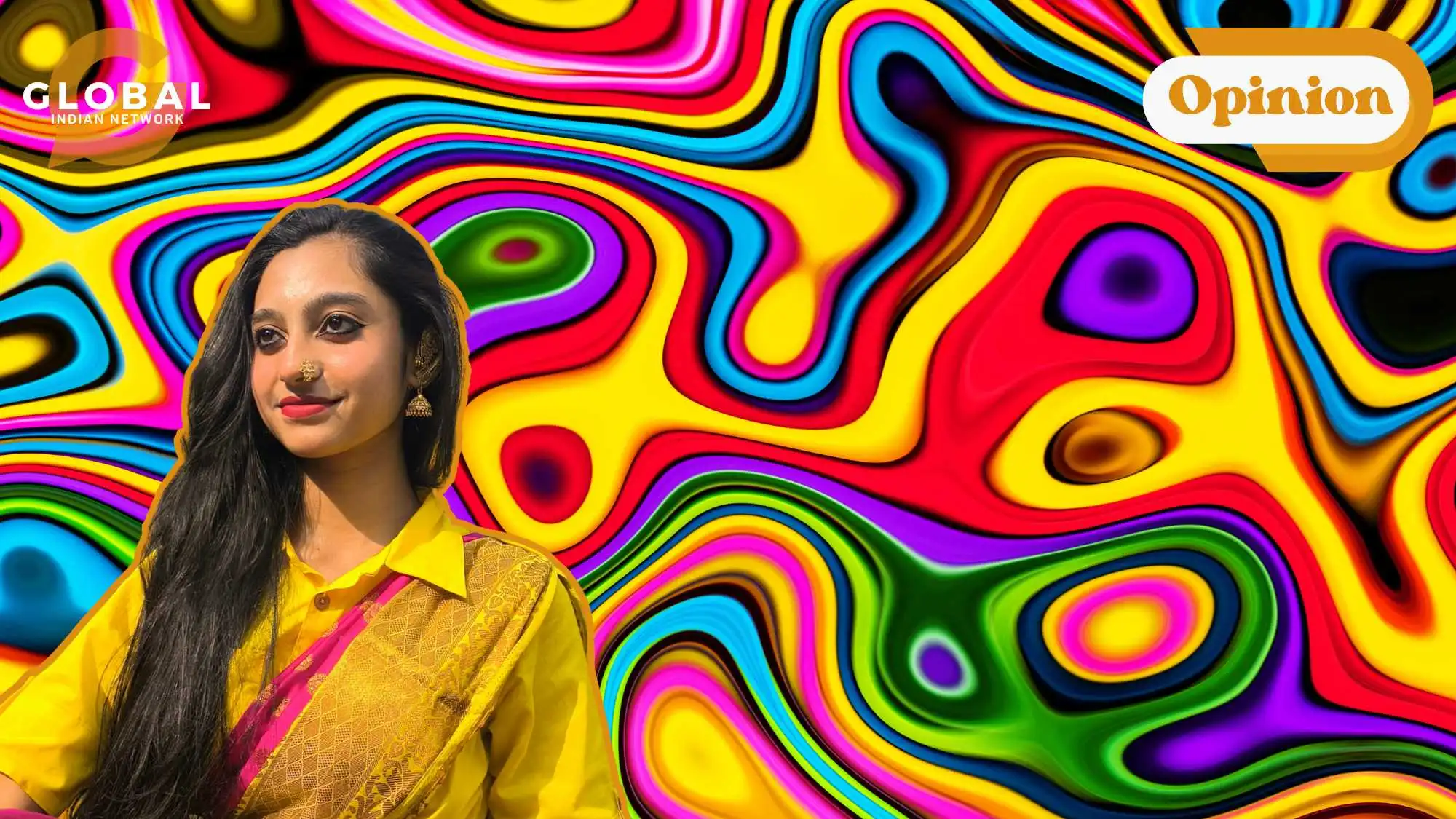

This is to inform you that the world is bleaching itself.
Indian weddings, eminent for their vibrant and blinding red and the most critical embroidery, had styles like Kanjivaram, Banarasi, Paithani, Patola, and Mysore Silk, all originated from the hearts of Indian artisans. Blended rich and royal colours were something that faded out all class distinctions. All weddings had this unity of colour amidst their financial diversity, which used to amaze me the most.
However, we have seen a murder of the red in recent years, ignited by Anushka Sharma’s 2017 pastel wedding. It’s gorgeous, undoubtedly, and a signature of an era, but somewhere it lacks the essence of a bride. The grandeur of a celebration and that too such a significant one, demands maximalism, but it’s completely a personal preference.
Ask a kid what neon colours are, I bet they wouldn’t know, and even if they did, the first reaction would be an “eww!”. The importance of high glow pigments can only be explained by a 2000-born. The 2010s fashion palette was a vibrant mix, defined by the early decade’s brights, neons, and pastels (mint green, coral, turquoise) alongside grungy neutrals (flannels, denim).
Walk into a Zara store, and you’ll feel like you’ve trespassed on a cemetery. The eerie degradation of the colour palette is worth giving a thought. We perceive the fact that our childhood times were comparatively brighter than the current spectrum of our peripheral vision. I ain’t talking about just clothes but our general habitat as a whole.
Yesterday, my uncle rang to check on me, and in the course of our conversation, he reminisced about his hostel days. He laughed at how his roommates used to tease anybody who called their homes often; they never had the leisure to do the same, absorbed as they were in one another’s company, studying together, trading gossip, improvising late-night music sessions, organizing small entertainments, and a hundred other convivial occupations. He was struck, with a fond sort of wonder, that I could find time to keep my grandmother on the line while attending to the day’s chores.
And then I looked around, an air of disappointment and sadness clutched my heart, for I knew well how I would never get to experience this life. Because, over time, people have found their buddies for life in their electronic devices. And the greatest pair is a phone and a headphone. I might be sharing a room, but I am all alone. And whatever my uncle spoke was a foreign concept to me. The saddest part is that what is now a foreign concept to me will not even be a concept in the upcoming generations.
The world is not losing colour; our eyes are, for the screen will always seem brighter than the real world. We are all at a performative stage. The audience is so accustomed to perfection that no matter how much we do, there will always be an intermolecular space that will never let us touch the irreproachable brink.

We’ve heard it once and many times how human bonds are lacking genuineness in the progressing days. But who are we to complain? We too fall in this race. This happens when emotions grow weaker. No, it absolutely doesn’t hint at our strength or anything like that, but our ineptitude. To be an empath is not to be frail. It’s just that we are built like this to adapt to newer things in a way that benefits us. I wonder when we will scream again on meeting our best friends after months. We are too polished now, driven by AI, whitewashed. And there’s no going back. Even after numerous trials, there won’t be any satisfactory results.
We are prey to McDonaldization, which is a phenomenon where everything is predictable and efficient and has spread to other parts of the world. George Ritzer’s seminal concept from his 1993 book, ‘The McDonaldization of Society’, describes the inexorable spread of fast-food logic based on the four pillars: efficiency, calculability, predictability, and control across modern institutions, echoing Max Weber’s iron cage of rationalization.
Drive-thrus epitomize efficiency by slashing wait times, supersized meals prioritize quantifiable volume over nuanced quality, uniform menus and scripted greetings ensure the same experience from Italy to India, while automated kiosks and surveillance enforce nonhuman control, sidelining human whimsy. This paradigm trades vibrant local character for scalable sameness, a convenience that starves the soul of spontaneity and ingenuity. There is no creative thought behind this, and it acts as a form of societal conditioning.
The most concerning element of society is the degradation of modern art, from buildings, monuments, museums, to art galleries. If a banana with duct tape can be sold for millions. I can’t help but think how pathetic the mindset of people has become. Compare the design of a random church from 40,000 years back and an office building in a big city today. You will get your answer. It’s like people have forgotten the intimacy of intricate and true beauty. They can give up everything for convenience. Basically, indoctrination of the principle of existing over living.
No, the world is not losing colour. Humanity is.
But this erosion extends far beyond India, manifesting as a tacit global compact to desaturate existence. Distinct cultural palettes, once vital assertions of place and defiance, yield to a homogenized pallor. Colour, far from mere ornament, encodes collective memory, insurgency, and anchorage. Its contraction narrows not just sight but cognition itself, flattening the perceptual field where humanity contends with its own multiplicity.
This chromatic restraint subtly rewires the psyche, fostering acquiescence to uniformity. It renders the soul inured to astonishment. In such a regime, emotional candour atrophies; minimalism morphs into anaesthesia. A world stripped bare begets affect stripped bare; we can’t feel richly in a sensorially impoverished world.
In the Indian context, the wound hurts deeper. Colour, abroad, has long served as instant semiotics of origin, a vermilion sari in exile in foreign winds, tethering the self to homeland. Yet when the source relinquishes its own vividness, this visual lexicon frays. Expatriates in distant cities confront not just dilution overseas, but erasure at the root, a betrayal that orphans identity from its primal gaze.
Remedies exist, grounded in deliberate reclamation. First, infuse the intimate domains under our sway, clothing, habitats, rituals, with deliberate saturation, not as a performative gesture but to reawaken dormant senses. The second is to choose real experiences over curated ones, even if they feel awkward or unpolished. Walk outside without headphones. Meet someone without checking how you look in the reflection. Let yourself be loud again, even if nobody else is. And the third is to support the keepers of colour, the artisans, handloom workers, traditional painters, small designers who are fighting a daily war against mass-produced neutrality.
The world will not restore our spectrum unbidden. We must seize it as vital praxis. For humanity forfeits colour precisely when it ceases to truly see.
Let us know your thoughts. If you have burning thoughts or opinions to express, please feel free to reach out to us at larra@globalindiannetwork.com.