



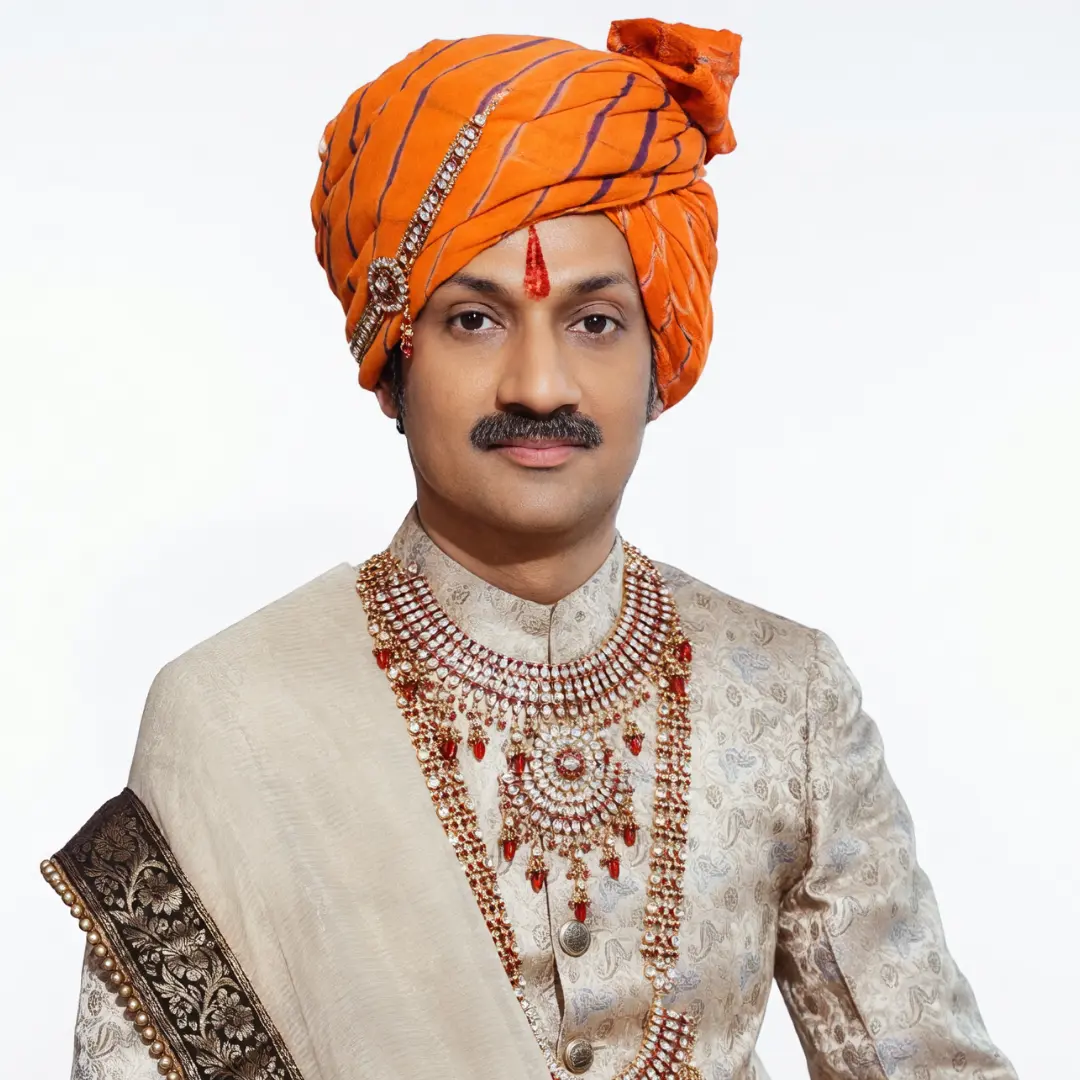
HRH Manvendra Singh Gohil
Widely recognised as the first openly gay royal in the world, a distinction that came at extraordinary personal cost
Biography
The Story
HRH Prince Manvendra Singh Gohil, born on 23 September 1965 in Ajmer, Rajasthan, is the Crown Prince of the former princely state of Rajpipla in Gujarat and the 39th descendant of the Gohil Rajput dynasty. He is widely recognised as the first openly gay royal in the world — a distinction that came at extraordinary personal cost, and that he has since transformed into a platform for one of the most sustained and influential LGBTQ+ advocacy careers in Asia. Through his charity Lakshya Trust, his royal establishment Queer Bagh, his fashion label Hanumanteshwar 1927, and his founding of multiple civil society initiatives, he has dedicated his life to building safe spaces, changing law, and shifting culture — in India and internationally.
Royal Origins and Early Life
Prince Manvendra was born the only child of Maharana Shri Raghubir Singhji Rajendrasinghji Sahib, Maharana of Rajpipla, and Maharani Rukmini Devi of Jaisalmer. In 1971, the Indian government de-recognised the princely states and ended the privy purse system, meaning his father lost the official title of Maharaja and the annual royal pension that came with it. The family adjusted to the new reality by converting their ancestral home — the Rajvant Palace in Rajpipla — into a tourist resort and film-shooting destination, while establishing a second residence in Mumbai.
Manvendra received his schooling at the Bombay Scottish School and later studied at the Amrutben Jivanlal College of Commerce and Economics, within the Mithibai College campus in Vile Parle, Mumbai. Alongside his formal education, he showed an early and serious passion for Indian classical music: he began playing harmonium at the age of five, received a Diploma in Indian Classical Music (Vocal) from Sangeet Mahabharti, Mumbai at thirteen, and for more than a decade was trained in solo harmonium by the renowned musician Pt. Purshottam Walavalkar. He has performed at music festivals across Rajpipla, Vadodara, and Vansda, and at international venues including the Gay Choir Festival in Brighton, UK, and Guildhall in the Hamptons, USA.
A Watershed Moment for India
In January 1991, as was customary within his family, Manvendra entered an arranged marriage with Chandrika Kumari, a princess of Jhabua State, Madhya Pradesh. The marriage was not consummated and ended in divorce within a year. Through this period, Manvendra had begun to understand his sexual identity more clearly, but the weight of royal expectation and social stigma kept him from speaking publicly.
Following a nervous breakdown in 2002 — caused in part by the mounting pressure from his parents to remarry and produce an heir — his psychiatrist informed his parents of his sexual orientation. Their response was one of denial and distress: they sought spiritual guides and subjected him to electroshock therapy and other attempts at gay conversion, practices he has since spoken about publicly and campaigned against as harmful and ineffective.
On 28 January 2006 — the first day of Holi — a local Gujarati newspaper published an interview in which Manvendra openly confirmed he was gay. The fallout was immediate and severe. More than 2,000 people burned his effigies in Rajpipla. His parents publicly disowned him and placed newspaper advertisements announcing he had been disinherited from the ancestral property for engaging in activities deemed 'unsuitable to society.' He received death threats and faced demands that he be stripped of his royal title. Yet he did not retract a word.
Within months, his story had reached international audiences. He was invited by Oprah Winfrey to appear on her acclaimed programme 'Gays Around the World' and later returned for 'Where Are They Now?' — two appearances that gave him a global platform and turned the prince from a local controversy into an international symbol of courage. He also inaugurated the Euro Pride Festival in Stockholm, led Pride marches in Sao Paulo, Los Angeles, and New York, and served as inaugural keynote speaker at the Human Rights Conference in New York during the World Pride Celebration.
Lakshya Trust
Prince Manvendra had quietly established Lakshya Trust in 2000 — six years before his public coming out — as Gujarat's first organisation working on HIV prevention among men who have sex with men (MSM), gay people, and transgender populations. The Trust provides counselling, clinics dedicated to sexually transmitted infections, libraries, condom promotion, and employment support for gay men and transgender individuals.
He co-founded the Trust alongside committed activists and serves as its Chairperson. Lakshya is also a founding member and former Community Representative organisation of INFOSEM — the Integrated Network for Sexual Minorities, India's most prominent NGO network working on HIV and AIDS issues for sexual minorities. From 2006 to 2010, Manvendra served as the Community Sector Representative for MSM (Men Having Sex with Men) in the India sub-region of APCOM (Asia Pacific Coalition on Male Sexual Health), working to improve the sexual health and wellbeing of LGBTQ+ populations across the region.
Queer Bagh
When the Supreme Court of India struck down Section 377 in September 2018 — decriminalising homosexuality in a landmark ruling that Manvendra had actively campaigned for — he marked the moment by opening the grounds of his royal establishment, Hanumanteshwar Palace, located 15 km from Rajpipla on the banks of the Narmada river, as a community centre and shelter home for LGBTQ+ individuals.
Now known as Queer Bagh, the 15-acre property runs entirely on solar energy and is modelled on American LGBTQ+ community centre practices. It offers free stays in exchange for volunteer work, provides vocational training and skills development to enable financial independence, promotes safe-sex education, menstrual health support, and medical and educational facilities. The centre primarily serves LGBTQ+ individuals who have been disowned by their families or who face acute social stigma — offering, in Manvendra's own words, the shelter, dignity, and community that society had denied them.
Marriage, Family Reconciliation, & Partnership
In 2013 — at a time when same-sex relationships were still criminalised under Indian law — Prince Manvendra married Cecil DeAndre Richardson, an American from Seattle, in the United States where same-sex marriage was legal. In 2022, the couple renewed their vows at the Ohio Statehouse. Their union, now more than a decade old, has been widely covered as both a personal love story and a political statement — a same-sex royal marriage conducted in defiance of centuries of tradition, at significant legal and social risk.
Over time, Prince Manvendra has reconciled with his family. His parents, who once publicly disowned him, eventually came to accept and understand his identity — a transformation he attributes in part to engagement with psychiatrists and to the passage of time. The reconciliation is a dimension of his story he speaks about with measured hope, as evidence that even the most entrenched attitudes can shift.
Search Ends Inclusion Impact, & Cont. Advocacy
Prince Manvendra founded Hanumanteshwar 1927, a private-label fashion brand that uses fashion as a platform to raise funds and awareness for LGBTQ+ rights and social empowerment. The brand operates with a cause, channelling its proceeds toward community initiatives and advocacy campaigns.
He is also the Managing Director and Co-founder of Search Ends Inclusion Impact, a newer initiative driving transformative change through inclusive practices in business and civil society. He has served as editor of Fun, a magazine for gay men, using media as another instrument for visibility and advocacy.
Today, Prince Manvendra continues to travel internationally, speak at conferences, lead pride events, fundraise for Queer Bagh's expansion, and advocate for legal reforms around same-sex marriage, adoption rights, and inheritance equality in India. In a country where the journey from criminalisation to acceptance is still very much in progress, he remains — six decades after his birth and nearly two decades after his coming out — among the most visible, most courageous, and most consequential advocates for LGBTQ+ dignity in Asia.
We (Indians) are very good administrators. Serving people is in our blood.
Highlights
At a Glance
Join the network that connects leaders across borders, industries, and generations.
Meet All Ambassadors